
Robotics company LiberAI announced Liber-0 on its official X account and technical blog. It is a World Action Model that jointly predicts future frames and actions, pretrained on more than 2.2 million hours of human experience and anchored by precise hand-motion data from its own LiberSense Glove. On 60 tasks proposed by GPT-6 across 600 trials, Liber-0 reached 36.0% overall success without robot demonstrations collected for those tasks, but only 10.5% on challenging multi-step tasks. No open weights or API have been announced.
Key Takeaways
- ✓Zero-shot results: 63.5% on pick-and-place, 34.0% on short non-pick-and-place tasks and 10.5% on challenging multi-step tasks, 36.0% overall (60 tasks x 10 trials)
- ✓For comparison, GPT-6 Astra used alone as a robot policy scored 8.3%, 5.0% and 1.7% on the same three task groups, with 87.3 s of reasoning per decision
- ✓10K hours of glove data beat 200 times more web human video (2,000K hours), suggesting precise action labels matter more than raw video volume
- ✓Glove data plus 25% of the robot demonstrations reached a progress score of 75.6, above the 72.8 from robot-only training with the full pool, using 75% fewer robot demos
- ✓All figures are LiberAI self-reported internal evaluations; no open weights, API or commercial timeline has been announced
Key Decision Metrics at a Glance
Turn your technical choice into a development budget
Compare 40 dev plans & simulate token costs vs $20/mo subscriptions
Project Links & Resources
Direct AccessIn-Depth Technical Analysis
Background and pain point
Robot manipulation has long depended on teleoperated demonstrations collected for a specific robot and task, which is expensive and hard to scale. Human video is abundant but faces three gaps: human and robot bodies differ, hand motion estimated from video is noisy, and camera viewpoints differ. Liber-0, released by LiberAI on November 4, aims to turn large-scale human experience directly into executable robot skills.
What is new
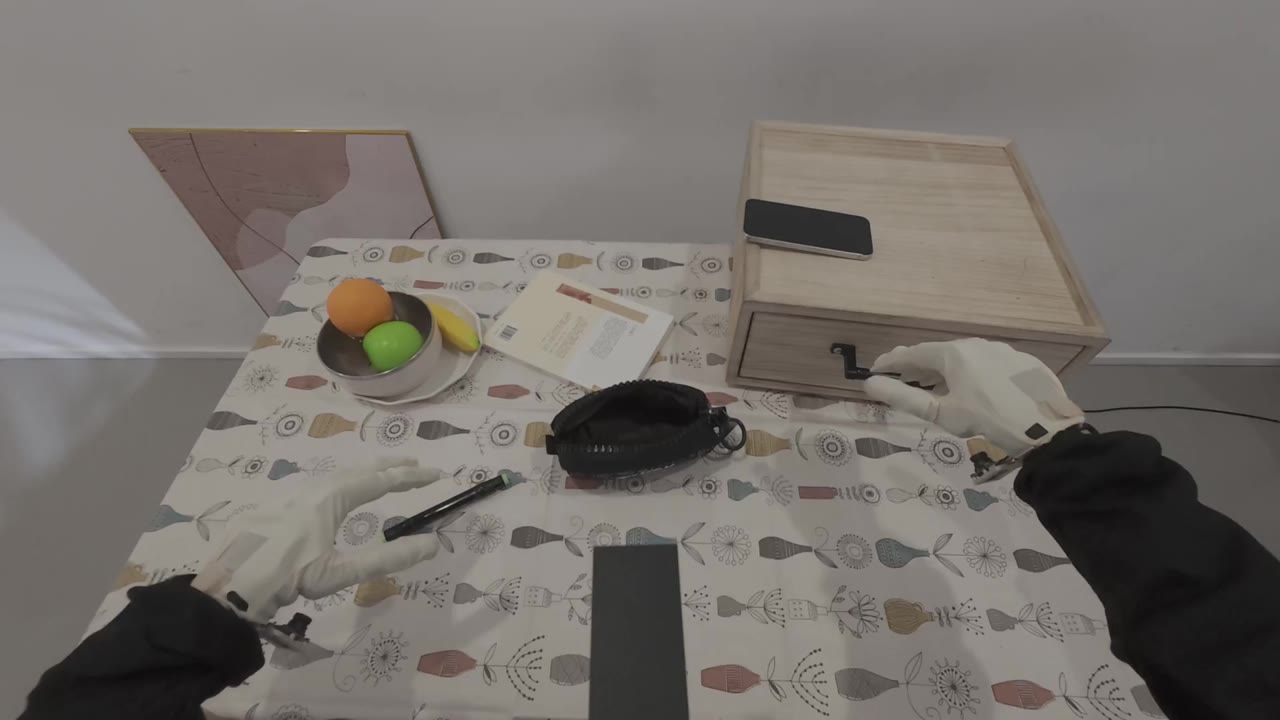
Liber-0 is a World Action Model built on a Mixture-of-Transformers architecture in which language, vision and action experts jointly predict future frames and actions. A Unified Embodiment Representation encodes human and robot morphology and kinematics in one space. On the data side, the 0.3 mm, 131 g LiberSense Glove records precise finger motion alongside first-person and wrist cameras; on the hardware side, the in-house LEO robot has three-degree-of-freedom wrists and an articulated waist, with camera views aligned to the human recordings. Pretraining runs in three stages: general visual prediction, joint world-action learning, then manipulation-focused training with more glove and teleoperation data.
Numbers
All figures are self-reported on the official blog. On 60 zero-shot tasks proposed by GPT-6 over 600 trials, overall success was 36.0% and multi-step success 10.5%; GPT-6 Astra alone as a policy scored 8.3%, 5.0% and 1.7% on the same task groups. On internal progress benchmarks, the full recipe after robot post-training scored 83.6 on pick-and-place and 73.8 on non-pick-and-place. Raising demonstrators from 1 to 100 at a fixed data volume lifted progress from 60.6 to 69.5.
Getting started
So far there is only a technical blog and demo videos; no open weights, API or pricing has been announced, so developers cannot call the model yet. The blog says Liber-0 can pair with a reasoning agent such as GPT-6 Astra to plan intermediate goals for multi-step tasks, and offers an online simulation app where users can upload custom objects. For embodied-AI teams the main takeaway is the data approach: scaling human demonstrations with low-cost gloves to reduce reliance on robot teleoperation data.
Benchmark side-by-side against alternatives, or calculate monthly token cost vs subscription break-even.
Discussion & Comments
0Sign in to join the discussion
Connect with AI developers to exchange benchmark insights.