AI Coding Live News

SenseTime Ships SenseNova 6.8 Flash: An Office Agent Model With Long-Term Memory and Proactive Interaction That Builds Animated Slides, Motion Posters and Editable Blender 3D Projects

On the evening of November 2, SenseTime released the official version of SenseNova 6.8 Flash, a multimodal agent model with two main upgrades. First, long-term memory and proactive interaction: it keeps user goals and constraints across tasks and sessions and flags affected items when information changes. Second, design generation across Web, SVG, Three.js, Blender, animated PPT and motion posters, with Figma integration. It is live in SenseNova Studio, the Raccoon assistant and the SenseNova Token Plan; the official X account says the Token Plan offers a free trial of 1,500 API requests every 5 hours. SenseTime says it beats some international frontier models on agent collaboration, data analysis and presentation generation, but the announcement lists no specific scores.

SenseTime Ships SenseNova 6.8 Flash: An Office Agent Model With Long-Term Memory and Proactive Interaction That Builds Animated Slides, Motion Posters and Editable Blender 3D Projects

Key Takeaways

  • The official release landed on the evening of November 2, positioned as a multimodal agent model for office collaboration and design delivery
  • Long-term memory plus proactive interaction: it remembers goals, constraints and preferences across sessions and suggests changes when related information shifts (demos ran on an internal Raccoon build)
  • Design output spans Web, SVG, Three.js, Blender, animated PPT and motion posters, producing editable PPTX files and Blender projects, with Figma integration
  • Available in SenseNova Studio, the Raccoon assistant and the SenseNova Token Plan; the official X post cites 1,500 free API requests every 5 hours
  • SenseTime only says it beats some international frontier models on agent collaboration, data analysis and presentation generation; no scores were published and there is no independent evaluation yet
Read full story
Linked Models & Agents:
⚡ SenseNova 6.8 Flash⚡ SenseNova Loop-9B-Preview🤖 Raccoon🌐 SenseTime

Tencent Releases Hy4: First Hy Model With Vision and Computer Use, Live on Tencent Cloud and OpenRouter, Open Weights Planned

On November 4, Tencent Hy published Hy4 on its official site. Versus Augusts Hy4 preview, Tencent says it scaled up pre-training and post-training, added vision for the first time, added computer use across CLI and GUI, and trained specifically on Blender, CAD and engines like Unreal, Unity and Godot. Hy4 is live on Tencent Cloud and OpenRouter (tencent/hy4, 1M context) at the same API price as the preview. Weights and a system card are promised soon, and a cheaper Hy4 flash is coming.

Key Takeaways

  • Official blog: Introducing Hy4, dated 2026-11-04; the Tencent Hy transparency center also lists V1.0 Hy4
  • Two firsts: vision (fine-grained image detail, complex charts, math visual reasoning) and computer use (CLI plus GUI, with targeted training on Blender, CAD and long cross-app workflows)
  • Tencent's own evals: on 579 real finance tasks rated by 213 finance professionals Hy4 scores 3.04, first among open-weight models (DeepSeek-V4.1-Flash-1017 2.97, Kimi K3.1 Pro 2.68, GLM-5.3 2.68); GameDev +19.1%, GameLogic +9.8%; internal search hallucination rate 15.76% to 5.45%
  • Same API price as the preview: $0.042 cached input, $0.834 input, $2.501 output per million tokens; the OpenRouter page currently shows 50% off ($0.417/$1.251), 1,048,576 context and up to 65,536 output tokens
  • Weights are not out yet: Tencent says it will open-source them with a full system card, working with vLLM and SGLang; Hy4 flash is due soon
Read full story
Linked Models & Agents:
⚡ Hy4⚡ Hy4 preview⚡ Hy4 flash🤖 CodeBuddy🤖 WorkBuddy🌐 Tencent

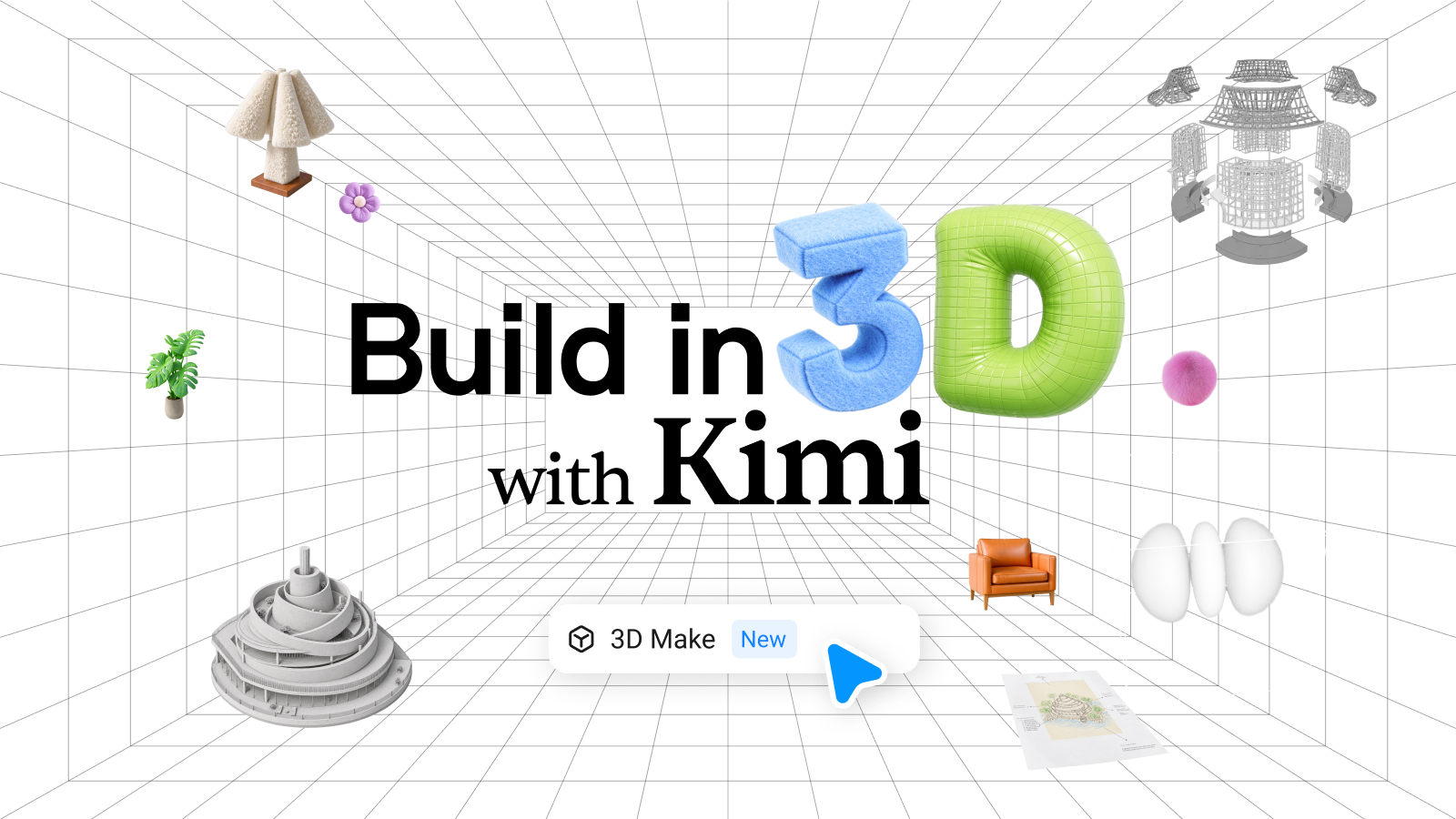
Kimi launches 3D Make: K3.1 Pro drives Blender, CAD tools and Unreal, Unity and Godot to build models, scenes and games

Moonshot AI's official Kimi account announced 3D Make at 03:14 UTC on Oct 30, saying Kimi connects to tools such as Blender and CAD software to create models, assemble scenes and develop games, available now on kimi.ai and Kimi Work. The companion 3D guide says K3.1 Pro was specifically trained to drive 3D software through Python scripts, so specialized tools without MCP support can join the workflow, while meshes such as people and animals are handed to diffusion services like Tripo. Plugins that need locally installed software work only in Kimi Work.

Kimi launches 3D Make: K3.1 Pro drives Blender, CAD tools and Unreal, Unity and Godot to build models, scenes and games

Key Takeaways

  • Availability: 3D Make is live on kimi.ai and Kimi Work; plugins that need locally installed software are Kimi Work only
  • Two modeling routes: parametric models (furniture, mechanical parts, buildings) via Python scripts written by K3.1 Pro, and meshes via services such as Tripo, Meshy and Hyper3D
  • Engines: Kimi says it is adapted to Unreal Engine, Unity and Godot to import models, assemble scenes and build gameplay step by step
  • Showcase: the celestial palace in the K3.1 Pro launch video was built in Unreal Engine 5.8 from source models totaling 36 million triangles, rendered with Nanite and Lumen
  • Benchmarks: no 3D benchmarks were published; the guide admits some tasks need several rounds, and rigging and complex materials remain weak spots
Read full story

BlenderWorld Benchmark Launches for Autonomous 3D Creation: GPT-6 Astra Leads with 79.9 Score on 223 Industrial Tasks

Researchers introduced BlenderWorld (arXiv:2610.23986), the first comprehensive benchmark evaluating visual agents creating and editing 3D models from real-world references in Blender. Spanning 223 tasks across procedural geometry, Python scripting, material shaders, spatial layouts, and lighting, GPT-6 Astra leads the benchmark with a composite Score of 79.9 (and a 42.2% Perfect completion rate), followed by Opus-5 at 73.0. Open-weight flagship DeepSeek-V4.1-Flash claims 65.7, matching proprietary models while relying on active execution-and-inspection tool loops.

BlenderWorld Benchmark Launches for Autonomous 3D Creation: GPT-6 Astra Leads with 79.9 Score on 223 Industrial Tasks

Key Takeaways

  • Researchers introduced BlenderWorld (arXiv:2610.23986), a 223-task benchmark evaluating autonomous visual agents creating 3D content in Blender
  • GPT-6-Astra leads the world with a 79.9 composite Score and 42.2% Perfect completion rate, followed by Opus-5 at 73.0
  • DeepSeek-V4.1-Flash ranks #1 among open models with 65.7, matching proprietary GPT-5.6-Sol on multimodal 3D synthesis (65.5)
  • Unmasks distinct engineering styles: GPT emphasizes upfront planning (39.9K tokens), while DeepSeek uses iterative inspection loops (168 tool calls/task)
Read full story
Linked Models & Agents:
ADSponsored

Voyager launches: a desktop agent harness that drives Blender, DaVinci Resolve, After Effects and Ableton — 'the Codex for creative work'

Nullframe (the Moda team, YC F26) shipped Voyager, a local desktop agent harness that drives creative apps through their own scripting APIs, ships free Design/Video/DAW engines, and works with your own Claude/Codex sign-in or API keys. The launch post passed 1.48M impressions.

Voyager launches: a desktop agent harness that drives Blender, DaVinci Resolve, After Effects and Ableton — 'the Codex for creative work'

Key Takeaways

  • Launch post: ~1.48M impressions, 3,074 bookmarks, 2,457 likes on X
  • Drives Photoshop, Illustrator, After Effects, Premiere Pro, DaVinci Resolve, Final Cut Pro, Blender, Unity and Ableton Live; skills also cover Cinema 4D, Houdini, Remotion, Manim
  • ~40 built-in skills, MCP server support, and reuse of skills installed for Claude Code / Codex / Cursor
  • Free app with BYO agent/keys; paid plans from $19/mo, generation billed at provider cost with no markup
  • Apple Silicon + macOS 15 required; Windows 11 / Linux in alpha; desktop v0.1.84 shipped Oct 8
Read full story
Linked Models & Agents:

Code2Games: Enabling Coding Agents for Playable 3D Gaming World Generation via Blender-to-UE5 Coordinated Reconstruction

Synthesizing high-fidelity, interactive 3D gaming worlds directly from natural language game concepts requires holistic joint reasoning across scene geometry, spatial topology, gameplay objectives, and executable game mechanics. However, existing LLM coding agents typically generate isolated 3D assets or rudimentary scripts, resulting in broken dependencies and spatial-logical incoherence. To bridge this gap, researchers from Peking University and collaborators introduce Code2Games (arXiv:2610.05033), a dedicated agentic framework that generates structured 3D gaming worlds. Code2Games anchors world generation upon a procedural Blender foundation using a shared scene-gameplay representation that enforces persistent entity correspondence. It then transfers the assets into Unreal Engine 5 (UE5) and deploys an execution-guided reconstruction pipeline driven by compilation diagnostics, runtime traces, and automated playtesting feedback to dynamically rectify engine adaptation discrepancies. Evaluated on the newly introduced GameCode4D benchmark spanning ten tiers of gameplay complexity, Code2Games establishes new state-of-the-art marks in visual quality, interactive fidelity, and complete playable game stability.

Key Takeaways

  • Introduces Code2Games, an agentic framework generating structured, playable 3D gaming worlds bridging Blender foundation to Unreal Engine 5
  • Develops a shared scene-gameplay representation coupled with execution-guided reconstruction resolving engine adaptation defects via diagnostic loops
  • Releases GameCode4D benchmark across ten complex game prompts, surpassing direct agent baselines in visual fidelity and playability
Read full story

LEGO-Anything: Image-to-Code 3D Scene Reconstruction via Iterative Coding Agents, Boosting LEGO-Bench Scores by 62.7%

Conventional single-image 3D scene reconstruction typically produces static meshes or radiance fields (NeRF/3DGS), which lack modularity, CAD interpretability, and programmatic editability. Researchers introduce LEGO-Anything, an Image-to-Code framework where a coding agent autonomously writes and executes Blender Python scripts, renders multiview checks, and iteratively refines the 3D scene program. To systematically evaluate programmatic 3D recovery, the authors release LEGO-Bench across 208 images from 104 realistic indoor and outdoor environments. Diagnosing three recurrent failure modes in agentic generation—weak layout initialization, regressive edits, and uncalibrated self-evaluation—they propose LEGO-Plugin, a training-free harness delivering up to 62.7% relative improvements across evaluated foundation models while supporting zero-shot downstream 3D spatial queries.

LEGO-Anything: Image-to-Code 3D Scene Reconstruction via Iterative Coding Agents, Boosting LEGO-Bench Scores by 62.7%

Key Takeaways

  • Image-to-Code 3D Reconstruction Paradigm: Transcends uneditable neural radiance fields by representing 3D scenes as explicit, human-readable Blender Python programs that can be inspected, queried, and modified.
  • LEGO-Plugin Training-Free Harness: Systematically mitigates regressive edits and unreliable agent self-evaluations, delivering up to a 62.7% relative performance gain across state-of-the-art LLMs without fine-tuning.
  • Deterministic 3D Vision Querying: The resulting scene programs directly enable deterministic queries for object detection, instance segmentation, and depth readouts, bridging computer vision and CAD simulation.
Read full story

OpenAI: global usage reset for all paid subscriptions ~6pm PST for Astra

OpenAI Codex lead Tibo (@thsottiaux) announced a one-time global usage reset for all paid subscriptions so users can keep using Astra after heavy Blender 3D-modeling burn. Lands around 6pm PST today.

Key Takeaways

  • Scope: one-time global usage reset across all paid subscriptions.
  • Why: restore headroom after Astra burn on Blender 3D modeling and similar.
  • When: lands around 6pm PST today.
Read full story

huashu-mac-use: open-source skill so Codex / Claude Code drive Mac apps via CLI/AppleScript/CDP first

HiSeven (@hisevenih) highlights newly open-sourced huashu-mac-use: lets Codex / Claude Code operate Mac apps without APIs (Blender, CapCut, WPS, Electron, etc.), preferring CLI / AppleScript / URL schemes / CDP / Accessibility before focus-stealing clicks, with screenshot verification each step. Install: npx skills add alchaincyf/huashu-mac-use.

Key Takeaways

  • Ship: open-source skill huashu-mac-use (alchaincyf/huashu-mac-use).
  • Strategy: prefer CLI/AppleScript/URL/CDP/Accessibility over mouse grabs.
  • Verify: screenshot checks each step; install via npx skills add.
Read full story

Latent Space: 20B+ tokens on Astra show full AI-eng workflows under ~$6/hour

Latent Space says it spent over 20B tokens putting GPT-6 Astra through real AI-engineering work—model selection/training, labeling and active learning, keeping pipelines saturated, instrumentation/logs, one-shot deploy-and-debug, and commanding/evaling subagents—claiming serious workflows at under about $6 per hour, beyond Blender demos and games.

Key Takeaways

  • Covers train/select models, labeling/active learning, saturated pipelines, logs, and one-shot deploy/debug.
  • Can fan out and eval subagents (including agents on other models) with multi-billion-token coherence.
  • Cost claim: serious AI-eng load at under ~$6/hour; longform at latent.space/p/astra.
Read full story
Linked Models & Agents:
ADSponsored