AI Coding Live News

CellType Launches BioSimBench: Frontier LLMs Get Only Part of Cell Responses Right, Gemini 4 Argon Leads and CellType 27B Beats Them on Every Track

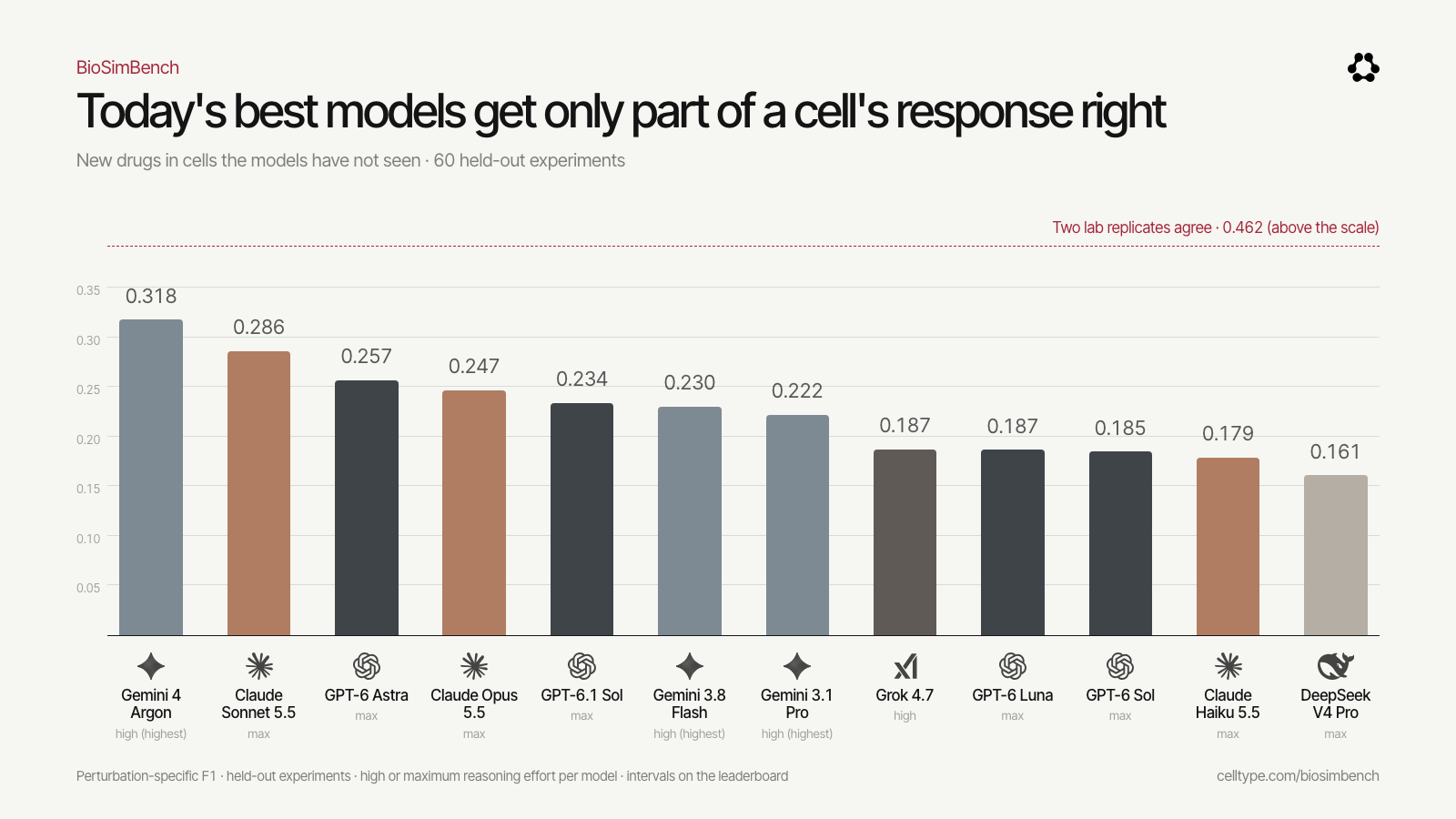
CellType, a YC W26 startup, released BioSimBench 1.0 on November 4. It uses real lab experiments to test whether language models can predict which genes go up or down after a cell is hit by a drug, a gene knockdown or an immune signal. Among 12 frontier models, Gemini 4 Argon ranks first with an overall score of 0.184, ahead of Claude Sonnet 5.5 (0.160) and GPT-6 Astra (0.159), while two lab replicates agree at 0.462. A 27B model CellType trained in its BioSimGym RL environments beats the best frontier model on all four prediction tracks.
CellType Launches BioSimBench: Frontier LLMs Get Only Part of Cell Responses Right, Gemini 4 Argon Leads and CellType 27B Beats Them on Every Track

Key Takeaways

  • BioSimBench 1.0 has five tracks: new drugs and cell contexts, gene knockdown, drug response, immune signals, and a tool-using research agent; test answers are kept private.
  • The 12 frontier models score between 0.110 and 0.184 overall, with Gemini 4 Argon first and DeepSeek V4 Pro last; two lab replicates agree at 0.462, so the gap is still large.
  • CellType 27B scores 0.366 on new drugs and cell contexts and 0.203 on drug response, about double the best frontier score of 0.103.
  • Data processing uses NVIDIA RAPIDS-singlecell, at least 4x faster for the whole pipeline; models were trained with NeMo RL and BioSimGym follows NeMo RL environment interfaces.
Read full story

Exin Therapeutics: Claude Sonnet 5 agent picks a gene therapy and drives a live mouse brain injection; Opus 5.5 declined

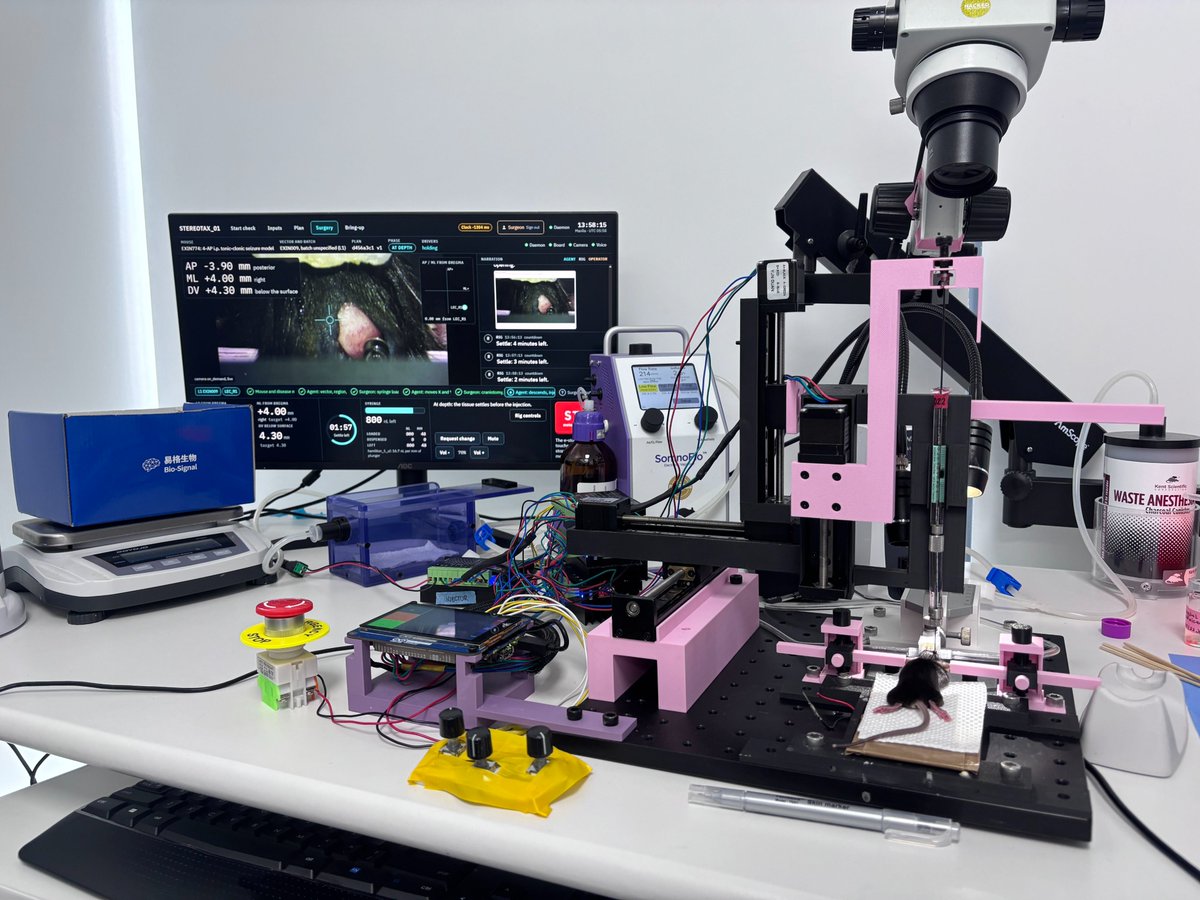
Exin Therapeutics co-founder and CEO Gabriel Ocana-Santero said on X on Oct 28 that an AI agent chose one of 19 gene therapy vectors, picked the brain region, derived coordinates from three papers and drove a stereotaxic rig to inject 250 nanolitres into an epilepsy-model mouse. WIRED reports Claude Opus 5.5 refused and Sonnet 5 did the run; a vet gated every irreversible step, and the work is not peer-reviewed.

Exin Therapeutics: Claude Sonnet 5 agent picks a gene therapy and drives a live mouse brain injection; Opus 5.5 declined

Key Takeaways

  • The agent chose the drug from 19 vectors, picked the brain region and derived coordinates from 3 papers (per the CEO)
  • It injected 250 nL while watching for bleeding via the rig camera; The Decoder reports 32 observations during the procedure
  • Per WIRED, Claude Opus 5.5 refused to inject, so the team used Sonnet 5; the run took just over 1 hour vs about 45 minutes normally
  • After a coordinate fault the agent refused to bypass its safety limits and the team had to fix the code separately; a vet still did the craniotomy
  • The original post drew 9,426 likes and 1.6M+ views; seizure outcomes are pending and nothing is peer-reviewed
Read full story

Cognition scores Gemini 4 Carbon at 40% on FrontierCode 2.0 for $4.04 a task, near the top, while Gemini 4 Argon gets 26.3% at $6.41

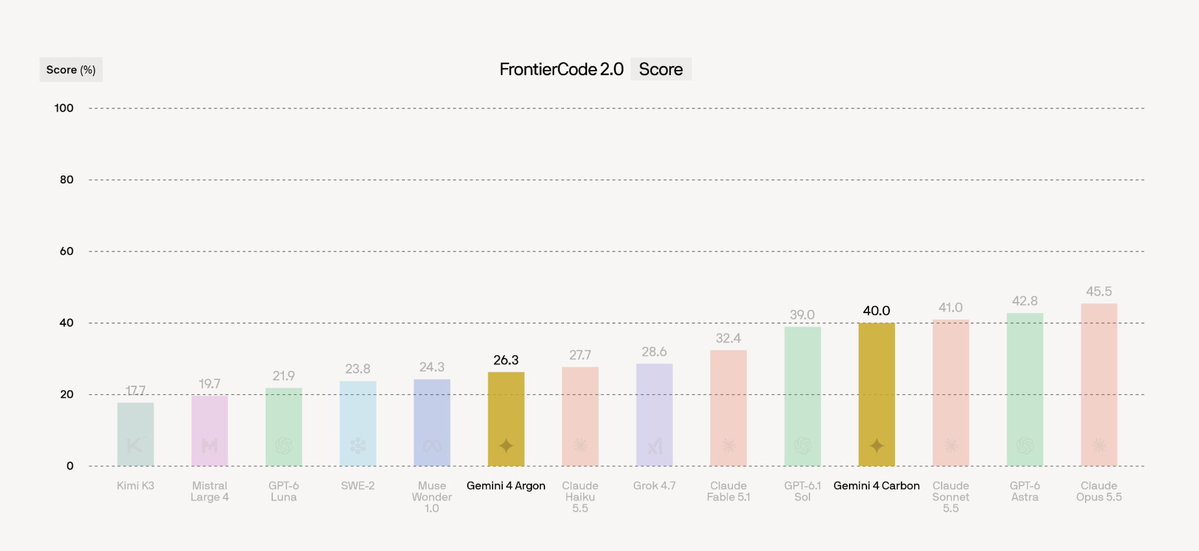
Cognition, the company behind Devin, posted on X at 01:45 UTC on Oct 30 that Google's new Gemini 4 Carbon scores 40% on its FrontierCode 2.0 coding benchmark at $4.04 per task, near the top and behind only Claude Opus 5.5, GPT-6 Astra and Claude Sonnet 5.5. The earlier Gemini 4 Argon scores 26.3% at a higher $6.41 per task. The results are Cognition's own runs, and the leaderboard on its site has been updated.

Cognition scores Gemini 4 Carbon at 40% on FrontierCode 2.0 for $4.04 a task, near the top, while Gemini 4 Argon gets 26.3% at $6.41

Key Takeaways

  • Gemini 4 Carbon scores 40% on FrontierCode 2.0 at $4.04 per task, behind Claude Opus 5.5 (45.5%), GPT-6 Astra (42.8%) and Claude Sonnet 5.5 (post)
  • Gemini 4 Argon scores 26.3% at $6.41 per task, ahead of Muse Wonder 1.0 but behind Claude Haiku 5.5 and Grok 4.7
  • From Argon to Carbon the score rises about 13.7 points while cost per task drops about $2.37
  • The changelog shows Gemini 4 Carbon was added on Oct 28; FrontierCode 2.0 has 132 tasks scored on whether a maintainer would merge the PR (leaderboard)
  • All figures are Cognition's own runs; Google has not published FrontierCode results itself
Read full story

Artificial Analysis Releases HealthBench & MLCR-AA: Exposing Severe Verbosity Bias in Medical AI Rankings

Independent AI evaluation platform Artificial Analysis officially released HealthBench Professional alongside the length-normalized MLCR-AA index (@ArtificialAnlys). The benchmark revealed a pervasive industry blindspot: LLM-as-a-Judge evaluations suffer from acute 'verbosity bias', disproportionately rewarding longer generations regardless of medical conciseness. In raw HealthBench scoring where Anthropic outputs were 4–6x longer, Claude Opus 5.5 led at 71.4%. However, once length bias was scientifically normalized via MLCR-AA, GPT-6 Astra (max) tied Claude Sonnet 5.5 for #1, while Claude Opus 5.5 plummeted from #1 down to #6, setting a new rigorous standard for medical model evaluation.

Artificial Analysis Releases HealthBench & MLCR-AA: Exposing Severe Verbosity Bias in Medical AI Rankings

Key Takeaways

  • Artificial Analysis unveils HealthBench Professional and the length-calibrated MLCR-AA benchmark
  • Exposes pervasive verbosity bias where evaluation judges disproportionately favor verbose outputs (Anthropic outputs averaged 4–6x longer)
  • Raw HealthBench placed Claude Opus 5.5 at #1 (71.4%) ahead of Sonnet 5.5 (70.8%) and GPT-6 Astra (69.7%)
  • Length-adjusted MLCR-AA shows GPT-6 Astra (max) tying Sonnet 5.5 for #1, while Opus 5.5 plummets from #1 to #6
Read full story
ADSponsored

Artificial Analysis Releases HealthBench Medical Evaluation: Verbosity Penalties Reshuffle Ranks as GPT-6 Astra Takes #1

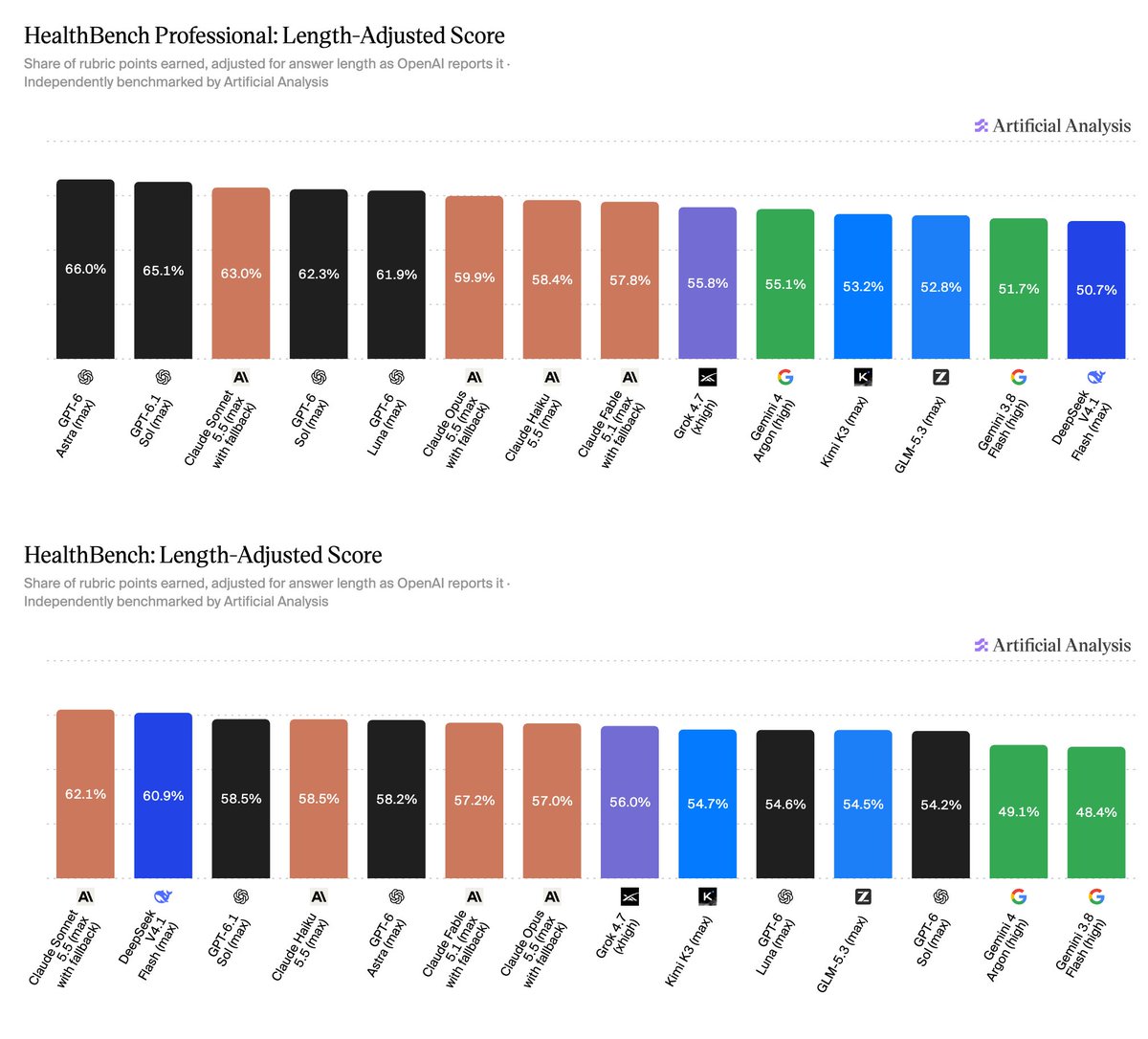
Independent AI evaluation authority Artificial Analysis launched the HealthBench and HealthBench Professional clinical reasoning and medical conversation leaderboards. Addressing the critical flaw where models artificially inflate medical scores through exhaustive, padded responses, the Professional benchmark implements rigorous length penalties. GPT-6 Astra (max effort) leads the world at 66.0%, with GPT-6.1 Sol at 65.1% and Claude Sonnet 5.5 at 63.0%. Claude Opus 5.5, despite holding a 71.4% raw score, collapses to 59.9% (#6) due to averaging ~5,900 characters per reply.

Artificial Analysis Releases HealthBench Medical Evaluation: Verbosity Penalties Reshuffle Ranks as GPT-6 Astra Takes #1

Key Takeaways

  • Artificial Analysis launched HealthBench, introducing strict length penalties on the Professional leaderboard to penalize verbose medical answers
  • GPT-6 Astra took #1 with 66.0%, followed by GPT-6.1 Sol at 65.1% and Claude Sonnet 5.5 at 63.0%
  • Claude Opus 5.5 scored 71.4% raw, but dropped to 59.9% (#6) under length penalties due to averaging ~5,900 characters per reply
  • On standard HealthBench, DeepSeek V4.1 Flash took #2 with 60.9%, outperforming multiple frontier commercial models
Read full story
Linked Models & Agents:

Artificial Analysis launches HealthBench and HealthBench Professional leaderboards: GPT-6 Astra leads clinician conversations at 66.0%, while Claude Opus 5.5 tops the raw score but falls to sixth after the length penalty

On October 19 independent evaluator Artificial Analysis launched two health-conversation leaderboards built on OpenAI's HealthBench (5,000 realistic health conversations) and HealthBench Professional (525 clinician conversations), graded against physician-written rubrics and reported as both raw and OpenAI-style length-adjusted scores. On Professional, GPT-6 Astra (max) leads at 66.0% length-adjusted, ahead of GPT-6.1 Sol (65.1%) and Claude Sonnet 5.5 (63.0%); Claude Opus 5.5 has the top raw score (71.4%) but drops to sixth (59.9%) because its ~5,900-character answers are penalized. On HealthBench, Claude Sonnet 5.5 leads at 62.1%, with DeepSeek V4.1 Flash close behind at 60.9% for about 1/16 of the cost per task.

Artificial Analysis launches HealthBench and HealthBench Professional leaderboards: GPT-6 Astra leads clinician conversations at 66.0%, while Claude Opus 5.5 tops the raw score but falls to sixth after the length penalty

Key Takeaways

  • HealthBench Professional (length-adjusted): GPT-6 Astra (max) 66.0%, GPT-6.1 Sol (max) 65.1%, Claude Sonnet 5.5 63.0%.
  • Claude Opus 5.5 posts the highest raw score (71.4%) but averages ~5,900 characters per answer, nearly 3x the 2,000-character threshold, and falls to sixth at 59.9%; Claude Fable 5.1 also loses over 11 points.
  • The Professional score-vs-cost Pareto frontier is all OpenAI: GPT-6 Luna (max) scores 61.9% at $0.004 per task, under 2% of GPT-6 Astra's $0.27.
  • HealthBench: Claude Sonnet 5.5 leads at 62.1%, DeepSeek V4.1 Flash 60.9% at $0.005 per task, GPT-6.1 Sol 58.5%.
  • Grading follows OpenAI's original setup: GPT-5.4 (low) grades Professional and GPT-4.1 grades HealthBench.
Read full story

Meta Unveils Gigawatt-Scale Prometheus Supercluster as Muse Wonder Secures #6 on WebDev Code Arena

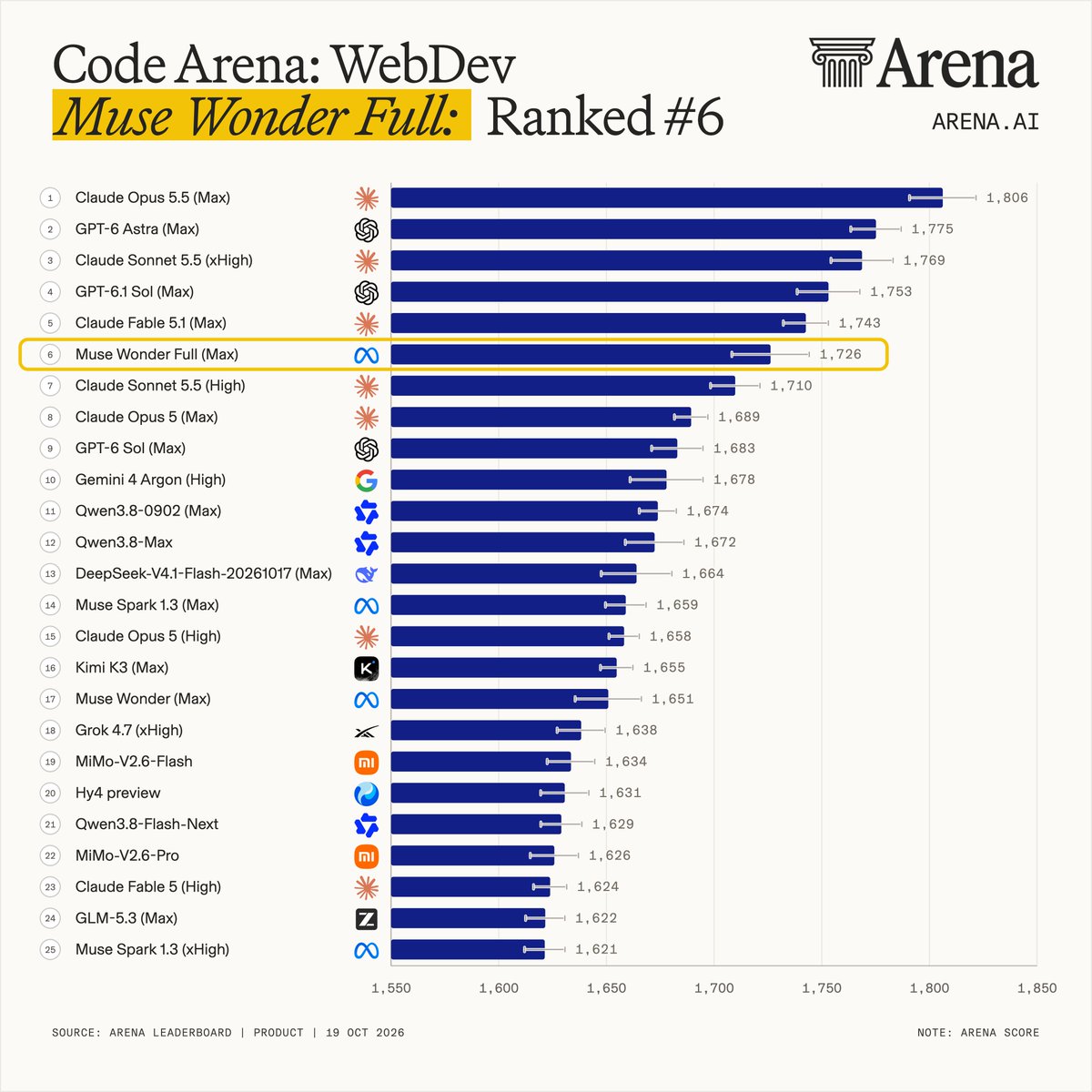
Meta officially disclosed its gigawatt-scale AI supercluster Prometheus in New Albany, Ohio, housing hundreds of thousands of frontier GPUs with 85%+ pretraining goodput and 90%+ in reinforcement learning. Powered by this infrastructure, Meta's latest coding flagship Muse Wonder Full surged to #6 globally on LMSYS Code Arena: WebDev with 1726 Elo points (surpassing Claude Sonnet 5.5 and Gemini 4 Argon), lifting Meta to the #3 AI research lab worldwide.

Meta Unveils Gigawatt-Scale Prometheus Supercluster as Muse Wonder Secures #6 on WebDev Code Arena

Key Takeaways

  • Meta unveiled its gigawatt-scale Prometheus supercluster in Ohio with hundreds of thousands of GPUs, delivering 85%+ pretraining goodput
  • Exceeded 90%+ goodput on RL workloads, recording ~47,000 GPU-hours MTBF during Muse Wonder's training cycle
  • Muse Wonder Full scored 1726 Elo on LMSYS Code Arena: WebDev (#6 globally), outperforming Claude Sonnet 5.5 (+16) and Gemini 4 Argon (+48)
  • Elevated Meta to the #3 AI lab worldwide; confirmed Muse Glimmer 30B open weights capable of 4-bit local execution on a single consumer GPU
Read full story
Linked Models & Agents:

GitHub Security Lab open-sources Fuzzing Taskflow: an LLM agent runs the C/C++ fuzzing loop from harness writing to vulnerability reports

GitHub Security Lab's MIT-licensed Fuzzing Taskflow, built on its Taskflow Agent framework, takes a GitHub owner/repo and lets an agent pick entrypoints, analyze the build, write harnesses, run AFL++, iterate on coverage, and write a per-crash vulnerability report with root cause and a suggested patch. Claude Sonnet 5 is the default model; GitHub warns to run it only in disposable environments.

GitHub Security Lab open-sources Fuzzing Taskflow: an LLM agent runs the C/C++ fuzzing loop from harness writing to vulnerability reports

Key Takeaways

  • One command: ./scripts/fuzzing/run_fuzzing.sh owner/repo, ideally inside a Codespace
  • Per-iteration budgets double from 30s to 960s (~32 min per target); the loop stops after two iterations each gain <1% line coverage
  • Every harness is built twice: an .afl binary (afl-clang-lto with ASan/UBSan) for fuzzing and a .cov binary for real line/branch coverage
  • Crashes are minimized with afl-tmin, replayed under ASan, deduplicated by stack-top hash, and given one of seven verdicts
  • LLM-chosen build commands run on the host with no container, so GitHub says to use only disposable, unprivileged environments
Read full story

GitHub open-sources ReviewBench, a 219-PR benchmark for AI code review: Copilot, Devin and Qodo lead; Cursor's grounded recall is 9.6%

GitHub's blog post ReviewBench (Oct 5, 2026) launches an offline AI code-review benchmark as a research preview. It has 219 PRs from 187 open-source repos in 19 languages, sampled to match the distribution of 103.9M GitHub PRs. The golden set combines human reviewers, several frontier LLMs and static analysis. Claude Sonnet 5 is the judge, and senior engineers agreed with its labels 96.6% of the time. On the leaderboard, grounded recall is 26.0% for Copilot Code Review (Balanced), 23.8% for Devin, 22.1% for Qodo and 9.6% for Cursor. The dataset, judge prompt and runner are MIT-licensed on GitHub.

GitHub open-sources ReviewBench, a 219-PR benchmark for AI code review: Copilot, Devin and Qodo lead; Cursor's grounded recall is 9.6%

Key Takeaways

  • Scale: 219 PRs from 187 open-source repos in 19 languages, sampled to match the distribution of 103.9M GitHub PRs (blog)
  • Trust: senior engineers independently re-labeled every golden finding and agreed with the benchmark 96.6% of the time; Claude Sonnet 5 is the judge
  • Leaderboard grounded recall: Copilot Balanced 26.0% (87.8% precision) > Devin 23.8% > Qodo 22.1% > Codex GPT-5.6 Sol Ultra 19.9% > Cursor 9.6%
  • Offline matched online: in a multi-model ensemble experiment, the online A/B showed +8.0% precision, +13.6% recall and −8.0% cost per review; critical comments were predicted at +227% offline and measured at +262% online
  • To submit: bring your own container image and model key, run the 25-PR test set, then the full 219 PRs over 3 rounds. The repo review-bench/ReviewBench is MIT-licensed
Read full story

Omni-IO Skills: Plug-and-Play Agent Harness Makes Existing Models Omni-Native Across 7 Modalities via Execution Graphs

While general-purpose agents exhibit strong long-horizon reasoning, enterprise workflows require manipulating seven distinct artifact modalities: text, images, audio, video, structured documents, 3D meshes, and code. Pretraining native omni-foundation models from scratch is economically prohibitive, while haphazard multi-tool integration triggers state desynchronization and intermediate asset sprawl across turns. Researchers from the National University of Singapore (NUS) and S-Lab introduce Omni-IO Skills (arXiv:2609.31847, ~300 upvotes on Hugging Face). As a modular agent harness, it organizes multimodal operations into Declarative Execution Graphs paired with a persistent Asset Registry, orchestrating 27 hierarchical skills across 38 tasks. Evaluated on UniM-90, the harness elevates input-support rates for GPT-5.6 Sol and Claude Sonnet 5 from ~40% to 100%, and lifts semantic quality scores from ~27 to over 77.

Omni-IO Skills: Plug-and-Play Agent Harness Makes Existing Models Omni-Native Across 7 Modalities via Execution Graphs

Key Takeaways

  • Pioneers Omni-IO Skills as a plug-and-play agent harness to make existing LLMs omni-native without parameter fine-tuning
  • Integrates 27 hierarchical skills across 7 artifact modalities, structured via Declarative Execution Graphs and persistent registries
  • Elevates GPT-5.6 Sol and Claude Sonnet 5 input-support rates from ~40% to 100%, nearly tripling semantic quality metrics
Read full story
ADSponsored

Google Antigravity lists Claude Opus/Sonnet 5.5: paid non-trial Pro + Ultra only; Claude 4.6 and GPT-OSS-120b retire Nov 2

Official Antigravity Models docs now list Claude Sonnet 5.5 (thinking) and Claude Opus 5.5 (thinking): Free/Plus/Enterprise ❌; Google AI Pro non-trial only ✅; Ultra ✅. Footnote: Claude 4.6 and GPT-OSS-120b remove on 2026-11-02. No separate changelog post—docs table is the source. No invented Antigravity SWE scores.

Google Antigravity lists Claude Opus/Sonnet 5.5: paid non-trial Pro + Ultra only; Claude 4.6 and GPT-OSS-120b retire Nov 2

Key Takeaways

  • Source of truth: antigravity.google/docs/models + /docs/plans — Claude 5.5 (thinking) rows are live in the table
  • Access: Google AI Ultra and paid non-trial Pro only; Free/Plus/Enterprise/trial Pro excluded
  • Retirement: Claude Sonnet/Opus 4.6 and GPT-OSS-120b removed 2026-11-02 per docs footnote
  • Switching: model picker under the prompt; mid-turn changes apply after the turn ends or is cancelled
  • Quotas: Pro/Ultra five-hour + weekly limits; optional AI Credit overages; no BYOK
Read full story
A
AICoder Editorial@aicoder·
👀79
🔥90

Developer 'A vs B' comparison intent surges: Sonnet 5.5, Sol, Argon, Air, and Copilot Computer Use collide in one week

Over ~7 days, Claude Sonnet 5.5, GPT-6.1 Sol, Gemini 4 Argon, JetBrains Air in IDEs EAP, and GitHub Copilot Computer Use landed in the same window. Search and HN discourse shifted from single-release chase to pairwise selection on price bands, terminal agents, IDE harnesses, and computer-use. Meta industry brief for readers without X.

Key Takeaways

  • Same-week cascade: Sonnet 5.5 in Copilot (09-28) → Sol in Copilot (09-29) → Argon Fairwind preview (09-30) → Air EAP + Copilot Computer Use (10-01)
  • Hot pairs: Sonnet↔Opus, Sonnet↔Sol, Argon↔Opus/Astra, Air↔Cursor, Copilot CU↔Claude CU, Codex↔Claude Code, Sol↔Astra same-family economics
  • Selection axes: price band × terminal harness × IDE orchestration (Air ACP BYO) × computer-use for GUI-only legacy
  • Compliance caveat: Anthropic subscription auth ToS constrains third-party harnesses; Air docs allow Claude subscription via terminal full-screen tab only
  • Argon still Fairwind-gated (not GA); no public developer GA date—label comparison pages as preview-gated
Read full story

Omni-IO Skills: Plug-and-Play Multimodal Harness Unlocks 7 Modalities via Declare Execution Graphs, Elevating Support Rates to 100%

While general-purpose LLM agents exhibit strong long-horizon reasoning, their production utility remains heavily fragmented across seven heterogeneous artifact modalities: text, images, audio, video, documents, 3D assets, and code. Training unified native omni-modal foundation models incurs prohibitive compute, while naive tool chaining fails to coordinate asset dependencies and multi-turn revisions. Researchers from the National University of Singapore (NUS) introduce Omni-IO Skills, a plug-and-play agent harness transforming existing text/vision LLMs into omni-native agents. Using hierarchical skill abstractions, standardized I/O interfaces, a persistent Asset Registry, and Declare Execution Graphs, Omni-IO coordinates complex multi-asset workflows concurrently. Evaluated on the UniM-90 multimodal benchmark, Omni-IO boosts input-support rates for frontier models from ~40% to 100%, and nearly triples semantic quality coupling scores without modifying foundational model weights.

Omni-IO Skills: Plug-and-Play Multimodal Harness Unlocks 7 Modalities via Declare Execution Graphs, Elevating Support Rates to 100%

Key Takeaways

  • Plug-and-Play 7-Modality Runtime: Transforms existing LLM backbones into omni-native agents across text, image, audio, video, document, 3D, and code without modifying foundational model weights.
  • Declare Execution Graphs & Persistent Asset Registry: Coordinates concurrent multi-asset pipelines while persisting intermediate multimodal artifacts for robust cross-turn reuse.
  • 100% Modality Support on UniM-90: Propels input-modality support for GPT-5.6 Sol and Claude Sonnet 5 from ~40% to 100%, nearly tripling coupled semantic-quality scores.
Read full story

Pydantic AI 2.52.0: unified Workspaces for Coder/Shell; web_fetch HTML DoS fix; CLAI2 ships

Pydantic AI shipped v2.52.0 on 2026-09-30 (pydantic-ai==2.52.0): ctx.workspace unifies local/sandbox file+command APIs with E2B, Fly.io Sprites, Modal, SSH, and Bubblewrap backends; harness moves in-repo to 0.52.0; first pydantic-clai2 release (uvx pydantic-clai2). Also patches local web_fetch nested-HTML resource exhaustion (GHSA-v36g-jcw9-x7cw, CVSS 6.5) and adds Claude Sonnet 5.5 plus GPT-6.1 Sol support.

Pydantic AI 2.52.0: unified Workspaces for Coder/Shell; web_fetch HTML DoS fix; CLAI2 ships

Key Takeaways

  • Release v2.52.0; 533 commits ahead of v2.51.0
  • Security: local web_fetch nested-HTML DoS patched (GHSA-v36g-jcw9-x7cw, CVSS 6.5); v1 patch 1.107.7; provider-native fetch unaffected
  • Workspaces via ctx.workspace (#6492) with E2B/Sprites/Modal/SSH/Bubblewrap backends; harness in-repo at 0.52.0; CLAI2 first release
  • Models: Claude Sonnet 5.5 (#8974), GPT-6.1 Sol (#9305); Anthropic default max_tokens 16384 on Sonnet 4.5+ (#9025)
  • Upgrade: pip install -U 'pydantic-ai==2.52.0'; uvx pydantic-clai2; docs: Workspace + Harness
Read full story
L
LangChainlangchain-ai·
👀64
🔥94

LangChain Anthropic 1.7.5 + Core 1.6.6: Claude Sonnet 5.5 compatibility, thinking/tool_choice guards

LangChain shipped langchain-anthropic==1.7.5 and langchain-core==1.6.6 on 2026-09-29, landing #40882: Claude Sonnet 5.5 model profile and capability discovery; reject unsupported forced tool_choice/thinking; allow mid-conversation system/tool changes; preserve computer-toolset namespaces, encrypted advisor blocks, and refusal details through streaming and replay. Invalid tool calls can fall back to unforced structured output or explicit method="json_schema".

LangChain Anthropic 1.7.5 + Core 1.6.6: Claude Sonnet 5.5 compatibility, thinking/tool_choice guards

Key Takeaways

  • Releases langchain-anthropic==1.7.5 + langchain-core==1.6.6
  • Core PR #40882 merged 2026-09-29T13:05Z
  • Validates thinking/tool_choice; mid-conversation system/tool changes; preserves streamed provider blocks
  • Forced tool-choice fallback or explicit method="json_schema"
  • Install: pip install -U "langchain-anthropic==1.7.5" "langchain-core==1.6.6"; docs Anthropic provider
Read full story