AI Coding Live News

Cognition scores Gemini 4 Carbon at 40% on FrontierCode 2.0 for $4.04 a task, near the top, while Gemini 4 Argon gets 26.3% at $6.41

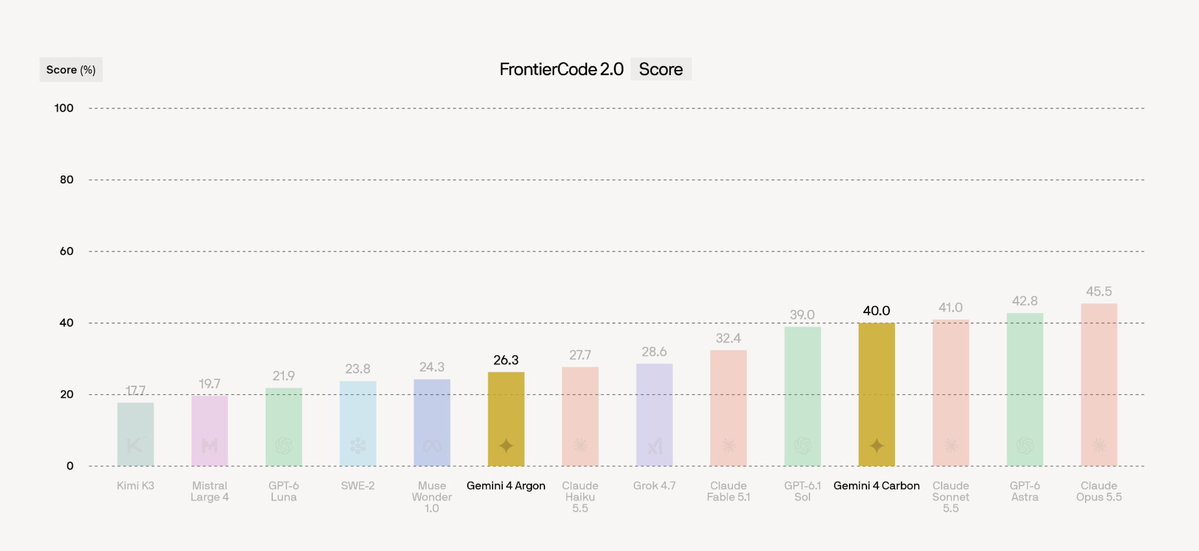
Cognition, the company behind Devin, posted on X at 01:45 UTC on Oct 30 that Google's new Gemini 4 Carbon scores 40% on its FrontierCode 2.0 coding benchmark at $4.04 per task, near the top and behind only Claude Opus 5.5, GPT-6 Astra and Claude Sonnet 5.5. The earlier Gemini 4 Argon scores 26.3% at a higher $6.41 per task. The results are Cognition's own runs, and the leaderboard on its site has been updated.
Cognition scores Gemini 4 Carbon at 40% on FrontierCode 2.0 for $4.04 a task, near the top, while Gemini 4 Argon gets 26.3% at $6.41

Key Takeaways

  • Gemini 4 Carbon scores 40% on FrontierCode 2.0 at $4.04 per task, behind Claude Opus 5.5 (45.5%), GPT-6 Astra (42.8%) and Claude Sonnet 5.5 (post)
  • Gemini 4 Argon scores 26.3% at $6.41 per task, ahead of Muse Wonder 1.0 but behind Claude Haiku 5.5 and Grok 4.7
  • From Argon to Carbon the score rises about 13.7 points while cost per task drops about $2.37
  • The changelog shows Gemini 4 Carbon was added on Oct 28; FrontierCode 2.0 has 132 tasks scored on whether a maintainer would merge the PR (leaderboard)
  • All figures are Cognition's own runs; Google has not published FrontierCode results itself
Read full story

Factory launches Droid 1.0: programmatic tool calling by default, hundreds of tool calls per model request, leads native harnesses on its own Terminal-Bench 4 runs

AI coding agent company Factory announced Droid 1.0 on X and its blog at 22:31 UTC on Oct 29, calling it the largest update yet to its agent harness. The key change makes programmatic tool calling (PTC) the default: the model writes a JavaScript program that runs up to hundreds of tool calls in a sandbox in one model request. In Factorys own Terminal-Bench 4 runs, Droid scored 57.6% with GPT-6.1 Sol ($0.79 per passed task) and 65.2% with Claude Opus 5.5 ($4.73), ahead of Codex, Claude Code, Cursor, OpenCode and Devin on the same models.

Factory launches Droid 1.0: programmatic tool calling by default, hundreds of tool calls per model request, leads native harnesses on its own Terminal-Bench 4 runs

Key Takeaways

  • Programmatic tool calling is now the default: the model writes JavaScript that runs in a sandbox with no file, network or system access of its own, making up to hundreds of tool calls per request, with independent calls run concurrently
  • Factory example: moving and verifying 151 Linear issues took 312 tool calls; direct calls needed about 36 requests and 3.1M input tokens, a Script needed 2 requests and 61K tokens
  • Terminal-Bench 4 (Factory runs, Oct 23-28, three trials per task): with GPT-6.1 Sol, Droid 57.6% vs Codex 54.0%, OpenCode 51.0%, Devin 45.0%; with Opus 5.5, Droid 65.2% vs Cursor and OpenCode 62.1%, Devin 59.6%, Claude Code 57.6%
  • The first request shrank from 20,887 to 13,055 tokens (-37%) and up-front tool definitions went from 11 to 2; newly loaded MCP tools are appended to keep the prompt cache intact, and a typical production request reads 98% of input from cache
  • Available now as a macOS and Windows desktop app, a terminal UI and the Droid SDK (@factory/droid-sdk); the benchmarks are vendor-run with no third-party reproduction yet
Read full story

Cognition acquires AI-native security company Corridor, folding its team into Devin Security

Cognition, the company behind Devin, announced on Oct 29 via its official @cognition account that it is acquiring Corridor. In a post on Cognition's official blog dated 2026.10.28, Corridor co-founders Jack Cable and Ashwin Ramaswami said the team is joining Cognition to take Devin Security to the next level. Corridor, founded almost two years ago, positions itself as the security layer for AI-native teams. Deal terms were not disclosed.

Cognition acquires AI-native security company Corridor, folding its team into Devin Security

Key Takeaways

  • Cognition is acquiring Corridor, and the team joins the Devin Security effort
  • Corridor co-founders Jack Cable and Ashwin Ramaswami will work with Cognition President Russell Kaplan, CSO Alex Stamos and CTO Steven Hao
  • Official view: AI agents can now run end-to-end attack chains, and the next 6 to 12 months are the most consequential period in cybersecurity
  • Deal terms were not disclosed
Read full story

Cognition launches FrontierCode 2.0 coding benchmark: it asks whether a PR should be merged, and top model Claude Opus 5.5 scores just 45.5%

Cognition, the maker of Devin, released FrontierCode 2.0 on Oct 27. It keeps the method of maintainer-written tasks graded on whether the code is actually mergeable, but draws tasks from more repositories, adds security patches and performance work, uses deliberately underspecified prompts and adds many thoroughness criteria. In Cognition's results Claude Opus 5.5 leads at 45.5%, GPT-6 Astra follows at 42.8%, and Grok 4.7 and Gemini 4 Argon drop into the 20s, leaving the benchmark far from saturated.

Cognition launches FrontierCode 2.0 coding benchmark: it asks whether a PR should be merged, and top model Claude Opus 5.5 scores just 45.5%

Key Takeaways

  • Claude Opus 5.5 leads at 45.5% (54.6% on v1.1) and GPT-6 Astra scores 42.8% (53.3% on v1.1), per Cognition (vendor-reported)
  • Grok 4.7 scores 28.6%, Gemini 4 Argon 26.3%, Muse Wonder 1.0 24.3%, SWE-2 23.9%, DeepSeek V4.1 Flash 19.3% and Kimi K3 17.7%, showing a wide gap for open models
  • Versus v1.1, reference solutions touch 67% more files and 89% more lines in codebases 25% larger; tasks come from 55% more repositories with 43% more blocking criteria
  • Thoroughness blockers grew from 168 to 501, about 3x; in 80% of tasks the reference solution improves on the upstream PR, and an audit agent found and reported an upstream security vulnerability
  • On the cost-score Pareto frontier, Opus 5.5 sits at the high end and Luna, Haiku and Sol at the low-cost end, with GPT-6.1 Sol called out for strong value (official blog)
Read full story
ADSponsored

Artificial Analysis Benchmarks Devin Fusion: Scoring 68.1 on Coding Agent Index While Slashing Task Cost by 31%

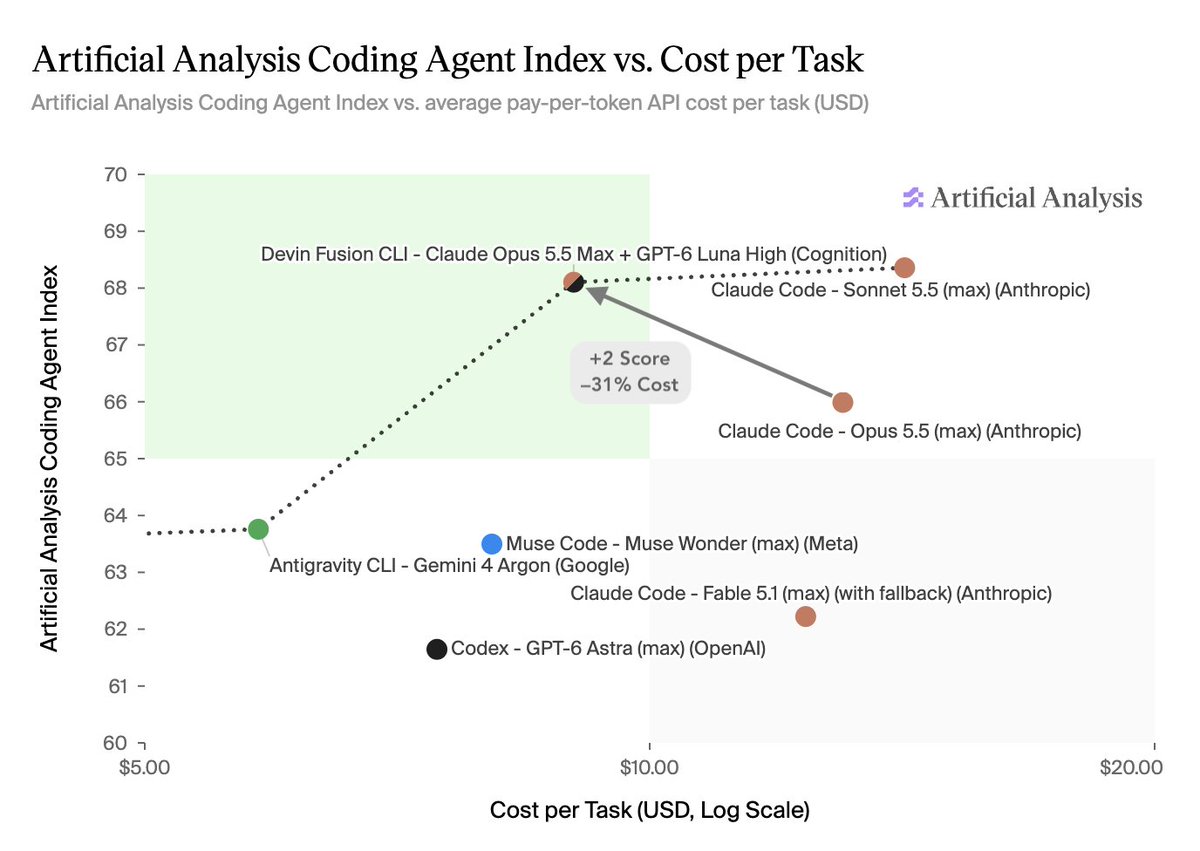
Artificial Analysis released an independent evaluation of Cognition's new coding agent, Devin Fusion. Moving beyond single-model execution, Devin Fusion employs an asymmetric multi-agent architecture pairing Claude Opus 5.5 (max) as the lead reasoning orchestrator alongside GPT-6 Luna (high) as a high-speed parallel worker. In the standardized Coding Agent Index, Devin Fusion achieved an elite score of 68.1 (matching Muse Code at 68.0 and rivaling Claude Code Sonnet 5.5 at 68.4). Crucially, the hybrid architecture slashes average task expense from $13.04 down to $9.01 (a 31% cost reduction) while shortening execution runtime from 65 to 55 minutes.

Artificial Analysis Benchmarks Devin Fusion: Scoring 68.1 on Coding Agent Index While Slashing Task Cost by 31%

Key Takeaways

  • Artificial Analysis independently benchmarked Devin Fusion, scoring 68.1 on the standardized Coding Agent Index
  • Pioneers asymmetric model collaboration: Claude Opus 5.5 orchestrates architecture while GPT-6 Luna executes parallel sub-tasks
  • Cuts per-task execution costs from $13.04 to $9.01 (a 31% savings) and trims average completion time from 65 to 55 minutes
  • Outperforms Claude Code with Opus 5.5 on DeepSWE v1.1 (72.6% vs 68.4%) and SWE-Atlas-QnA (69.6% vs 66.4%)
Read full story

Devin Fusion with an Opus 5.5 lead and GPT-6 Luna sidekick tops the Artificial Analysis Coding Agent Index at 68.1, at what Cognition says is 31% lower cost per task than Claude Code with Opus 5.5

Cognition said on October 19 that Devin Fusion, pairing Claude Opus 5.5 as the lead with GPT-6 Luna as the sidekick, scored 68.1 on the Artificial Analysis Coding Agent Index v1.5. Artificial Analysis's current data puts it first, but only 0.1 ahead of Muse Code with Muse Wonder Full at 68.0, effectively a tie; Antigravity CLI with Gemini 4 Argon is third at 63.8. Cognition says the pairing costs 31% less per task than Claude Code with Opus 5.5 (vendor-reported). Fusion ships in Devin CLI and Desktop.

Devin Fusion with an Opus 5.5 lead and GPT-6 Luna sidekick tops the Artificial Analysis Coding Agent Index at 68.1, at what Cognition says is 31% lower cost per task than Claude Code with Opus 5.5

Key Takeaways

  • 68.1 overall: DeepSWE v1.1 72.6, SWE-Atlas-QnA 69.6, Terminal-Bench v4 62.1, equally weighted (Artificial Analysis data).
  • Just 0.1 ahead of Muse Code with Muse Wonder Full (68.0); Antigravity CLI with Gemini 4 Argon 63.8, Codex with GPT-6.1 Sol (xhigh) 62.9.
  • Cost: Cognition says 31% lower per task than Claude Code with Opus 5.5 (vendor-reported).
  • Earlier, Fusion with Fable 5.1 + SWE-2 cut DeepSWE 1.1 cost per task from $14.63 to $7.88 (-46%) while scoring 63.1 vs 64.3.
  • Recommended pairing is Opus 5.5 + GPT-6 Luna, available by installing Devin CLI.
Read full story

Devin now works with any personal ChatGPT plan: Go, Plus or Pro subscriptions cover GPT model usage instead of Devin quota

On Oct 9 Cognition said Devin can now link any personal ChatGPT plan (Go, Plus or Pro). The GPT share of each session is billed to the ChatGPT subscription instead of Devin quota or on-demand credits, across Devin Cloud, Desktop and CLI. It requires a self-serve Devin Pro, Max or Teams plan (not Free or Enterprise), and falls back to Devin quota when the ChatGPT allowance runs out.

Devin now works with any personal ChatGPT plan: Go, Plus or Pro subscriptions cover GPT model usage instead of Devin quota

Key Takeaways

  • Eligible ChatGPT plans widened from Plus/Pro at the Sep 29 launch to Go, Plus and Pro; free ChatGPT accounts can't share usage
  • Only self-serve Devin Pro ($20/mo), Max ($200/mo) and Teams ($80/mo minimum); not Free or Enterprise
  • GPT usage bills only to ChatGPT, never double-counted against Devin quota; fast/priority variants excluded
  • Vendor-cited Artificial Analysis Coding Agent Index v1.5: Fusion (GPT-6 Astra + SWE-2) scores 58.9 at $4.54/task vs Codex Astra (max) 61.6 at $7.47, 39% cheaper
Read full story

LiteLLM open-sources Moyai, a self-hosted cloud coding agent: $101,872 on Devin vs ~$21,700 on Moyai over 31 days (79% cheaper)

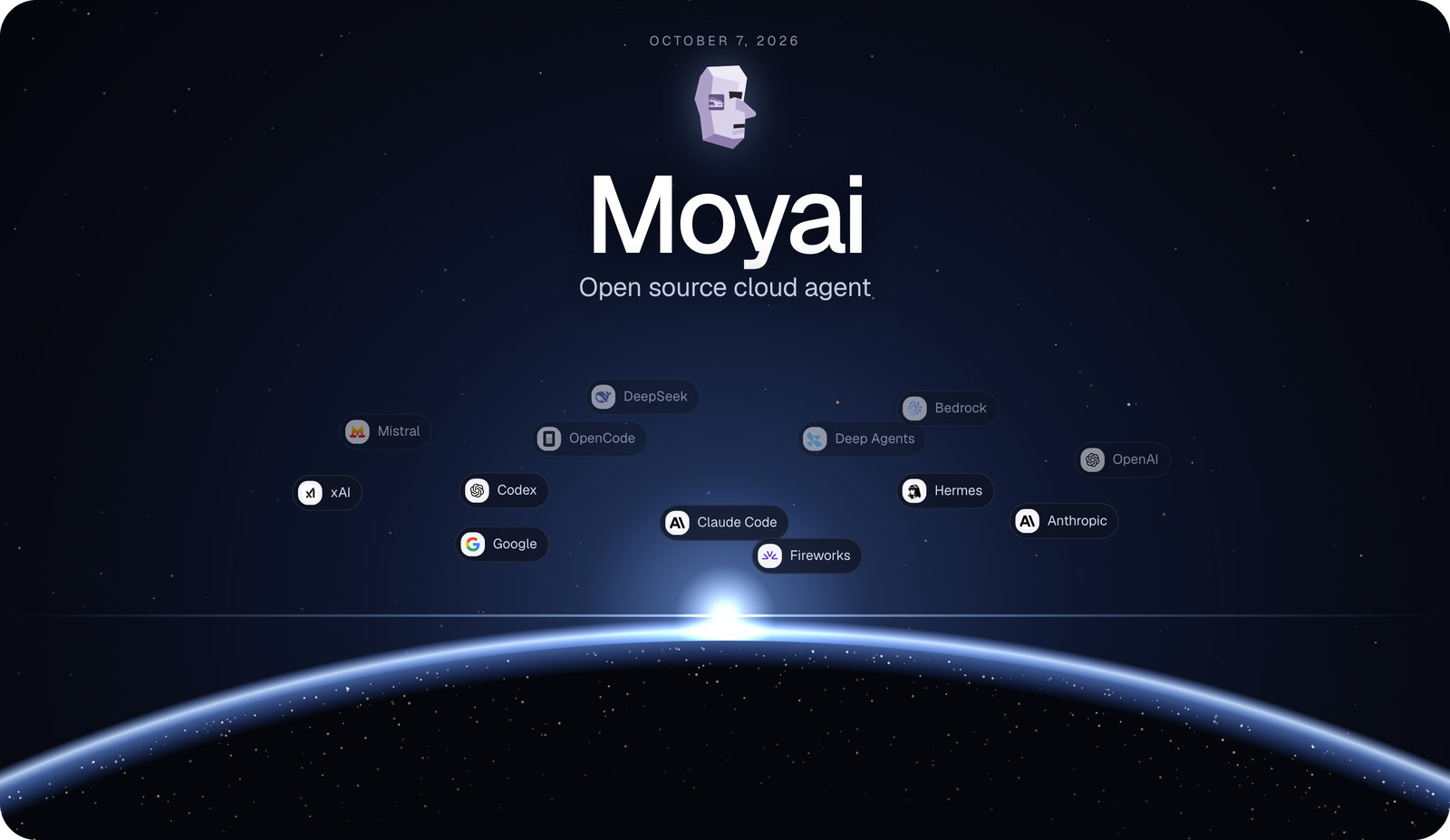
On Oct 7 LiteLLM open-sourced Moyai (BerriAI/moyai), the self-hosted background coding agent its team runs daily: tasks from Slack or the browser run in isolated cloud workspaces that edit code, run tests and open PRs. Harnesses (Claude Agent SDK, Codex, Hermes, OpenCode, Deep Agents, Tool Loop) are switchable per session and inference routes through LiteLLM's 100+ providers. LiteLLM says replacing Devin cut a 31-day bill from $101,872 to about $21,700.

LiteLLM open-sources Moyai, a self-hosted cloud coding agent: $101,872 on Devin vs ~$21,700 on Moyai over 31 days (79% cheaper)

Key Takeaways

  • Cost: $101,872 on Devin vs ~$21,700 on Moyai (~$700/day) over the same 31 days, a claimed 79% / ~$80,172 saving (launch post)
  • Pluggable harnesses: Claude Agent SDK by default (prompt caching on), plus Hermes, Codex, OpenCode, Deep Agents and Tool Loop (docs)
  • Inference via LiteLLM across 100+ providers; switch GPT-6 Astra / Claude Opus 5.5 / GLM-5.3 mid-session with per-teammate spend attribution
  • Provider keys stay server-side and never reach the sandbox; each session gets its own terminal, filesystem and browser
  • Caveat: ~58 stars at publish time and no LICENSE file detected by GitHub; confirm terms before commercial use
Read full story

GitHub open-sources ReviewBench, a 219-PR benchmark for AI code review: Copilot, Devin and Qodo lead; Cursor's grounded recall is 9.6%

GitHub's blog post ReviewBench (Oct 5, 2026) launches an offline AI code-review benchmark as a research preview. It has 219 PRs from 187 open-source repos in 19 languages, sampled to match the distribution of 103.9M GitHub PRs. The golden set combines human reviewers, several frontier LLMs and static analysis. Claude Sonnet 5 is the judge, and senior engineers agreed with its labels 96.6% of the time. On the leaderboard, grounded recall is 26.0% for Copilot Code Review (Balanced), 23.8% for Devin, 22.1% for Qodo and 9.6% for Cursor. The dataset, judge prompt and runner are MIT-licensed on GitHub.

GitHub open-sources ReviewBench, a 219-PR benchmark for AI code review: Copilot, Devin and Qodo lead; Cursor's grounded recall is 9.6%

Key Takeaways

  • Scale: 219 PRs from 187 open-source repos in 19 languages, sampled to match the distribution of 103.9M GitHub PRs (blog)
  • Trust: senior engineers independently re-labeled every golden finding and agreed with the benchmark 96.6% of the time; Claude Sonnet 5 is the judge
  • Leaderboard grounded recall: Copilot Balanced 26.0% (87.8% precision) > Devin 23.8% > Qodo 22.1% > Codex GPT-5.6 Sol Ultra 19.9% > Cursor 9.6%
  • Offline matched online: in a multi-model ensemble experiment, the online A/B showed +8.0% precision, +13.6% recall and −8.0% cost per review; critical comments were predicted at +227% offline and measured at +262% online
  • To submit: bring your own container image and model key, run the 25-PR test set, then the full 219 PRs over 3 rounds. The repo review-bench/ReviewBench is MIT-licensed
Read full story

Codex kicks off "28 days of improvements or a full reset": Day 1 makes GPT-6 Astra and GPT-6.1 Sol ~50% faster by default, including OpenCode, Pi, Amp and Devin via Sign in with ChatGPT

On Oct 5, Codex lead Thibault "Tibo" Sottiaux committed that for the next 28 days OpenAI will ship one clear improvement for most Codex/ChatGPT Work users each day, or give everyone a full usage reset. Day 1 is an inference speedup: GPT-6 Astra and GPT-6.1 Sol are ~50% faster by default on subscriptions (roughly 30 to 50 tokens/s), including partner tools using Sign in with ChatGPT. No API speed change was announced.

Key Takeaways

  • 28-day pledge: each day either one clear improvement or a full usage reset for everyone (OpenAI Developer Community thread)
  • Day 1: GPT-6 Astra / GPT-6.1 Sol default speed ~+50%; Tibo cited roughly 30 to 50 tokens/s (closer to +67% if exact; both called approximate)
  • Scope: OpenAI products plus every Sign in with ChatGPT partner (OpenCode, Pi, Amp, Devin), no config change, live within ~2 hours
  • Subscription path only; no API speed change announced, so API-billed evals are unaffected
  • One community user reported slower 6.1 Sol runs on a private benchmark after the change; unverified single data point
Read full story
ADSponsored

Who Finishes the Job? First Empirical Study Reveals AI Coding Agent Merges Require 1.62x More Follow-Up Fixes

Researchers from Monash University and the University of Melbourne published the first large-scale empirical study tracking the post-merge lifecycle of AI coding agents across GitHub open-source repositories (arXiv:2609.26847). Analyzing 6,774 merged agent PRs (spanning Devin, Cursor, Claude Code, GitHub Copilot, and OpenAI Codex) against 5,044 contemporaneous human PRs across repos with 500+ stars, the study reveals that merged agent code requires verified follow-up bug fixes at 1.62 times the odds of human merges. However, 69.6% of verified fixes are authored by the same agent, and 76.4% of fix PR commits remain entirely agent-driven, debunking assumptions that human maintainers bear the full manual burden of cleanup.

Who Finishes the Job? First Empirical Study Reveals AI Coding Agent Merges Require 1.62x More Follow-Up Fixes

Key Takeaways

  • Empirical scale: analyzes 6,774 merged agent PRs and 5,044 contemporaneous human PRs across popular repos (500+ stars)
  • Higher bug odds: merged agent PRs attract verified follow-up fixes at 1.62x the odds of human PRs (OR = 1.62)
  • Self-fixing loop: 69.6% of verified fixes come from the original agent, with 76.4% of fix commits authored entirely by AI
  • High-agreement benchmark: evaluated via human annotators and LLM Judge (Kappa = 0.78 vs human-human Kappa = 0.77) with 90% direct-fix precision
  • Engineering takeaway: maintainers should introduce post-merge staging soak periods and harness agent self-repair workflows
Read full story

OpenHands v1.23.0 Released: Upgraded Multi-Agent Orchestration & Autonomous Regression Validation

OpenHands (@OpenHandsAI, formerly OpenDevin) has released v1.23.0. This release significantly upgrades the multi-agent execution pipeline and sandboxed runtime, introduces automated regression evaluation suites for complex repositories, and enhances compatibility with local inference backends like vLLM and Ollama.

OpenHands v1.23.0 Released: Upgraded Multi-Agent Orchestration & Autonomous Regression Validation

Key Takeaways

  • Introduces tri-agent architecture (Planner, Coder, Verifier) for robust end-to-end PR resolution.
  • Local Docker sandbox runtime execution latency reduced by 35% with real-time file event watchers.
  • Built-in SWE-bench Verified regression runner for local evaluation of custom agent policies.
  • Full source code and container images released on GitHub with native local backend support.
Read full story

Cognition ships Devin Cloud in Terminal and devin ssh: CLI cloud sessions plus SSH into Devin VMs

@cognition introduced Devin Cloud in Terminal and devin ssh: create, steer, and resume Devin Cloud sessions from the CLI with /cloud, and for the first time SSH into Devin’s dedicated VM then /handoff the work back to your own device.

Cognition ships Devin Cloud in Terminal and devin ssh: CLI cloud sessions plus SSH into Devin VMs

Key Takeaways

  • New CLI: /cloud to create, steer, and resume Devin Cloud sessions in the terminal.
  • devin ssh: first-time SSH into Devin’s dedicated VM.
  • /handoff: return cloud work to your own device for local workflows.
Read full story
Linked Models & Agents:

herdr-agent-quota open-sources Herdr sidebar gauges for multi-agent model/context/subscription quota

@DanKornas shipped herdr-agent-quota (github.com/levi-qiao/herdr-agent-quota): an MIT Herdr plugin that groups agents under Spaces and shows model, context, and subscription quota for Claude, Codex, Grok, Agy, OpenCode, Pi, OMP, Devin, Muse, and Cursor, with remaining/used gauges and configurable low-quota alerts so parallel agents do not silently drain a shared pool.

Key Takeaways

  • Herdr sidebar groups multi-agent model/context/subscription quota by Space.
  • Shows remaining or used percentage gauges with configurable low-quota alerts.
  • MIT open source; covers Claude, Codex, Cursor, Devin, Grok, Agy, and more.
Read full story

Autonomous open-sources OpenHarness: one control plane for Claude Code, Codex, and domain-specific harnesses

Autonomous (@autonomous_labs) open-sourced OpenHarness (github.com/autonomous-ai/openharness): not another coding agent, but a harness control plane that runs Claude Code, Codex, Cursor, OpenCode, Pi, Command Code, Devin, Grok Build, and more in persistent tmux sessions across machines. Domain-Specific Harnesses target CAD, PCBs, robotics, and games; a desktop app plus open-hardware Harness units shipped the same week. Credentials stay in each vendor’s local config; machines link via outbound-only daemons with end-to-end encrypted relay/WebRTC.

Key Takeaways

  • Open-sources OpenHarness: a multi-agent control plane for Claude Code/Codex/Cursor and peers, not another agent.
  • Adds Domain-Specific Harnesses (CAD/PCB/robotics/games) plus an open-hardware desk device shipping the same week.
  • Persistent tmux sessions; credentials stay local; outbound-only multi-machine link with E2E encrypted relay.
Read full story