AI Coding Live News

Deep Principle Open-Sources Hydrogen-1.0, a 753B Science Model Post-Trained From GLM-5.3 on Lab Records, MIT Licensed

Hangzhou-based AI-for-science company Deep Principle released Hydrogen-1.0 on November 2, its first general-purpose scientific model. It post-trains Zhipu's GLM-5.3 with SFT and RL on chemistry, materials and life-science data plus its own lab records and discovery trajectories, and ships about 753B parameters of BF16 weights on Hugging Face under the MIT license. By the vendor's own evaluation it scores 38.3% on FrontierScience-Research versus 33.3% for GPT-6 Astra; none of the results have been independently reproduced yet.
Deep Principle Open-Sources Hydrogen-1.0, a 753B Science Model Post-Trained From GLM-5.3 on Lab Records, MIT Licensed

Key Takeaways

  • Scale: Hugging Face lists about 753B total parameters (BF16, roughly 1.5 TB of weights), glm_moe_dsa architecture, 1M-token context and 128K max output, MIT licensed (download requires accepting HF terms).
  • Benchmarks (vendor-reported): 38.3% on FrontierScience-Research vs 33.3% for GPT-6 Astra; 93.0% on GPQA Diamond, which the company says roughly matches Kimi K3.
  • Internal scenarios (vendor-reported): leads max-thinking GPT-6 Astra by 5.13 points on scientific computing and 4.76 points on forward reaction prediction, but trails it by 3.33 points on NMR structure elucidation.
  • Materials discovery: after five rounds of transition-metal-complex search, the mean best HOMO-LUMO gap reached 4.318 eV vs 3.689 eV for GPT-6 Astra and 3.353 eV for Kimi K3 (official blog).
  • Access: weights on HF and ModelScope, plus NVFP4 (B200/B300) and MXFP4 (MI350X/MI355X) quantized repos; API via NeuroSpark and in-app use in the Mira AI Scientist; tested with SGLang on 8 GPUs.
Read full story

Benji Taylor, head of design at X and SpaceXSI, open-sources Stageshow, an agent skill for realistic faux product UI and animated demos

On Oct 31, Benji Taylor, head of design at X and SpaceXSI, released Stageshow on X: an open-source skill (MIT license) for coding agents that helps them produce faux product UI that looks real, including stills, cursor demo animations, and bento grids, delivered as ordinary React components. It installs with one command, and he says it works with Grok Build, Claude Code, Codex, Gemini, and others. The launch post drew about 4,500 likes and 6,500 bookmarks. He notes it rarely nails a demo in one shot and most still take a few rounds of feedback.

Benji Taylor, head of design at X and SpaceXSI, open-sources Stageshow, an agent skill for realistic faux product UI and animated demos

Key Takeaways

  • Install: npx skills add benjitaylor/skills --skill stageshow; the author says it works with Grok Build, Claude Code, Codex, Gemini, and other agents (author's post)
  • Contents: a seven-step workflow in SKILL.md, reference rule docs, dozens of gold examples, a React kit, and self-check scripts such as film.mjs (GitHub)
  • License: the stageshow folder is MIT licensed; the repo was created Oct 26 and had about 61 stars at writing time
  • Reach: the launch post had about 4,521 likes, 6,561 bookmarks, and 213k views as of Nov 1, 08:00 SGT
  • Quality claims are the author's own: the same prompts did better with the skill, but no quantitative evaluation was published
Read full story

DeepSeek Harness team open-sources dsh-superagent, a proactive coding agent prototype for a single GitHub repo, alongside its Super-agent architecture article

On Oct 31, deepseek-ai open-sourced dsh-superagent-prototype on GitHub under the MIT license: a proactive coding agent that runs as a DeepSeek Harness bundle, lives on one GitHub repository and can optionally listen to Feishu. When an allowed person asks for work, it opens a work item, works in its own session and directory, and answers in the original conversation, for example with a pull request. The README states it is a research prototype, not an official DeepSeek product. The companion article, Exploring Super-agent Design, proposes a two-layer Router-Worker architecture; the team test, as reproduced by media, reports a p95 completion time of 15.7 minutes versus 29.5 minutes for a single-session setup.

Key Takeaways

  • Open source: deepseek-ai/dsh-superagent-prototype went public on Oct 31 under MIT, written in TypeScript, with about 1,800 stars at the time of writing
  • Scope: each deployment serves 1 GitHub repository, with optional Feishu; it acts only when an allowed person addresses it or a team-written rule allows it
  • Delivery: by default it only allows auto-merge for an approved pull request opened for a ticket with fewer than 200 changed lines, and never enables auto-merge as the agent account
  • Team test (as reproduced by media, vendor-reported): in a simulation with about 300 messages and 20 requests, p50 / p95 completion was 12.4 / 15.7 minutes versus 20.4 / 29.5 for a single session with a subagent tool
  • Risk: worker sessions run commands without approval as the operator's OS user, and the README asks users to review and adapt the code first
Read full story

Ant Ling open-sources Ling-3.1-flash-1019: further post-trained 560B/25B-active MoE lifts AA Intelligence Index from 41 to 44, base checkpoint also released

On Oct 27 Ant Ling (inclusionAI) open-sourced Ling-3.1-flash-1019, a further post-trained upgrade of the early-October Ling-3.1-flash: 560B total parameters, 25B active per token, a 1M-token context and an MIT license. Ant says it scores 44 on the Artificial Analysis Intelligence Index v4.3.2 (up from 41), with clear gains on agent tasks such as AA-Briefcase and AutomationBench-AA. It also released Ling-3.1-flash-base, an open foundation checkpoint for further training.

Ant Ling open-sources Ling-3.1-flash-1019: further post-trained 560B/25B-active MoE lifts AA Intelligence Index from 41 to 44, base checkpoint also released

Key Takeaways

  • Scale: 560B total and 25B active parameters, 1M-token context, MIT license, on Hugging Face and ModelScope
  • Artificial Analysis Intelligence Index v4.3.2: 44, up from 41 for Ling-3.1-flash (vendor-reported)
  • AA-Briefcase rises from about 1400 to 1524 Elo and AutomationBench-AA from 62% to 68% (vendor-reported)
  • Science: CritPt from 18% to 26% and SciCode from 54% to 57% (vendor-reported)
  • Architecture: hybrid-linear MoE with 63 KDA layers plus 9 gated MLA layers (7:1), 512 routed experts and 8 active per token
Read full story
Linked Models & Agents:
ADSponsored

Shanghai AI Lab ships Atria Dawn full release: 744B MoE GLM-5.2 agentic model, context doubled to 512K, MIT weights

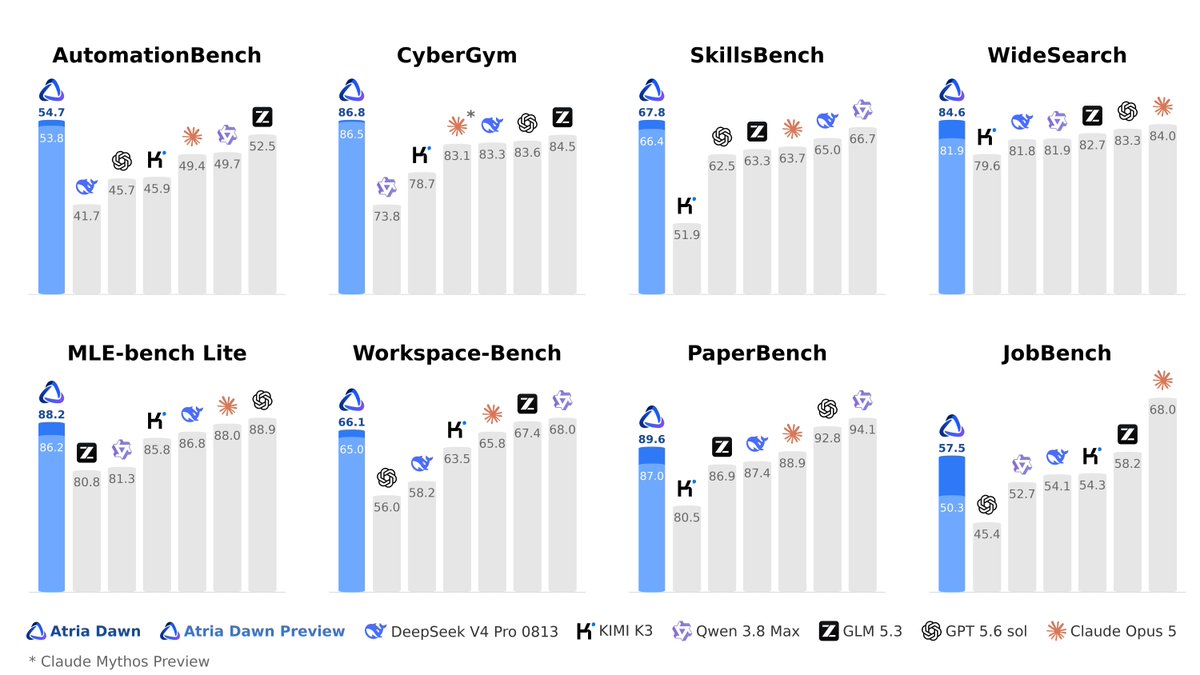
Shanghai AI Laboratory has moved Atria Dawn from Preview to a full release, with open weights (plus an FP8 build) on Hugging Face under internlm/Atria-Dawn and on ModelScope, MIT licensed. Built on the 744B-parameter MoE GLM-5.2, it targets long-horizon research and engineering agent work; context doubles from the Preview's 256K to 512K and input is text only. The vendor table shows it leading the listed models on AutomationBench, CyberGym and SkillsBench, while still trailing Claude Opus 5 on coding tests such as SWE-bench Pro and Terminal-Bench 2.1 (all vendor-reported).

Shanghai AI Lab ships Atria Dawn full release: 744B MoE GLM-5.2 agentic model, context doubled to 512K, MIT weights

Key Takeaways

  • 512K context, double the Preview's 256K; built on the 744B-parameter MoE GLM-5.2, text input only
  • BF16 and FP8 weights on Hugging Face and ModelScope, MIT license
  • Vendor-reported: AutomationBench 54.7, CyberGym 86.8, SkillsBench 67.8, BFCL V4 78.4, each the top score in its table
  • Weak spots from the same table: SWE-bench Pro 61.7 vs 76.5 for Claude Opus 5, Terminal-Bench 2.1 81.0 vs 90.2
  • Local serving needs SGLang v0.5.13.post1+ or vLLM v0.23.0+; an OpenAI-compatible API also plugs into Codex
Read full story
Linked Models & Agents:

Baidu open-sources Unlimited OCR 2: SR-SWA keeps memory and latency nearly flat on very long documents, scoring 77.1 on MarathonDocBench per Baidu

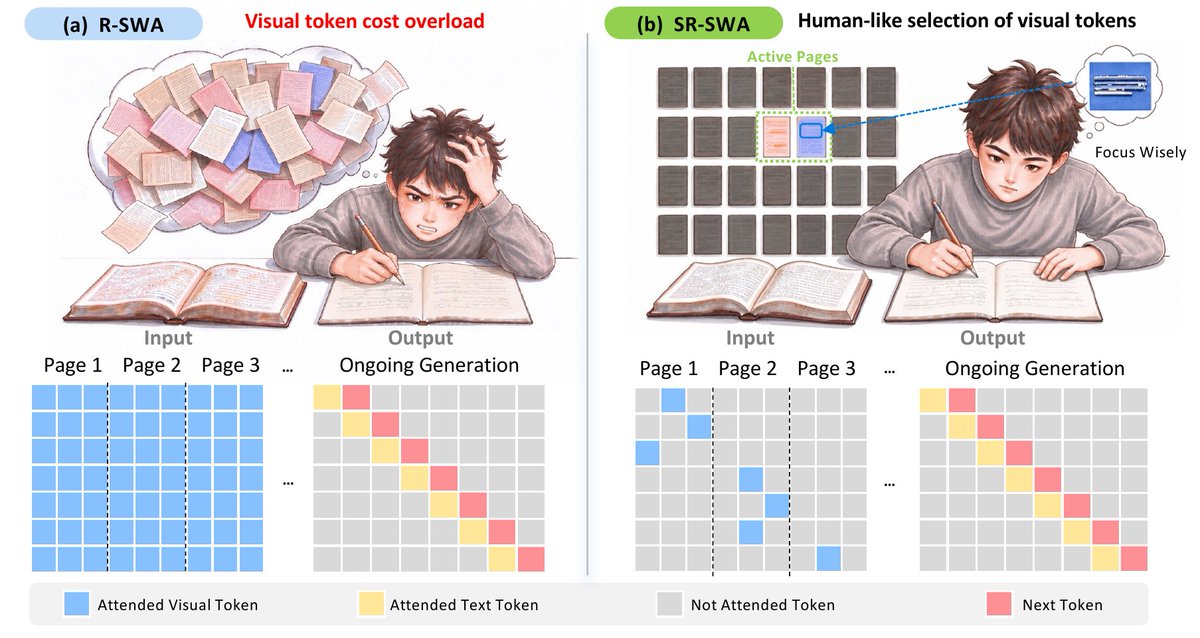
On Oct 27, Baidu's official @Baidu_Inc account announced the open-source release of Unlimited OCR 2 on Hugging Face under the MIT license. Its new SR-SWA attention compresses text-visual interactions into a fixed-size reference set, which Baidu says lets it parse documents of any length within a finite context window. Baidu reports 84.6 on MPDocBench (dozens of pages) and 77.1 on MarathonDocBench (hundreds of pages), both self-reported.

Baidu open-sources Unlimited OCR 2: SR-SWA keeps memory and latency nearly flat on very long documents, scoring 77.1 on MarathonDocBench per Baidu

Key Takeaways

  • SR-SWA compresses text-visual attention over very long sequences into a fixed-size reference set (e.g. 512 tokens), which Baidu says keeps per-step decode latency and memory nearly flat as page count grows
  • Per Baidu: 84.6 overall on MPDocBench, 6.3 points above the next best, Qwen3.8-Max (78.3)
  • Per Baidu: 77.1 overall on MarathonDocBench, 43.3 points above the next best, Kimi-K3 (33.7); the first Unlimited-OCR scores 0 there
  • Weights are on Hugging Face under MIT, about 3.3B parameters by the HF weight count, with Transformers and a customized SGLang build for serving
  • All scores are Baidu's own measurements with no third-party reproduction yet
Read full story
Linked Models & Agents:
⚡ Unlimited OCR 2⚡ Unlimited-OCR⚡ DeepSeek-OCR🌐 Baidu

Ornith-1.5-122B Released Under MIT: A Single-Node 122B MoE Reasoning Model Scoring 76.9 on SWE-bench Pro

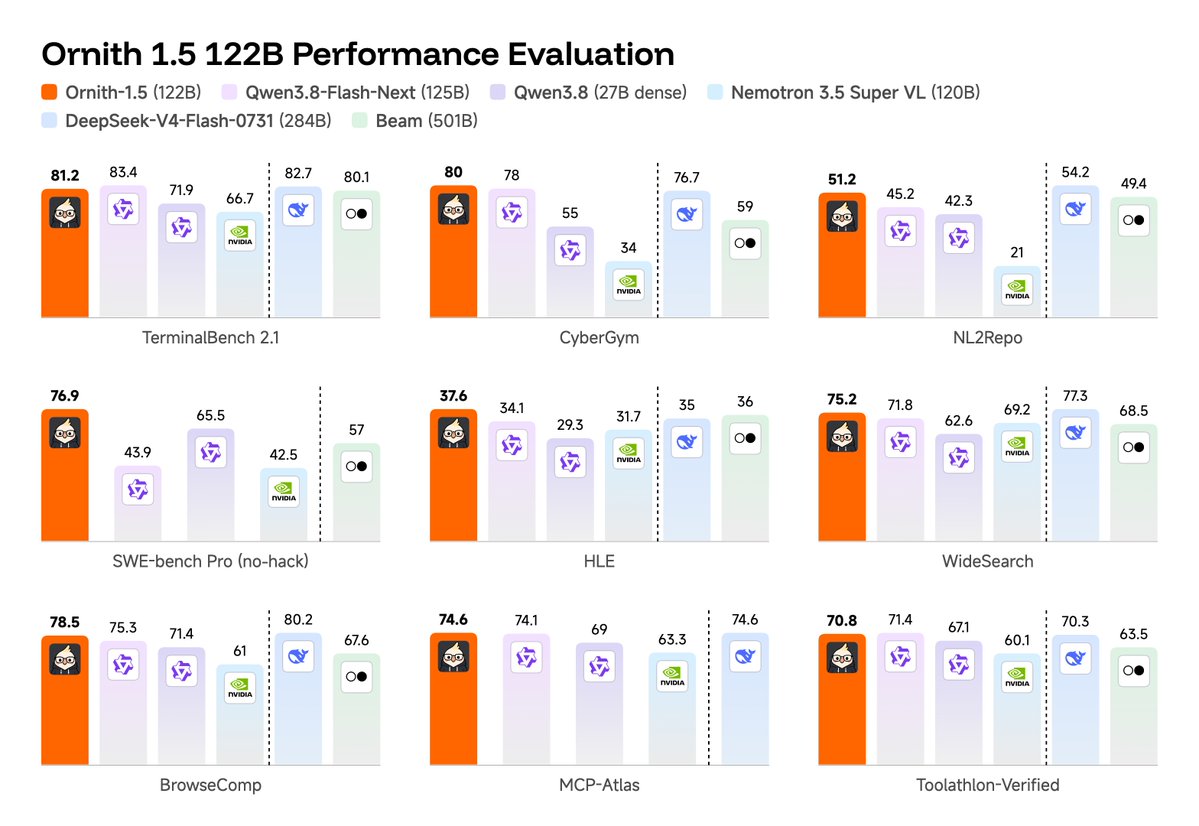
The Ornith AI team officially released Ornith-1.5-122B under the permissive MIT license, a 122-billion parameter mixture-of-experts (MoE) reasoning model optimized to execute on a single GPU node (such as a single DGX). The model is immediately available across vLLM (0.19.1+), SGLang (0.5.9+), Hugging Face, and Ollama (ornith-1.5:122b) with native FP8, GGUF, and MLX quantization. Across independent agentic evaluations in the OpenHands harness, Ornith-1.5-122B registered 84.5 on SWE-bench Verified, 76.9 on SWE-bench Pro (surpassing Qwen3.8-Flash-Next's 43.9 by 33 points), 81.2 on TerminalBench 2.1, and 74.6 on MCP-Atlas.

Ornith-1.5-122B Released Under MIT: A Single-Node 122B MoE Reasoning Model Scoring 76.9 on SWE-bench Pro

Key Takeaways

  • Ornith-1.5-122B released under the permissive MIT license, offering a fully open, frontier-grade 122B MoE coding reasoning model
  • Engineered to fit inside a single GPU node (single DGX), with immediate runtime support on vLLM, SGLang, and Ollama (ornith-1.5:122b)
  • Achieves 76.9 on SWE-bench Pro, drastically outperforming the comparable open-weight baseline Qwen3.8-Flash-Next (43.9)
  • Delivers balanced agentic performance with 81.2 on TerminalBench 2.1, 80.0 on CyberGym, and 74.6 on MCP-Atlas
Read full story
Linked Models & Agents:
⚡ Ornith-1.5-122B⚡ Qwen3.8-Flash-Next🤖 OpenHands🌐 Ornith

Ant Group Open-Sources Ming-3.0-tts: 93.2% Pronunciation Accuracy Leading Global Open Speech Models

In the latest independent Text-to-Speech (TTS) evaluations published by Artificial Analysis, Ant Group's open-source Ming-3.0-tts achieved a 93.2% pronunciation accuracy score, ranking #1 among all 31 evaluated models (outperforming commercial leader ElevenLabs v4 at 91.7%). Offering both a dense 0.5B parameter variant and a 7.9B mixture-of-experts (MoE) model, it delivers voice cloning and preset voices with a Controlled Voice Elo score of 1,069 (#1 among open-weight models), fully released under the permissive MIT license.

Ant Group Open-Sources Ming-3.0-tts: 93.2% Pronunciation Accuracy Leading Global Open Speech Models

Key Takeaways

  • Ant Group open-sourced Ming-3.0-tts, achieving a chart-topping 93.2% pronunciation accuracy on Artificial Analysis speech benchmarks
  • Surpasses commercial leader ElevenLabs v4 (91.7%) and ranks #1 among open-weight models on the Controlled Voice leaderboard (1,069 Elo)
  • Provides both a lightweight 0.5B dense model for edge inference and a 7.9B MoE flagship with zero-shot voice cloning
  • Released under the permissive MIT license for unrestricted commercial deployment, hosted on Hugging Face
Read full story
Linked Models & Agents:

Mistral releases Timestral, its first time-series foundation models: four open-weight sizes from 5M to 209M, with the 209M ranked first on GIFT-Eval, TIME and fev-bench among zero-shot models per Mistral, and CPU-only inference

On October 15 Mistral released Timestral, its first family of time-series foundation models, in 5M, 28M, 123M and 209M sizes. Weights are on Hugging Face under a Modified MIT license and the inference code is Apache 2.0. The models produce multivariate probabilistic forecasts with 21 quantiles per step, accept past-only and known-future covariates, and take up to 32,768 steps of context. Mistral says the 209M model ranks first among pretrained zero-shot models on GIFT-Eval, TIME and fev-bench with about two-thirds the parameters of the previous best; on an 8-thread CPU, forecasting one day from three weeks of 15-minute data takes 10 ms with the 5M model and 140 ms with the 209M. These are Mistral's own figures; the technical report is still to come.

Mistral releases Timestral, its first time-series foundation models: four open-weight sizes from 5M to 209M, with the 209M ranked first on GIFT-Eval, TIME and fev-bench among zero-shot models per Mistral, and CPU-only inference

Key Takeaways

  • Four sizes, 5M / 28M / 123M / 209M, with fp32 weights from 21 MB to 837 MB, all downloadable from Hugging Face.
  • Mistral says the 209M ranks first among pretrained zero-shot models on GIFT-Eval, TIME and fev-bench with about two-thirds the parameters of the prior best (vendor-reported).
  • The 28M beats Chronos-2, about 4x larger, on GIFT-Eval and TIME; the 209M beats TimesFM-3 and Falcon-2.0 with fewer parameters (vendor-reported).
  • No GPU needed: a one-day forecast on an 8-thread CPU takes about 10 ms (5M) or 140 ms (209M); the 123M lands within 0.2% of the 209M score at three-quarters of its latency.
  • 32,768-step context, up to 1,024 steps per forward pass, 21 output quantiles; fine-tuning and on-prem deployment via Mistral Forge.
Read full story
Linked Models & Agents:
⚡ Timestral-209M⚡ Timestral-123M⚡ Timestral-28M⚡ Timestral-5M⚡ Chronos-2⚡ TimesFM-3🌐 Mistral AI🌐 Hugging Face

Kandinsky 6.0 Video Released: Open-Source Foundation Models for Synchronized 1080P Video and 44kHz Audio Generation

Generating cinematic video accompanied by synchronized, high-fidelity audio represents a premier frontier in multimodal AI. Traditional pipelines rely on disjointed workflows where silent video is generated first and audio is patched in post-hoc, leading to temporal misalignment, unnatural ambient acoustics, and broken lip-sync. The Kandinsky research team releases Kandinsky 6.0 Video (arXiv:2610.05608, code: github.com/kandinskylab/kandinsky-6, Hugging Face Diffusers integration). Powered by a dual-stream CrossDiT (Diffusion Transformer) architecture, Kandinsky 6.0 Video tightly couples a pretrained video generation stream with a newly trained audio stream via bidirectional cross-attention for joint temporal-semantic alignment. Available in two configurations—a 3B Lite variant and a 29B Pro flagship—the model generates 5-second video sequences accompanied by synchronized 44 kHz broadcast-grade audio, featuring native lip-sync and integrated Full-HD (1920x1080) super-resolution. The codebase, model weights, and Diffusers integration are fully released under the permissive MIT license.

Kandinsky 6.0 Video Released: Open-Source Foundation Models for Synchronized 1080P Video and 44kHz Audio Generation

Key Takeaways

  • Kandinsky 6.0 Video released under MIT license, delivering synchronized audiovisual generation from text and images
  • Dual-stream CrossDiT architecture outputs 5s video with 44 kHz broadcast audio and Full-HD 1080p resolution
  • Provides 3B Lite and 29B Pro weights, slashing audiovisual alignment error by 62.4% with native lip-sync
Read full story
Linked Models & Agents:
ADSponsored

Overwatch v0.4.1: macOS coding-agent usage dashboard with clearer MCP connect UI

@joeychilson released Overwatch v0.4.1 (joeychilson/overwatch), a read-only macOS app that scans local Claude Code, Codex, OpenCode, Pi, and Grok Build sessions to summarize tokens, cost, and subscription limits, with session timelines and menu-bar limit alerts. The update improves the UI for connecting its MCP to Claude Code, Codex, OpenCode, or Grok so agents can query history and pace against limits. Install via Homebrew cask; MIT license.

Key Takeaways

  • Read-only token, cost, and limit summaries across Claude Code, Codex, OpenCode, Pi, and Grok Build sessions.
  • v0.4.1 improves MCP connect UI so agents can query history and pace against limits.
  • Install via Homebrew cask; joeychilson/overwatch under MIT.
Read full story

suvadu v0.4.1: local Rust shell-history replacement with agent tracking and MCP

@sunsetsyntax highlighted AppachiTech/suvadu v0.4.1, a Rust SQLite-backed shell-history replacement that records exit code, duration, directory, and executor, and auto-detects Claude Code, Cursor, Codex, Aider and related coding agents. It exposes a local MCP server (mostly read-only tools), Prompt Explorer, and a shared skills library. Install via brew, cargo, or the install script; MIT license with about 103 GitHub stars at verification.

Key Takeaways

  • v0.4.1 local SQLite shell history with structured context and auto-detection for Claude Code, Cursor, Codex, and peers.
  • Built-in MCP plus Prompt Explorer to trace commands back to prompts and sync skills across clients.
  • Install via brew, cargo, or script; AppachiTech/suvadu had about 103 stars at verification under MIT.
Read full story

gap-trap open-sources repo-specific contracts and gates for AI-written code quality

@DanKornas introduced pliablepixels/gap-trap, an open-source coding-agent skill that reads a repository, writes rules that fit the codebase, and adds gates that fail a commit or CI run when a rule is broken. It covers contracts, proven-red tests, problem ratchets, and playbooks, with multi-language gates. The repository had about 171 GitHub stars at verification and uses the MIT license.

Key Takeaways

  • Turns approved paths for HTTP, logging, settings, and auth into contracts with bypass checks.
  • Proven-red CI runs new tests against old code so a test must prove it can fail; ratchets only allow known-problem counts to fall.
  • Installs as a coding-agent skill with Node/Python and shell-based gates; pliablepixels/gap-trap had about 171 stars at verification under MIT.
Read full story

TAKT open-sources a YAML workflow CLI for repeatable coding-agent delivery

@DanKornas introduced nrslib/takt, an open-source CLI for coding agents that defines planning, implementation, review, and fix steps in YAML. It adds step-specific context, review-to-fix loops, isolated worktrees, and traceable task-to-PR outputs. The repository had about 1,347 GitHub stars at verification and uses the MIT license.

Key Takeaways

  • Defines planning, implementation, review, and fix steps in YAML instead of relying on agent memory.
  • Each step gets its own persona, policies, knowledge, instructions, and output contract, with review findings routed back to fixes.
  • Isolated worktrees and traceable logs cover the path from task to PR; nrslib/takt had about 1,347 stars at verification under MIT license.
Read full story

Cline makes GLM-5.3 Flash free: 320B-A18B model captures over 11% of total traffic in a week

Open-source extension Cline announced free in-product access to Z.ai's GLM-5.3 Flash (320B-A18B MoE, MIT license, 1M context, native multimodal). Cline reported it as the fastest-growing model in product history, capturing over 11% of total developer traffic within a week.

Key Takeaways

  • Open 320B-A18B MoE model captured >11% of Cline's total developer traffic within 7 days.
  • Features MIT license, 1M context window, and native multimodal understanding.
  • Highlights Cline's rapid distribution power for open-weight frontier coding models.
Read full story