AI Coding Live News

Axion 1.0 Open Agent Foundation Model: Two SFT Stages Plus RL, 35B-A3B Reproduction Checkpoint Under Apache 2.0, Full Recipe Released

arXiv paper 2611.03233 by Yuqi Jia, Yunjie Tian and five co-authors introduces Axion 1.0, an agent foundation model that is open beyond its weights. It uses just two lightweight SFT stages plus reinforcement learning, with no dedicated mid-training, DPO or on-policy distillation, and about 18K SFT trajectories in total. Training code is hosted under the bytedance GitHub organization, and the training data and an Axion 1.0-35B reproduction checkpoint (Qwen3.6-35B-A3B base, 35B total / 3B active, Apache 2.0) are on Hugging Face; weights for the paper's 122B model are listed as coming soon.

Axion 1.0 Open Agent Foundation Model: Two SFT Stages Plus RL, 35B-A3B Reproduction Checkpoint Under Apache 2.0, Full Recipe Released

Key Takeaways

  • A minimal recipe: SFT stage one for self-contained scientific reasoning, stage two for tool use and information seeking, then RL for long-horizon interaction, with 18,363 SFT trajectories and 484 RL tasks
  • The release covers data construction, generation, filtering, verification, prompts and training code (GitHub), not just weights
  • The 35B reproduction checkpoint scores 52.8 on HLE, 60.4 on SEAL-0, 85.0 on FrontierScience Olympiad and 55.0 on FrontierScience Research (HF model card)
  • The paper's 122B model reports 59.0 on HLE with restricted website access and 66.7 on FrontierScience Research; 122B weights are not out yet
  • All scores are self-reported; the HF card lists Claude Opus 5 at 63.6 on HLE, so Axion still trails the strongest closed models
Read full story
Linked Models & Agents:
⚡ Axion 1.0-35B⚡ Axion 1.0-122B⚡ Qwen3.6-35B-A3B🌐 ByteDance🌐 Hugging Face

X discussion: open-source AI builder Jun Song says he turned down an anonymous black hat group offering huge money to post-train open-weight models on exploit data

At 02:20 UTC on Nov 1, open-source AI builder Jun Song (@jun_song, who builds Supergemma) posted on X that an anonymous black hat group offered him an "astronomical" sum to post-train open-weight models with reinforcement learning on the exploit data it holds. He said the volume was so large he would have believed it was an undercover FBI dataset, that he turned it down, and that what scares him is that someone else will eventually take the deal. As of 17:10 SGT the post had about 2,029 likes, 222K views and 771 bookmarks, and it has been rewritten as a parody template. This is a personal account; the offer, the data volume and the group cannot be verified, so it is treated here as a discussion.

Key Takeaways

  • Reach: the original post had about 2,029 likes, 127 reposts, 101 replies, 771 bookmarks and 222.2K views as of Nov 1, 17:10 SGT
  • Claim: an anonymous black hat group offered an "astronomical" sum to post-train open-weight models on exploit data; he says he declined, and neither the amount nor the data volume is public or verifiable
  • Comparison: he says a white-hat project of his built on GLM-5.3 used under 1% of that volume and already beat frontier models "by a huge margin"; this is self-reported with no public benchmark
  • Reaction: accounts such as msuiche and Samuel Cardillo reused the opening lines as a parody template, so the thread splits between taking it seriously and joking about it
  • Issue: open-weight models cannot be recalled once released and their safeguards can be trained away, so a request like this makes the open-weights versus misuse debate concrete
Read full story
Linked Models & Agents:

X discussion: Turing Award winner Richard Sutton shares the "intelligence explosion" passage he wrote at 17 in 1975

Richard Sutton, a founder of reinforcement learning and co-winner of the 2024 Turing Award, posted on X at 23:42 UTC on October 30 that he is sanguine about the technological singularity partly because he has seen it coming for over 50 years. He quoted a passage he wrote in 1975 at 17: once man creates an intelligence greater than his own, that intelligence should be able to create a still greater one, and intelligence could shoot up within years. The post drew more than 2,300 likes and about 167,000 views, and was widely shared in English and Chinese threads debating what role humans keep. This is a summary of an X discussion, not a verified conclusion.

Key Takeaways

  • Original post: Richard Sutton himself, 23:42 UTC on October 30, quoting a passage he wrote in 1975 at age 17 and calling it one reason he is sanguine about the singularity
  • Key ideas in the passage: understand the brain first; once that breakthrough comes, progress accelerates exponentially; a smarter-than-human intelligence builds an even smarter one; humans are either left behind or become that intelligence
  • Engagement (X API, read around 19:07 SGT on Oct 31): 2,376 likes, 232 reposts, 45 quotes, 97 replies, 882 bookmarks and about 167,000 views
  • Debate points: how early this anticipates todays recursive self-improvement framing; Chinese-language reposts focus on what human intelligence still means; others argue for using AI to learn faster
  • Sutton co-founded reinforcement learning and temporal-difference learning, and his 2019 essay The Bitter Lesson argues that general methods that scale with compute win in the long run
Read full story

Mistral releases the open weights of Mistral Large 4 "Le Chonk": a 1T-total, ~52B-active multimodal MoE that Mistral says leads open models on FrontierCode 2.0

On Oct 29 Mistral released an improved Mistral Large 4 (Le Chonk) with open weights on Hugging Face (plus an NVFP4 quantized checkpoint), served on its API as mistral-large-4. After about three more weeks of reinforcement learning since the early-October preview, Mistral reports 19.7% on FrontierCode 2.0, Terminal-Bench 4.0 up from 28% to 41%, and new low/medium/high reasoning modes. The license is a modified MIT that allows commercial use, but running a model-as-a-service business needs a separate commercial license.

Mistral releases the open weights of Mistral Large 4 "Le Chonk": a 1T-total, ~52B-active multimodal MoE that Mistral says leads open models on FrontierCode 2.0

Key Takeaways

  • Specs: about 1T total parameters with 49B active per token (about 52B including embeddings and output layers), 128 routed experts with 4 active plus 1 shared expert, 1M context, text and image input
  • Per Mistral: 19.7% on Cognition's FrontierCode 2.0, ahead of DeepSeek V4.1 Flash at 19.3% and GLM-5.3 at 17.8%, first among open models
  • 48% on the Artificial Analysis Coding Agent Index, roughly tied with GLM-5.3 while using 47% fewer tokens per task on average; Terminal-Bench 4.0 rose from 28% in preview to 41%
  • 51% on the Artificial Analysis Cyber Index, and a 96.6% average refusal rate on malicious cyber requests, which Mistral says is the highest among open models
  • Trained from scratch on 3,800 NVIDIA Grace Blackwell GPUs in Mistral's own European datacenters; in Surge Code blind pairwise tests it ranked behind only Claude Opus 5.5
Read full story
Linked Models & Agents:
ADSponsored

Cadence launches Maestro, a domain-specialized AI model portfolio for agentic chip and system design built in part on NVIDIA Nemotron, claiming up to 30% better results and 5x token efficiency

EDA leader Cadence announced the Maestro AI Model Portfolio on October 26: domain post-trained LLMs, trained decision models and self-improving agent skills that power its AuraStack, ChipStack, InnoStack and ViraStack AI Super Agents as they drive Cadence EDA and SDA tools. Cadence solvers score outputs against engineering constraints to close a reinforcement learning loop. Initial results per Cadence show up to 30% higher quality and up to 5x token efficiency versus a general-purpose foundation model. NVIDIA contributes Nemotron and OpenShell, and the stack runs on Cadence cloud, public cloud or on-premises. The first models reach select early access customers in Q4 2026.

Key Takeaways

  • Maestro is a portfolio, not one model: domain post-trained LLMs, decision models and self-improving agent skills, mixed with frontier and open-weight models per task
  • Deterministic solvers and EDA tools score outputs against engineering objectives and constraints, feeding a verified reinforcement learning loop
  • Per Cadence: up to 30% higher quality of results and up to 5x token efficiency versus a general-purpose foundation model; no third-party evaluation yet
  • NVIDIA supplies Nemotron models and the OpenShell sandbox reference architecture; customers can post-train on their own designs and run on-premises
  • First models go only to select early access customers in Q4 2026; Socionext expects up to 5x productivity from deploying InnoStack
Read full story

Microsoft Research Open-Sources WildAWM: Generalist Agent World Model in the Wild for GUI & Web Simulation

Microsoft Research (MSRA) researchers published and open-sourced WildAWM (arXiv:2610.26828, GitHub: MSR-Orchard/WildAWM), a generalist agent world model designed for open-ended 'in the wild' digital environments. Traditional computer-use agents rely on slow, brittle, and expensive live web/OS sandboxes for training and evaluation. WildAWM establishes a scalable multimodal world model that accurately predicts visual screen transitions and DOM mutations conditioned on agent actions (click, type, scroll). By replacing live execution environments with a high-fidelity neural simulator, WildAWM unlocks safe, accelerated offline reinforcement learning for GUI agents.

Microsoft Research Open-Sources WildAWM: Generalist Agent World Model in the Wild for GUI & Web Simulation

Key Takeaways

  • Microsoft Research open-sources WildAWM (arXiv:2610.26828), establishing the first generalist world model for wild web and GUI domains
  • Eliminates dependency on fragile, expensive live web sandboxes that risk side-effects during agent trial-and-error training
  • Employs an action-conditioned multimodal autoregressive design predicting high-fidelity visual rollouts following clicks, typing, and scrolling
  • Decisively outperforms prior state-transition baselines across e-commerce, enterprise software, and desktop GUI simulations
Read full story

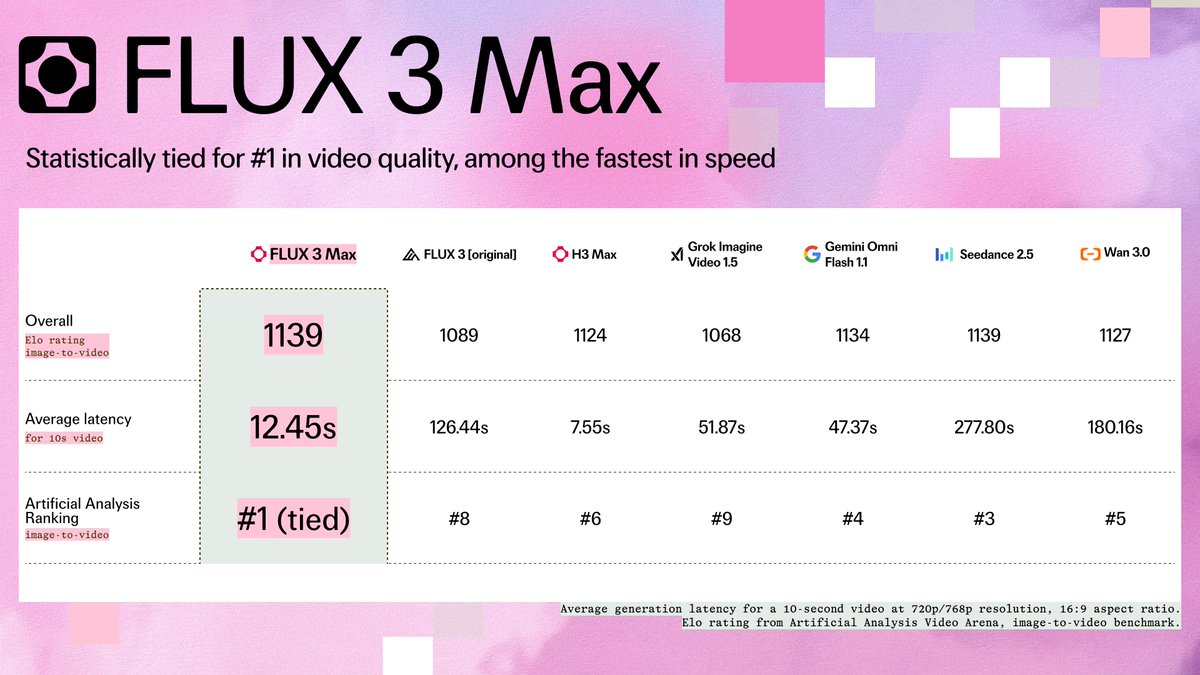
fal and Black Forest Labs launch FLUX 3 Max video model: tied #1 in image-to-video quality, a 10-second clip in about 12 seconds, roughly 22x faster than Seedance 2.5

On Oct 19 (UTC) fal released FLUX 3 Max, a video model built by fal Research with Black Forest Labs through post-training, reinforcement learning and inference optimization on top of the FLUX 3 foundation model. It handles text-to-video, image-to-video and keyframes, up to 20 seconds, at 720p or 1080p, with audio on by default. On Artificial Analysis's preliminary image-to-video arena it scores 1,139 Elo, level with Seedance 2.5 and within the confidence interval of leader MiniMax H3 (1,141), and fal says a 10-second clip takes about 12.45 seconds. A 75% launch discount runs until Nov 7, putting 720p at $0.0425 per second.

fal and Black Forest Labs launch FLUX 3 Max video model: tied #1 in image-to-video quality, a 10-second clip in about 12 seconds, roughly 22x faster than Seedance 2.5

Key Takeaways

  • Artificial Analysis AA-Video-I2V v1.1 (preliminary): FLUX 3 Max at 1,139 Elo, level with Seedance 2.5 and just under MiniMax H3 at 1,141; "tied #1" rests on overlapping confidence intervals
  • Speed (fal-reported, 10-second 16:9 at 720p): FLUX 3 Max 12.45s, Gemini Omni Flash 1.1 47.37s, Seedance 2.5 277.80s; the press release quotes 10.95s instead
  • Versus the original FLUX 3: Elo up from 1,089 to 1,139 (+50) and a 10-second clip down from 126.44s to about 12s (11.5x per the press release, about 10x per the product page)
  • Pricing: promotional $0.0425/s at 720p and $0.0725/s at 1080p until Nov 7, then $0.17/s and $0.29/s, billed per output second
  • API options: 5-20 second duration, multiple aspect ratios, reasoning_level (low/high), generate_audio on by default; model IDs blackforestlabs/flux-3-max/*
Read full story
Linked Models & Agents:
⚡ FLUX 3 Max⚡ FLUX 3⚡ Seedance 2.5⚡ MiniMax H3🌐 fal🌐 Black Forest Labs🌐 Artificial Analysis

Technical University of Munich Introduces TabWM: Relational World Modeling for Enterprise Database Decision Agents

Researchers from the Technical University of Munich (TUM) introduced TabWM (Tabular World Model) and the WorldRel benchmark generator in arXiv:2610.16763. Moving beyond traditional relational learning that only performs static prediction on database rows, TabWM formulates operational database environments as relational world models capable of simulating state transitions and downstream consequences under arbitrary business actions, unlocking offline reinforcement learning for enterprise decision agents.

Technical University of Munich Introduces TabWM: Relational World Modeling for Enterprise Database Decision Agents

Key Takeaways

  • Technical University of Munich introduced TabWM and WorldRel (arXiv:2610.16763), formalizing relational databases as dynamic world models
  • Expands relational learning beyond static predictions to counterfactual simulations of state deltas under business actions
  • Achieves >0.84 correlation on state transition prediction from only 10-20 observed traces, improving decision-making utility by 28.4%
  • Provides enterprise teams with a differentiable simulation sandbox to train autonomous database and ERP agents via offline RL
Read full story
Linked Models & Agents:

AWS & UIUC Introduce Lean4AgenticRL: Verifiable Multi-Level Process Rewards in Lean4, Reaching 77.3% on TerminalBench

Researchers from Amazon Web Services (AWS) and UIUC unveiled Lean4AgenticRL (arXiv:2610.22448). Tackling the limitations of conventional agentic reinforcement learning relying on sparse, binary outcome rewards, the framework grounds multi-level process rewards within a formal Lean4 verification schema. Utilizing workflow-stage-normalized GRPO, the resulting LAR-27B model reaches 77.3% on TerminalBench-2.1, outperforming base models by 9.89% and surpassing comparable open models by 5.07%.

AWS & UIUC Introduce Lean4AgenticRL: Verifiable Multi-Level Process Rewards in Lean4, Reaching 77.3% on TerminalBench

Key Takeaways

  • AWS and UIUC introduced Lean4AgenticRL (arXiv:2610.22448), the first framework grounding multi-level process rewards in Lean4 formal proofs
  • Overcomes sparse outcome reward bottlenecks using workflow-stage-normalized GRPO to stabilize multi-turn credit assignment
  • LAR-27B hits 77.3% on TerminalBench-2.1, outperforming base models by 9.89% and outscoring comparable baselines by 5.07%
  • Ablations show verifiable process rewards accelerate RL convergence by over 42%, establishing a rigorous paradigm for terminal coding agents
Read full story
Linked Models & Agents:

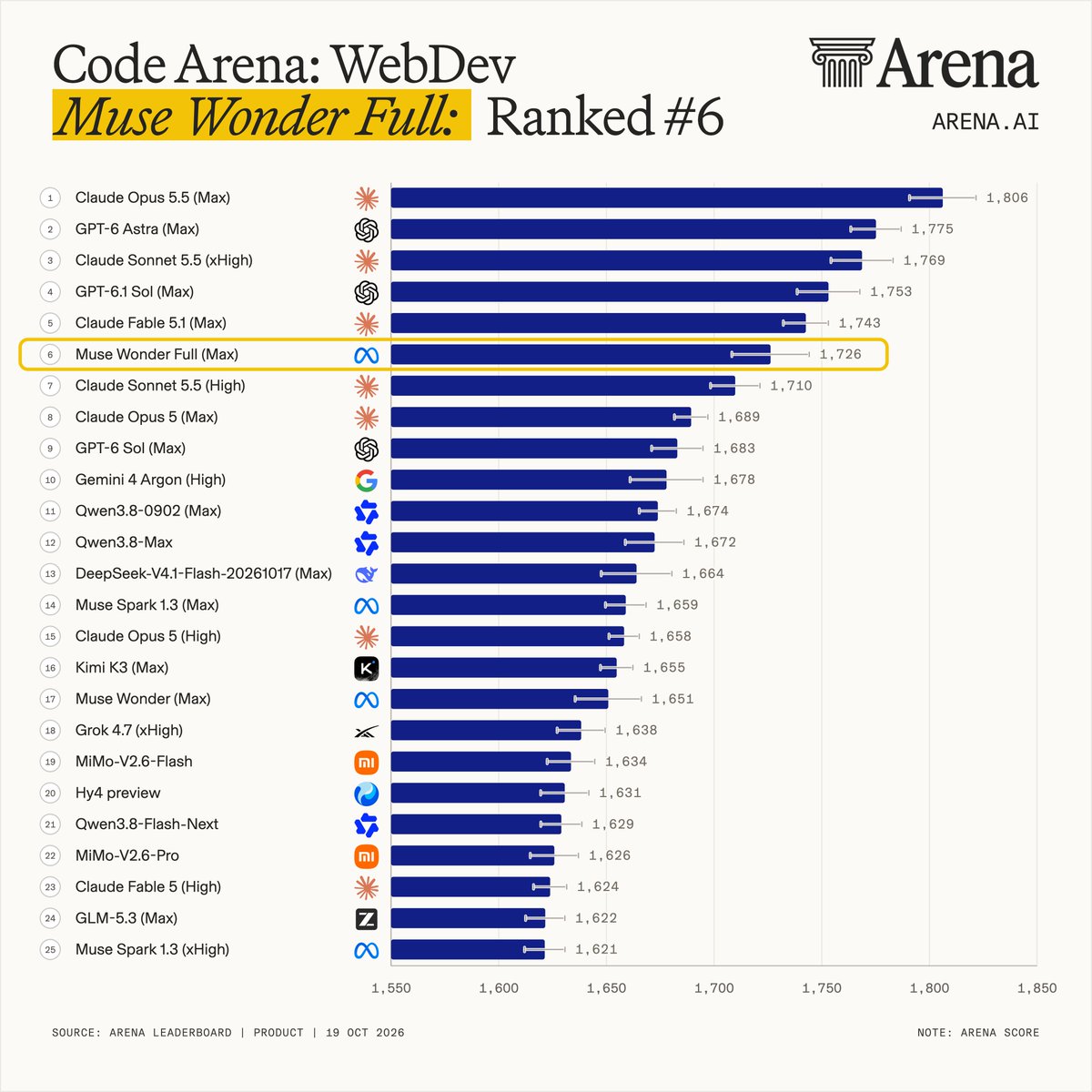
Meta Unveils Gigawatt-Scale Prometheus Supercluster as Muse Wonder Secures #6 on WebDev Code Arena

Meta officially disclosed its gigawatt-scale AI supercluster Prometheus in New Albany, Ohio, housing hundreds of thousands of frontier GPUs with 85%+ pretraining goodput and 90%+ in reinforcement learning. Powered by this infrastructure, Meta's latest coding flagship Muse Wonder Full surged to #6 globally on LMSYS Code Arena: WebDev with 1726 Elo points (surpassing Claude Sonnet 5.5 and Gemini 4 Argon), lifting Meta to the #3 AI research lab worldwide.

Meta Unveils Gigawatt-Scale Prometheus Supercluster as Muse Wonder Secures #6 on WebDev Code Arena

Key Takeaways

  • Meta unveiled its gigawatt-scale Prometheus supercluster in Ohio with hundreds of thousands of GPUs, delivering 85%+ pretraining goodput
  • Exceeded 90%+ goodput on RL workloads, recording ~47,000 GPU-hours MTBF during Muse Wonder's training cycle
  • Muse Wonder Full scored 1726 Elo on LMSYS Code Arena: WebDev (#6 globally), outperforming Claude Sonnet 5.5 (+16) and Gemini 4 Argon (+48)
  • Elevated Meta to the #3 AI lab worldwide; confirmed Muse Glimmer 30B open weights capable of 4-bit local execution on a single consumer GPU
Read full story
Linked Models & Agents:
ADSponsored

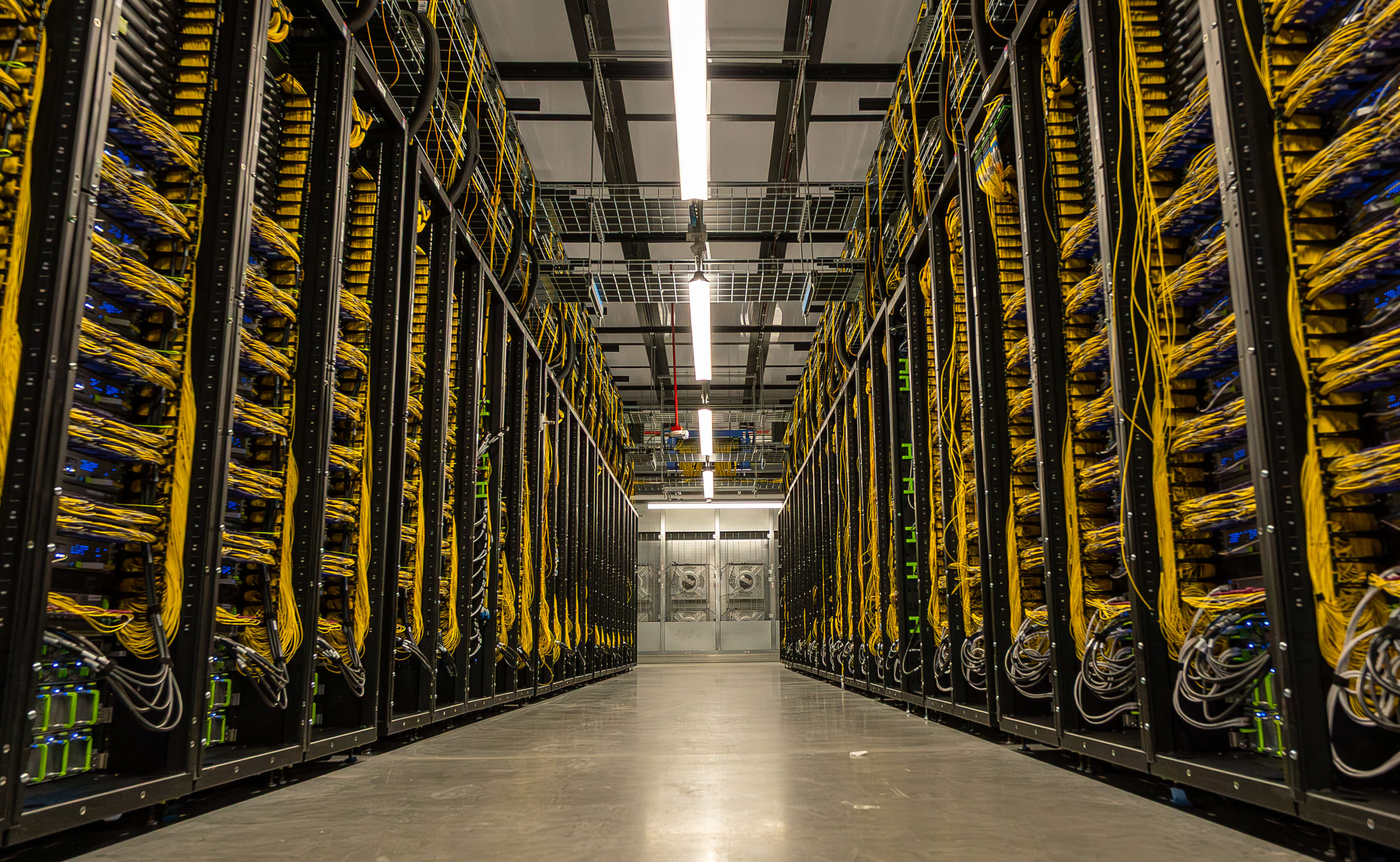
Meta details Prometheus, the gigawatt-scale supercluster that trained Muse Wonder: 85%+ pretraining goodput, 90%+ for RL, scaling toward ~1M GPUs

Meta's engineering blog on October 19 gave the first detailed look at Prometheus, the New Albany, Ohio supercluster that trained the Muse family, including Muse Wonder. Phase one is complete with hundreds of thousands of GPUs, and the full build targets about 1 million. Muse Wonder training reached more than 85% goodput in pretraining and more than 90% in reinforcement learning, with a mean time between interruptions of about 47K GPU hours, since raised above 54K by firmware fixes. It runs GB200 NVL72 and GB300 NVL72 platforms, with Vera Rubin NVL72 arriving soon.

Meta details Prometheus, the gigawatt-scale supercluster that trained Muse Wonder: 85%+ pretraining goodput, 90%+ for RL, scaling toward ~1M GPUs

Key Takeaways

  • Scale: phase one trained the Muse family; it has hundreds of thousands of GPUs today, targets about 1 million, and runs across buildings as a single machine.
  • Reliability: Muse Wonder hit 85%+ pretraining goodput and 90%+ for RL; MTBI was about 47K GPU hours and is now above 54K.
  • Interruptions: a mid-2025 peak of nearly 1,000 events per 8K GPUs per day was cut by 99% over a year of engineering.
  • Sparing: each NVL72 rack runs a 64-GPU slice with 8 in-rack spares, plus about 2% spare racks; a 32,768-GPU job needs 523 racks or 37,656 GPUs, about 13% extra.
  • Network: each building fabric links up to 20,736 GPUs, and the aggregation network spans 2 km to over 100 km.
Read full story

Modal will run agent Sandboxes on NVIDIA Vera CPUs: up to 2x the throughput of comparable x86 under heavy load

Modal said in an October 19 blog post that it will add NVIDIA's Arm-based Vera CPU to power Modal Sandboxes, its first step beyond an all-x86 fleet. Using Agentless Agent Bench, a 50-task suite built from Terminal-Bench, Modal measured up to 2x the task throughput of a comparable x86 GNR machine under heavy concurrency, with per-task latency equal or lower (vendor figures). On an idle host running tasks serially, Vera's edge was small. The capacity targets background coding agents and reinforcement learning rollouts.

Modal will run agent Sandboxes on NVIDIA Vera CPUs: up to 2x the throughput of comparable x86 under heavy load

Key Takeaways

  • Throughput: under heavy concurrency Vera reached up to 2x the task throughput of a comparable x86 GNR machine, with per-task latency equal or lower (Modal early tests, vendor figures).
  • Benchmark: Agentless Agent Bench uses 50 Terminal-Bench oracle solutions and verifiers with network calls removed, isolating CPU work such as compilation, grep, git and device emulation.
  • Idle serial runs: across the 50 tasks Vera was often but not always faster, and not by a large margin; the gap opens under contention.
  • Why: Modal credits Vera's high memory bandwidth for packing more containers per core without throttling; x86 alternatives plateaued earlier as CPU counts rose.
  • Rollout: this is Modal's first Arm support and needs infrastructure and image-build changes; no launch date or pricing was announced.
Read full story

Stanford & UC Berkeley Introduce Librarian Agents: Training LLMs to Proactively Curate Workspaces, Cutting Navigation Costs by 33.8%

Researchers from Stanford University and UC Berkeley introduced Librarian Agents (arXiv:2610.22273). To overcome the bottleneck of reactive RAG methods struggling with complex cross-document reasoning at query time, the framework uses reinforcement learning to train LLMs to perform anticipatory directed curation on messy long-context workspaces into structured synthetic filesystems. On BrowseComp+, it hits 55.86% accuracy while reducing navigation token consumption by 33.8% to 51%.

Stanford & UC Berkeley Introduce Librarian Agents: Training LLMs to Proactively Curate Workspaces, Cutting Navigation Costs by 33.8%

Key Takeaways

  • Stanford and UC Berkeley introduced Librarian Agents (arXiv:2610.22273), replacing reactive RAG with anticipatory directed workspace curation
  • Uses reinforcement learning to train builder agents to restructure raw documents into modular synthetic filesystems via CreateFile and MergeFiles
  • Achieves 55.86% accuracy on BrowseComp+ with only 3,635 navigation tokens, cutting navigation token costs by 51% compared to flattened workspaces
  • Reduces tokens per correct answer by 33.8% at 10 queries per corpus, establishing an amortized curation paradigm for repeatedly queried knowledge bases
Read full story
Linked Models & Agents:

Breaking GRPO Exploration Collapse: SERO Executable Oracle Continuations (+11.2 pts on ALFWorld OOD) and EDEN Anchored Embedding Noise (+13.3 pts on AIME 2025)

Addressing rollout homogenization and zero-variance advantage collapse in group-relative reinforcement learning (GRPO), SERO (arXiv:2610.19397) restores learner-visited states to execute multi-step oracle continuations with policy-reachability weighting—boosting 7B ALFWorld OOD success by +11.20 points to 87.50%—while UNSW's EDEN (arXiv:2610.16105) appends a single anchored Gaussian-perturbed embedding position to a fraction of rollouts, lifting Qwen2.5-Math-7B AIME 2025 Pass@256 by +13.33 points (to 66.67%) without increasing rollout budgets.

Breaking GRPO Exploration Collapse: SERO Executable Oracle Continuations (+11.2 pts on ALFWorld OOD) and EDEN Anchored Embedding Noise (+13.3 pts on AIME 2025)

Key Takeaways

  • SERO restores learner-visited states and executes multi-step oracle continuations with policy-reachability weighting, boosting 7B ALFWorld unseen success by +11.20 points to 87.50% (95.57% seen)
  • UNSW's EDEN appends a single anchored Gaussian-perturbed embedding position to a fraction of rollouts, beating G=32 standard GRPO using only G=16 rollouts
  • On AIME 2025, EDEN lifts Qwen2.5-Math-7B Pass@256 by +13.33 percentage points (from 53.33% to 66.67%) while preserving diverse multi-derivation reasoning traces
Read full story
Linked Models & Agents:

Mosaic: Multi-Session Agentic Reinforcement Learning for Context Compaction and Subagent Forking

Standard agentic reinforcement learning assumes single-session trajectories with continuously accumulated context, clashing with production agent techniques like context compaction and subagent forking. Researchers introduce Mosaic (arXiv:2610.22174), a critic-free hierarchical optimization framework for Multi-Session Agentic RL. By incorporating session-usage signals at the trajectory level and shaping per-session advantages by marginal contribution, Mosaic outperforms trajectory-level broadcasting on BrowseComp across both compaction and subagent scenarios while using fewer sessions.

Mosaic: Multi-Session Agentic Reinforcement Learning for Context Compaction and Subagent Forking

Key Takeaways

  • Bridges single-session RL and multi-session inference: formalizes Multi-Session Agentic RL for context compaction and subagent forking workflows
  • Critic-free hierarchical advantage shaping: combines trajectory-level session-usage signals with session-level marginal contribution estimation
  • Higher accuracy with fewer sessions: outperforms trajectory-level broadcasting on BrowseComp across both compaction and subagent scenarios
Read full story