AI Coding Live News

SemiAnalysis releases GDPx, an agentic benchmark of 206 tasks across 11 high-value domains where the top model, Claude Opus 5.5, scores just 12%

On Nov 2, semiconductor and AI research firm SemiAnalysis released GDPx, a benchmark of agentic capability across 11 domains: chip design, cybersecurity, biology, finance, legal, quant trading, recursive self-improvement (RSI), hardware design, materials science, alignment and software engineering. Its 206 tasks were built by 14 specialist data partners, with SemiAnalysis doing final QA. On the official leaderboard Claude Opus 5.5 leads at 12.0%, followed by Gemini 4 Carbon at 10.9% and GPT-6 Astra at 9.6%; nearly every model scores 0 on finance and legal. SemiAnalysis says safety classifiers drag down Opus 5.5 and GPT-6 Astra, and plans a new version every 3–6 months. All scores are as reported by SemiAnalysis.

SemiAnalysis releases GDPx, an agentic benchmark of 206 tasks across 11 high-value domains where the top model, Claude Opus 5.5, scores just 12%

Key Takeaways

  • Scale: 11 domains, 14 data partners and 206 tasks, with a default time limit of 8 hours per task (GDPx site)
  • Leaderboard (as reported by SemiAnalysis): Claude Opus 5.5 12.0%, Gemini 4 Carbon 10.9%, GPT-6 Astra 9.6%, Muse Wonder Full 9.0%, Claude Fable 5.1 8.5%, GPT 6.1 Sol 8.4%, Claude Sonnet 5.5 8.2%
  • Lower tier and open weights: DeepSeek 4.1 Flash 1017 5.4%, GPT-6 Luna 5.1%, Grok 4.7 3.9%, GLM 5.3 2.7%; almost every model scores 0 on finance and legal
  • Method: each model runs in its native harness where one exists (Claude Code for Opus, Codex for Astra, Antigravity for Carbon), otherwise OpenCode; the headline is pass@1 over three attempts with all domains weighted equally (SemiAnalysis blog)
  • By domain: Opus 5.5 wins quant trading, hardware and chip design; Gemini 4 Carbon wins biology and software engineering; GPT-6 Astra wins RSI and materials science; Muse Wonder Full is the strongest cyber model
Read full story

SemiAnalysis Releases Landmark Datacenters 2027 Report: +50GW in a Single Year, $1.3T in Lease Contracts, and Shifting Supply Bottlenecks

SemiAnalysis published its major forward-looking industry analysis 'Datacenters 2027: The Year of Acceleration'. The report reveals an unprecedented +50GW of capacity added in a single year, 60GW under construction, and over $1.3T in signed lease contracts year-to-date. As massive power and real-estate infrastructure projects come online by 2027, the primary bottleneck in the AI supply chain is projected to pivot from grid power back to leading-edge accelerator silicon.

SemiAnalysis Releases Landmark Datacenters 2027 Report: +50GW in a Single Year, $1.3T in Lease Contracts, and Shifting Supply Bottlenecks

Key Takeaways

  • SemiAnalysis published its major report 'Datacenters 2027: The Year of Acceleration'
  • Reveals 60GW currently under construction globally, with +50GW of capacity projected to deliver in 2027 alone
  • Discloses over $1.3 Trillion in signed datacenter lease contracts year-to-date across major hyperscalers
  • Projects that once gigawatts of power come online, the primary AI infrastructure bottleneck will swing back to advanced accelerator silicon
Read full story
Linked Models & Agents:

SemiAnalysis Discloses Google & Inferact TPUv7 Submission: TorchTPU vLLM Megakernels Drive 2.8T Kimi K3, Surpassing GB200 NVL72 and B300 in High-Interactivity TCO

SemiAnalysis revealed the first Google TPUv7 benchmark submission for the 2.8T Kimi K3 MoE model, led end-to-end by Inferact (the creators of vLLM) and Google using the TorchTPU vLLM stack. At a hardware rental cost of just $1.21/chip-hour (vs $2.31 for GB300 and $1.86 for GB200), TPUv7 delivers ~2.2M tokens per $1 TCO in the ultra-high interactivity regime (~390 tok/s/user), outpacing NVIDIA GB200 NVL72, B300, and AMD MI355X on cost-performance.

SemiAnalysis Discloses Google & Inferact TPUv7 Submission: TorchTPU vLLM Megakernels Drive 2.8T Kimi K3, Surpassing GB200 NVL72 and B300 in High-Interactivity TCO

Key Takeaways

  • Inferact (creators of vLLM) and Google submitted their first preliminary TPUv7 benchmark for the 2.8T Kimi K3 MoE model
  • TPUv7 chip rental sits at $1.21/hour, significantly below GB300 ($2.31), B300 ($2.26), and GB200 ($1.86)
  • Delivers ~2.2M tokens per $1 TCO at ~390 tok/s/user, beating NVIDIA GB200 NVL72, B300, and AMD MI355X in the ultra-high interactivity regime
  • Built with fused TorchTPU vLLM megakernels and the TPU-Sync KVCache offload library for production PD disaggregation
Read full story
Linked Models & Agents:

Kimi K3 Hits 842 tok/s on NVIDIA GB300 NVL72: NVIDIA and vLLM Unveil 12,000-Line CuTe DSL Decode Megakernel with 1.8x Higher AgentX Interactivity

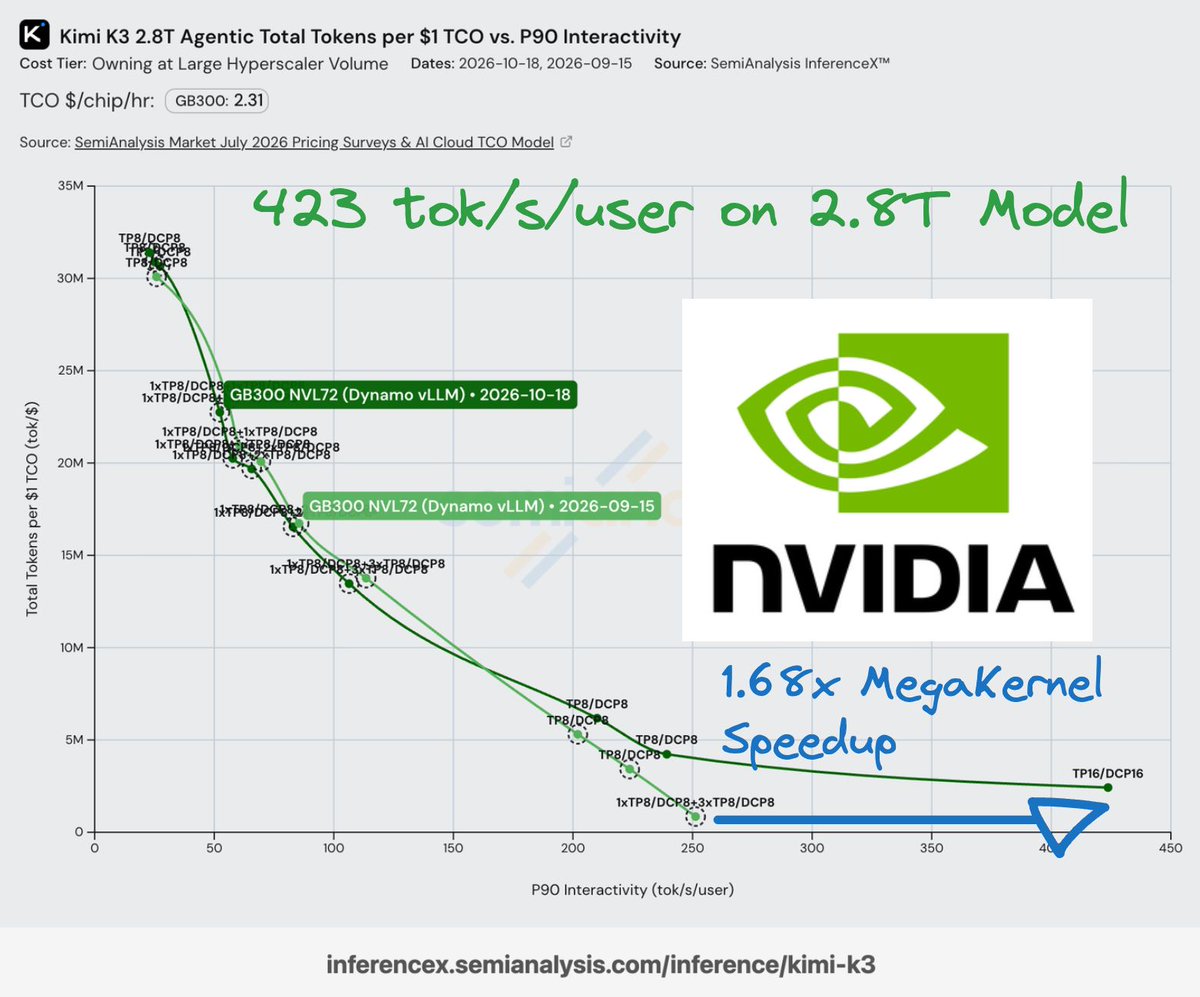
vLLM and NVIDIA unveiled a unified CuTe DSL decode megakernel (~12,000 LoC authored by NVIDIA CentML's Benjamin Chislett) for Moonshot AI's frontier Kimi K3 model on NVIDIA GB300 NVL72. By fusing attention, MoE, and cross-GPU communication, the optimization cuts per-layer latency from 130 µs (23 kernels) to 69 µs (13 kernels), delivering 842 tokens/s at batch=1 with DSpark speculative decoding (1.73x faster than stock vLLM) and up to 1.8x higher P90 per-user interactivity (403.2–423 tok/s/user) on SemiAnalysis AgentX, with DeepSeek-V4.1-Flash (PR #61868) and GLM-5.3 support coming next.

Kimi K3 Hits 842 tok/s on NVIDIA GB300 NVL72: NVIDIA and vLLM Unveil 12,000-Line CuTe DSL Decode Megakernel with 1.8x Higher AgentX Interactivity

Key Takeaways

  • NVIDIA and vLLM introduce a 12,000-line CuTe DSL decode megakernel for the 2.8T-parameter Kimi K3, reducing per-layer execution from 23 kernels (130 µs) to 13 kernels (69 µs)
  • On 16x NVIDIA GB300 NVL72 GPUs, batch-1 decode hits 842 tok/s with DSpark speculative decoding (1.73x faster) and 256.4 tok/s without speculation (1.88x faster)
  • Delivers up to 1.8x higher P90 interactivity (403.2-423 tok/s/user) on SemiAnalysis AgentX, with DeepSeek-V4.1-Flash (vLLM PR #61868) and GLM-5.3 megakernels following next
Read full story
Linked Models & Agents:
ADSponsored

Ollama Cloud Launches US/EU Zero-Data-Retention Hosting for DeepSeek-V4.1-Flash-1017 with Claude Code CLI, While SemiAnalysis Reveals GLM-5.3 Was Built 100% via Post-Training

Ollama launched US- and EU-hosted Ollama Cloud with strict zero data retention and zero training, adding immediate support for DeepSeek-V4.1-Flash-1017 via one-line launch commands for Claude Code and OpenCode alongside Ollama v0.40.6. Meanwhile, SemiAnalysis revealed that GLM-5.3 was built entirely by post-training the previous GLM-5.2 base model without pretraining from scratch, achieving a 'night and day difference' in cybersecurity and agentic capabilities.

Ollama Cloud Launches US/EU Zero-Data-Retention Hosting for DeepSeek-V4.1-Flash-1017 with Claude Code CLI, While SemiAnalysis Reveals GLM-5.3 Was Built 100% via Post-Training

Key Takeaways

  • Ollama Cloud launches US- and EU-hosted zero-data-retention serving for DeepSeek-V4.1-Flash-1017 with one-line ollama launch integrations for Claude Code and OpenCode
  • Ollama v0.40.6 adds GGUF q2_0 tensor support, clef cloud integration, and fixes orphaned runner processes on Windows
  • SemiAnalysis reveals GLM-5.3 was built entirely by post-training the previous model without pretraining from scratch, delivering a 'night and day difference' in cyber capabilities over GLM-5.2
Read full story
Linked Models & Agents:

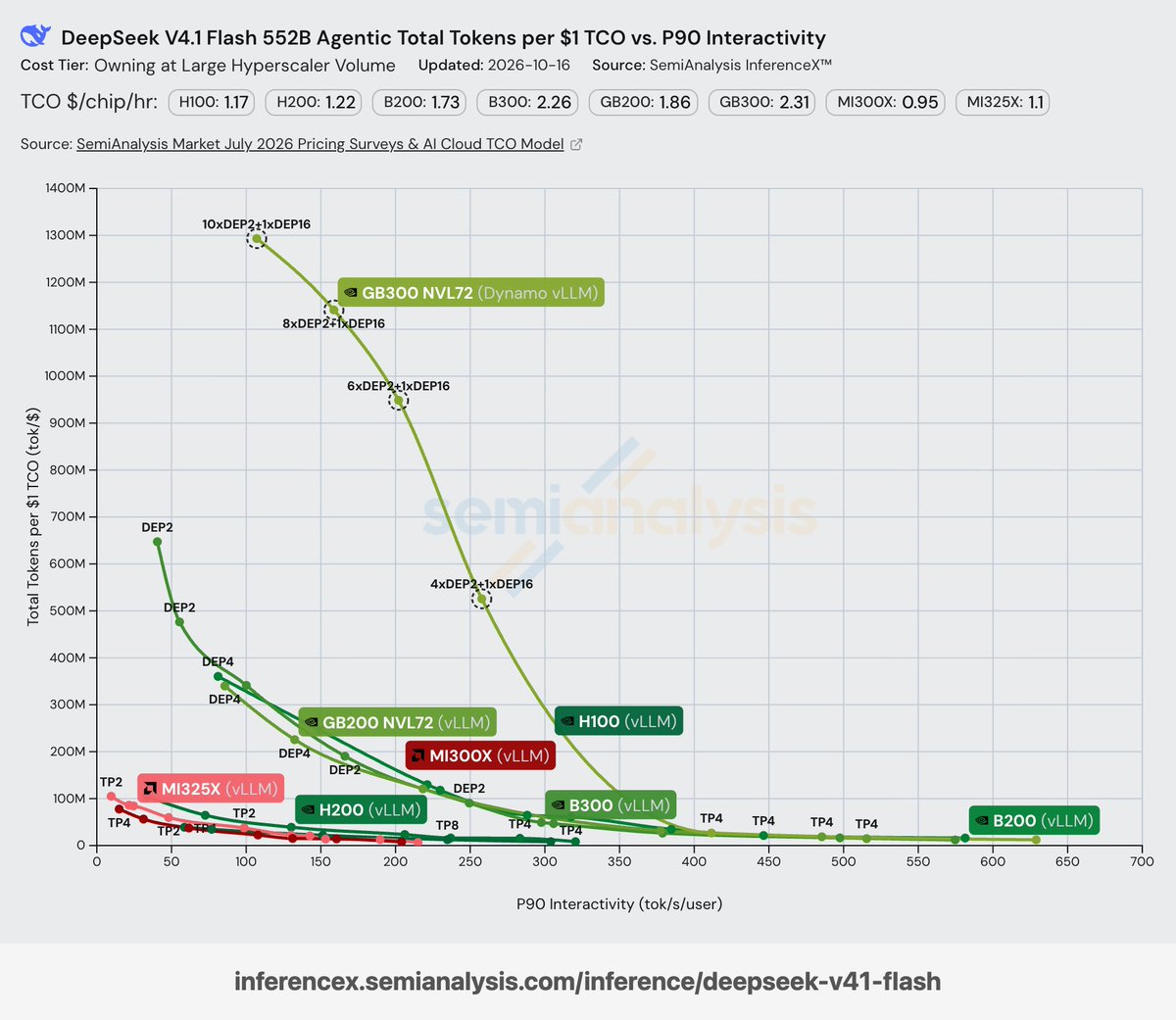
SemiAnalysis Breaks Down 1.3B Tokens/$ AgentX Record: vLLM + Inferact Disaggregated Serving Beats Aggregated B300 by 4x, While Cline Highlights Multi-Harness RL

SemiAnalysis published the architectural breakdown behind the 1.3B tokens per dollar TCO record on AgentX: vLLM and Inferact utilized Prefill/Decode disaggregated serving at hyperscaler volume pricing to achieve 4x better cost-efficiency than an aggregated NVIDIA B300 configuration. Concurrently, open-source coding agent Cline reported that DeepSeek-V4.1-Flash-1017 beats GPT-5.6-Sol on Terminal-Bench at ~17x lower cost (+35% over prior V4.1-Flash) purely by scaling RL training across multiple coding agent harnesses.

SemiAnalysis Breaks Down 1.3B Tokens/$ AgentX Record: vLLM + Inferact Disaggregated Serving Beats Aggregated B300 by 4x, While Cline Highlights Multi-Harness RL

Key Takeaways

  • SemiAnalysis confirms vLLM and Inferact achieve 1.3B tokens per dollar TCO on AgentX via disaggregated serving—4x better than an aggregated NVIDIA B300 configuration
  • Cline reports that DeepSeek-V4.1-Flash-1017 improves prior V4.1-Flash Terminal-Bench performance by 35%, beating GPT-5.6-Sol at ~17x lower cost
  • The 35% agentic coding leap was achieved without base algorithmic changes by scaling reinforcement learning directly across multiple coding agent harnesses
Read full story
Linked Models & Agents:

vLLM and OpenRouter Launch Day-0 Serving for DeepSeek-V4.1-Flash-1017: 830K tok/s per GPU and 1.3B Tokens/$ TCO on SemiAnalysis AgentX

Following the release of DeepSeek-V4.1-Flash-1017, vLLM announced Day-0 serving optimization delivering 1.3B tokens per dollar TCO and 830K tok/s per GPU at 100 tok/s/user on SemiAnalysis AgentX (5x agentic throughput gain since Day 0), while OpenRouter launched live multi-provider routing starting at $0.10/M input and $0.50/M output tokens.

vLLM and OpenRouter Launch Day-0 Serving for DeepSeek-V4.1-Flash-1017: 830K tok/s per GPU and 1.3B Tokens/$ TCO on SemiAnalysis AgentX

Key Takeaways

  • vLLM delivers 830K tok/s per GPU (cached + input + output) at 100 tok/s per user and 1.3B tokens/$ TCO on SemiAnalysis AgentX for DeepSeek-V4.1-Flash-1017 (5x faster since Day 0)
  • DeepSeek-V4.1-Flash-1017 reaches 77.0% on DeepSWE v1.1 (beating Claude Opus 5 at 74.0%), 68.2% on NL2Repo-Bench, and 72.1% on Apex Bench with shorter agentic outputs
  • Live on OpenRouter from $0.10/M input and $0.50/M output tokens, while DeepSeek's official API alias deepseek-flash remains at $0.15/M input and $0.60/M output
Read full story
Linked Models & Agents:

vLLM adds NVIDIA Vera Rubin NVL72 support: up to 7.84x per-GPU throughput over GB200 on AgentX with MiniMax M3

On Oct 9 the vLLM team, with Inferact, Red Hat and NVIDIA, shipped early Vera Rubin NVL72 support: CUDA 13.4 nightly images already serve DeepSeek, Kimi, GLM and MiniMax. Vendor-reported results: up to 7.84x per-GPU throughput vs GB200 on SemiAnalysis AgentX (MiniMax M3, matched interactivity) and up to 3.7x vs GB300 NVL72 on the MLPerf Inference v6.1 VLM benchmark (Qwen3-VL-235B-A22B).

vLLM adds NVIDIA Vera Rubin NVL72 support: up to 7.84x per-GPU throughput over GB200 on AgentX with MiniMax M3

Key Takeaways

  • Versus GB200 NVL72: 5x NVFP4 FLOPS, ~2.4x HBM4 bandwidth, 1.7x bidirectional NVLink, 2–4x faster softmax exponentials (vLLM blog)
  • AgentX with MiniMax M3: up to 7.84x per-GPU throughput at matched interactivity, 5.18x under a 150 TPS cap (vendor-reported, early)
  • MLPerf Inference v6.1: Qwen3-VL-235B-A22B on vLLM + Dynamo, up to 3.7x vs GB300 NVL72
  • CUDA 13.4 locality domains split MoE weights for ~1.2x average MoE-layer speedup in small-token decode
  • Image: vllm/vllm-openai:cu134-nightly (CUDA 13.4 + PyTorch 2.15)
Read full story

SemiAnalysis AgentX: AMD MI355x beats B300 on tokens/$ TCO at lower interactivity

SemiAnalysis reports that on AgentX (multi-turn, long-context agent workloads), a new AMD MI355x submission beats B300 on total tokens-per-dollar TCO at lower interactivity ranges, shouting out vLLM, AMD, and LMCache engineers—useful signal for agentic serving hardware choices.

Key Takeaways

  • Benchmark: AgentX targets multi-turn, long-context agent traffic.
  • Result: AMD MI355x beats B300 on tokens/$ TCO at lower interactivity.
  • Stack: shoutout to vLLM, AMD, and LMCache on agentic serving work.
Read full story
Linked Models & Agents: