AI Coding Live News

OpenAI Details Pando, Its In-House Git Backend: Median Push Latency Down Nearly 5x, Nearly 1 PB Served Daily, Built With Codex in 10 Weeks

On November 2 OpenAI published "Scaling Git at OpenAI", describing Pando, a Git-compatible backend it built for its monorepo. Per OpenAI, Pando cut median push latency by nearly 5x (about 80%), now delivers nearly a petabyte of Git data per day, and has served more than 57 TB in a single hour. It is written in Rust, its core was designed by one engineer and implemented by teams of Codex agents, and it went from kick-off to production in 10 weeks, serving production traffic since April. The trigger: Codex multiplied parallel branches and pushes, and the old system's reliability at times fell below 90%.
OpenAI Details Pando, Its In-House Git Backend: Median Push Latency Down Nearly 5x, Nearly 1 PB Served Daily, Built With Codex in 10 Weeks

Key Takeaways

  • Per OpenAI: median push latency down nearly 5x (about 80%), nearly 1 PB of Git data delivered per day, and a peak of more than 57 TB in one hour, with over 99% of bytes from local disk cache.
  • The trigger: Codex let engineers run far more branches and CI jobs in parallel; the old system struggled from late last year, with reliability at times below 90%.
  • The key trade-off: Pando drops repository-wide consistency for per-branch causal consistency and reuses pushed packfiles, stored as immutable blobs, to serve later fetches.
  • Written in Rust, core designed by one engineer and implemented by teams of Codex agents in 10 weeks; agents using GPT-6 Astra also wrote Lean and TLA+ specs to find bugs and prove properties.
  • Several improvements, such as packfile-uri fixes, are already in upstream Git, and OpenAI says it is exploring ways to share the technology with users.
Read full story

X Discussion: Elon Musk Says Grok Bot Serving Costs Were Unsustainably High Relative to Revenue; Replit CEO Amjad Masad Warns Subsidized AI Subscriptions Face a Rug Pull

After users on X complained that their Grok Bot usage ran out early this cycle, Elon Musk replied that "the cost of serving Grok Bot was unsustainably high relative to revenue", a reply with about 13K likes and 5.5M views. Replit CEO Amjad Masad then quoted the news, saying people enjoying subsidized AI subscriptions should "get ready to get rug pulled", sparking a debate over whether flat-rate AI plans can last. This is an X discussion with personal views; xAI has not published a formal pricing or limit announcement.

Key Takeaways

  • Trigger: user @DogecoinNorway said their Grok Bot usage hit 100% with 4 days left until reset, a post with about 1.24M views.
  • Musk replied that the cost of serving Grok Bot was unsustainably high relative to revenue, with about 13.2K likes, 5.51M views and 1,900+ quotes.
  • Amjad Masad (Replit CEO) quoted it, warning subsidized AI subscriptions are about to get rug pulled, with about 2,347 likes and 146K views; in replies he said Replit never subsidized.
  • xAI has not published a formal limit or pricing change; rely on official notices for specifics.
Read full story

Tencent Hunyuan open-sources Hy-SimulMT, a Chinese-English real-time simultaneous interpreting model with ~3s lag and live voice cloning

On Oct 26 Tencent Hunyuan (Tencent Hy) open-sourced Hy-SimulMT, a real-time simultaneous interpreting model for bidirectional Chinese-English speech-to-speech translation. It translates while the speaker talks, outputs both translated text and speech, and can clone the speaker's voice in real time. Six checkpoints landed on Hugging Face (30B-A3B translation-only and source-plus-translation Interleave variants, each in BF16, FP8 and GGUF), with the model card listing Apache-2.0; GitHub ships the SimulInfer serving stack and SimulTrain training tools. Vendor-reported: about 3s StreamLAAL on RealSI long-form audio, the lowest among compared systems.

Tencent Hunyuan open-sources Hy-SimulMT, a Chinese-English real-time simultaneous interpreting model with ~3s lag and live voice cloning

Key Takeaways

  • Size and variants: 30B-A3B MoE (about 3B active), six checkpoints: translation-only and Interleave (source plus translation), each in BF16, FP8 and GGUF (Hugging Face collection)
  • Latency (vendor-reported): about 3s StreamLAAL on RealSI long-form audio, the lowest among compared systems, with a GEMBA quality score above the compared open models and 4 of 5 commercial APIs
  • Short-form (vendor-reported): FLEURS 90.3, CoVoST2 75.5, ACL6060 81.2, RealSI-Sentence 84.7, the last being the top score in the table; Qwen3.8-LiveTranslate scores 88.4/82.1/80.5/84.4 in the same table
  • Human comparison: 18 real Chinese and English recordings of about 6 minutes each against 6 CATTI Level 1/2 interpreters; Tencent says quality was on par with often lower latency, and notes the result only covers this small test
  • Deployment: one SimulInfer deploy.sh command starts vLLM (>=0.31) plus a web/WebSocket service; speech output and voice cloning need a separate TTS service; llama.cpp support is not yet merged upstream (SimulInfer docs)
Read full story
Linked Models & Agents:
⚡ Hy-SimulMT-30B-A3B⚡ Hy-SimulMT-30B-A3B-Interleave⚡ Qwen3.8-LiveTranslate🌐 Tencent

Cache Engineering for Agents: Tsinghua and CUHK Introduce AKV Paradigm Cutting Inference Costs by 27.7%

Researchers from Tsinghua University and CUHK introduced a breakthrough paper titled 'Cache Engineering for Agents' (arXiv:2610.28577) alongside the open-source AKV serving engine (thu-nics/AKV). While multi-turn agents rely on traditional 'context engineering' (text trimming and summarization) that invalidates prefix KV-caches and incurs punishing re-prefilling overhead, cache engineering empowers agents to directly manipulate KV-cache states via 'drop' and 'repos' primitives. Coupled with AKV's drop-aware radix-tree engine, the framework slashes agent inference costs by 27.7%, accelerates P95 latency by 1.5x, and boosts benchmark solve scores by 1.7 points.

Cache Engineering for Agents: Tsinghua and CUHK Introduce AKV Paradigm Cutting Inference Costs by 27.7%

Key Takeaways

  • Tsinghua and CUHK researchers formalize 'Cache Engineering' in arXiv:2610.28577 for multi-turn autonomous agents
  • Demonstrates how traditional prompt trimming destroys prefix cache reuse, causing massive latency and redundant re-prefilling
  • Introduces 'drop' (selective cache eviction) and 'repos' (RoPE position alignment) primitives directly on GPU KV-caches
  • Open-sources the AKV stateful serving engine (thu-nics/AKV), slashing agent serving costs by 27.7% while accelerating P95 latency by 1.5x
Read full story
ADSponsored

SGLang Introduces Elastic EP with NIXL: Dynamic Live MoE Scaling Without Restarts or Traffic Draining

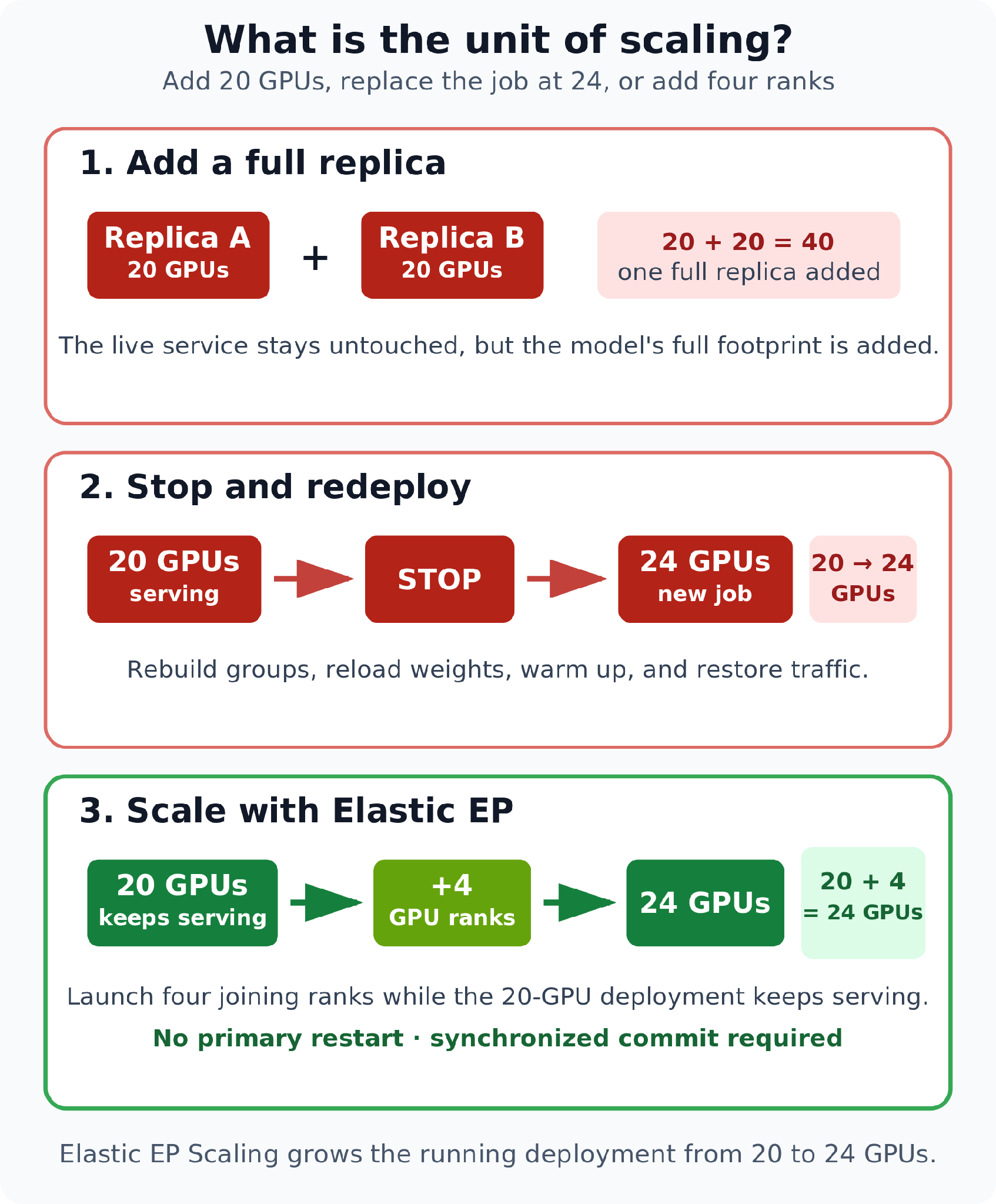
LMSYS Org in collaboration with the NVIDIA Dynamo team officially unveiled Elastic Expert Parallelism (Elastic EP) with NIXL backend integration in SGLang (@lmsysorg). Addressing the critical vulnerability of large-scale MoE deployments (such as DeepSeek-V3/V4) where static EP causes entire cluster crashes upon single-node failures and prevents live capacity resizing, Elastic EP decouples rigid expert-to-GPU bindings. Leveraging NVIDIA NIXL device APIs and Mooncake orchestrators, SGLang enables live scaling of active MoE serving deployments (e.g. dynamically expanding from 20 to 24 GPUs) without draining traffic or restarting clusters, while delivering resilient fault tolerance.

SGLang Introduces Elastic EP with NIXL: Dynamic Live MoE Scaling Without Restarts or Traffic Draining

Key Takeaways

  • LMSYS Org and NVIDIA Dynamo team roll out Elastic EP in SGLang, enabling live scaling of production MoE clusters
  • Eliminates the single-point-of-failure bottleneck in static EP deployments, enabling instantaneous fault-tolerant degradation
  • Integrates NVIDIA NIXL device primitives (--moe-a2a-backend nixl) with native RDMA and NVLink zero-copy token routing
  • Demonstrates zero-downtime live expansion, seamlessly growing active deployments (e.g. from 20 to 24 GPUs) under live query load
Read full story

Google Cloud Open-Sources TorchTPU: Native PyTorch on Google TPU Hardware with Day-Zero vLLM and SGLang Support

Google Cloud officially open-sourced TorchTPU, enabling native, zero-compilation-barrier PyTorch execution directly on Google Cloud TPU hardware (TPU v5p and TPU v6e). Overcoming the legacy friction of PyTorch/XLA's rigid graph compilation and dynamic-shape stalls, TorchTPU supports native PyTorch eager execution and custom Triton/C++ kernels. Leading high-throughput serving engines vLLM and SGLang announced immediate Day-0 support. Concurrently, Google Cloud introduced OpenAI models and Codex into its Vertex Model Garden, becoming the first hyperscaler to offer all three top frontier closed models.

Google Cloud Open-Sources TorchTPU: Native PyTorch on Google TPU Hardware with Day-Zero vLLM and SGLang Support

Key Takeaways

  • Google Cloud open-sources TorchTPU, delivering native, compilation-free PyTorch execution on TPU v5p and TPU v6e hardware
  • Eliminates PyTorch/XLA graph-compilation overhead, natively supporting PyTorch eager mode and custom Triton/C++ kernels
  • vLLM and SGLang announce immediate Day-0 TorchTPU releases, unlocking substantial throughput boosts on TPU infrastructure
  • OpenAI frontier models and Codex join Google Cloud's Model Garden, solidifying Google Cloud as the premier multi-model hyperscaler
Read full story

OpenAI Patch the Planet: GPT-5.6 Sol helped find two critical PHP RCE flaws, fixed in PHP 8.5.12, 8.4.27, 8.3.36 and 8.2.35

On Oct 21, PHP published a security advisory fixing two critical unauthenticated remote code execution flaws (CVE-2026-109618, CVE-2026-109619) affecting every PHP install serving web requests, with mod_php at highest risk. OpenAI disclosed the same day that Calif found a flaw using GPT-5.6 Sol under its Patch the Planet initiative, with Wiz independently finding and reporting both; OpenAI coordinated a two-month disclosure and committed $1B in subsidized Daybreak access for under-resourced defenders.

OpenAI Patch the Planet: GPT-5.6 Sol helped find two critical PHP RCE flaws, fixed in PHP 8.5.12, 8.4.27, 8.3.36 and 8.2.35

Key Takeaways

  • Flaws: CVE-2026-109618 (memory corruption via OOM handling) and CVE-2026-109619 (stale global state across requests), both unauthenticated RCE (PHP official)
  • Fix: upgrade to PHP 8.5.12, 8.4.27, 8.3.36 or 8.2.35; PHP says there are no complete mitigations and updating is the only safe choice
  • Scope: PHP-FPM, Apache mod_php, php-cgi, FrankenPHP and LiteSpeed are affected, with a demonstrated exploit on mod_php
  • AI role: Calif found a flaw with GPT-5.6 Sol, Wiz reported both independently; OpenAI coordinated a ~2-month disclosure (vendor account)
  • Investment: OpenAI committed $1B in subsidized Daybreak access and will ship a Codex skill to check PHP versions
Read full story

vLLM and Ant Group Open-Source Humming: Up to 5x Kernel Acceleration and +43.3% MoE Throughput

The vLLM project team and Ant Group officially open-sourced Humming (humming-kernels), a specialized high-performance kernel library designed for serving quantized MoE and dense LLMs at massive scale. Humming natively supports WnA16, W8A8, W4A8, and W4A4 across INT1–INT8 and FP4–FP8 formats, spanning NVIDIA architectures from Turing through Blackwell as well as T-Head Zhenwu 810E silicon. In production benchmarks, Humming kernels outpace cuBLAS by 3–4x at small batch sizes and surpass Marlin by 2x on H200 clusters. Serving DeepSeek-V4.1-Flash across 8x H20 GPUs, Humming drives a +43.3% throughput gain under 64 concurrent requests while reducing time-to-first-token (TTFT) by 32%, pre-integrated directly into vLLM v0.29.0+.

vLLM and Ant Group Open-Source Humming: Up to 5x Kernel Acceleration and +43.3% MoE Throughput

Key Takeaways

  • vLLM and Ant Group open-sourced Humming (humming-kernels), integrated out-of-the-box into vLLM v0.29.0+
  • Covers WnA16, W8A8, W4A8, and W4A4, compiling JIT kernels in just 1.82 seconds versus 23.35 seconds for CUTLASS
  • Serving DeepSeek-V4.1-Flash on 8x H20 GPUs yields a +43.3% throughput boost at 64 concurrency (442 to 634 tokens/sec)
  • Cuts time-to-first-token (TTFT) by 25% to 32% while delivering up to 5x kernel speedups on Blackwell B300 systems
Read full story

vLLM Narrows Gap with DeepInfer to 6% on NVIDIA GB200, Reaching 1M Tokens/s per GPU on GB300

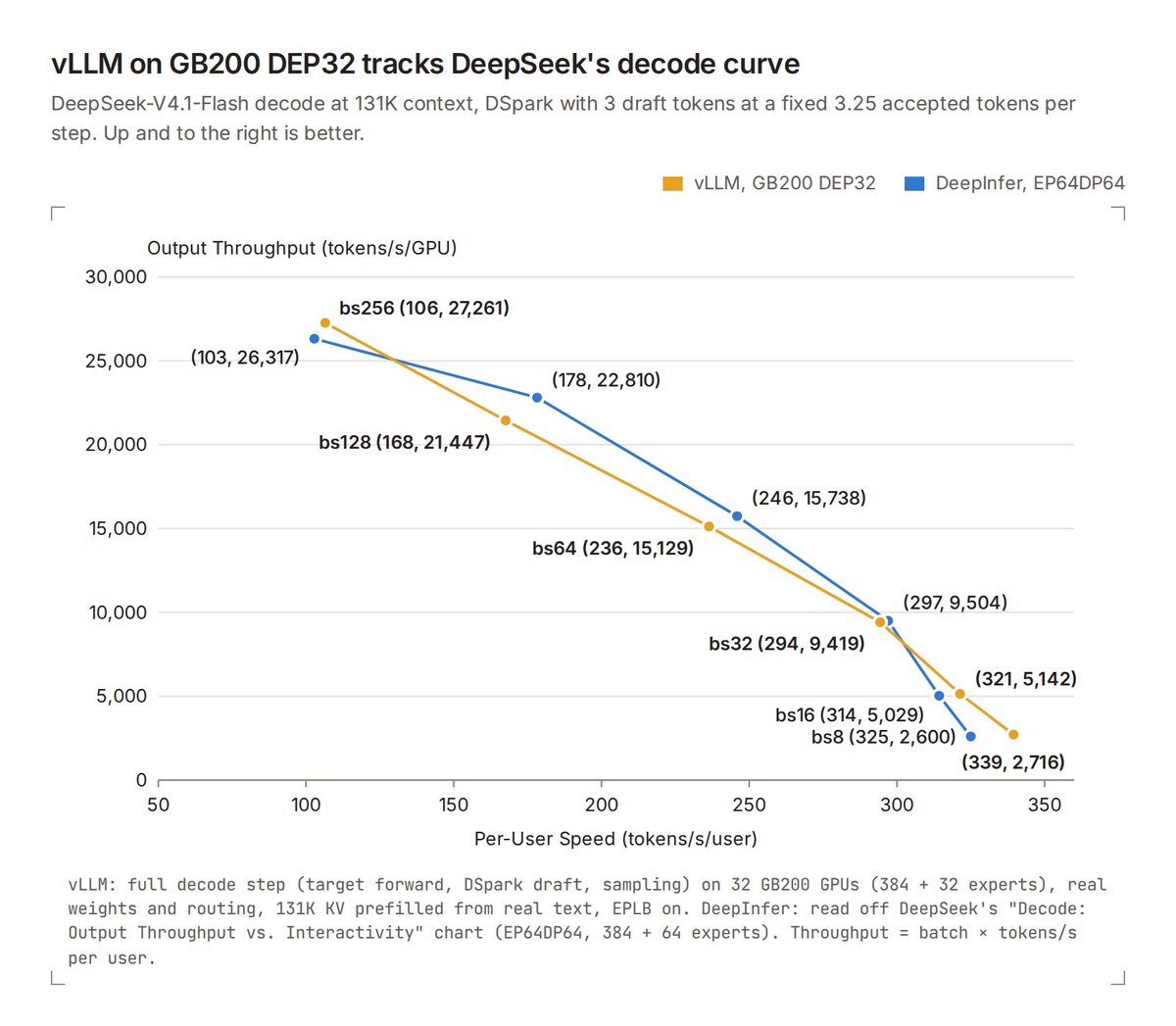
Hours after DeepSeek open-sourced DeepInfer, the vLLM project team released official benchmark parity data serving DeepSeek-V4.1-Flash. Utilizing DeepSeek's identical decoding setup (131K context window, nextn=3 speculative decoding), vLLM closed its throughput performance delta to within 6% of DeepInfer across batch sizes 8 through 256 on NVIDIA GB200 systems. On GB300 hardware, vLLM attained up to 1,000,000 tokens/second per GPU and 826 tokens/second per user, generating $38.96 in hourly GPU revenue at DeepSeek off-peak rates. vLLM simultaneously shipped day-0 runtime support for FastH3-Omni and Spark-X2.6-4B.

vLLM Narrows Gap with DeepInfer to 6% on NVIDIA GB200, Reaching 1M Tokens/s per GPU on GB300

Key Takeaways

  • vLLM published direct benchmark comparisons, demonstrating that its serving throughput on NVIDIA GB200 is within 6% of DeepInfer
  • Achieves unprecedented scaling on NVIDIA GB300: up to 1,000,000 tokens/second per GPU and 826 tokens/second per active user stream
  • Generates up to $38.96 per GPU-hour in revenue when mapped to DeepSeek's production off-peak API pricing schedule
  • Delivers immediate Day-0 support for the FastH3-Omni video model and the 1M-token Apache 2.0 model Spark-X2.6-4B
Read full story
Linked Models & Agents:

DeepSeek Open-Sources DeepInfer Inference Engine: Powering V4.1-Flash at Scale Across NVIDIA SM100 and Huawei Ascend 950

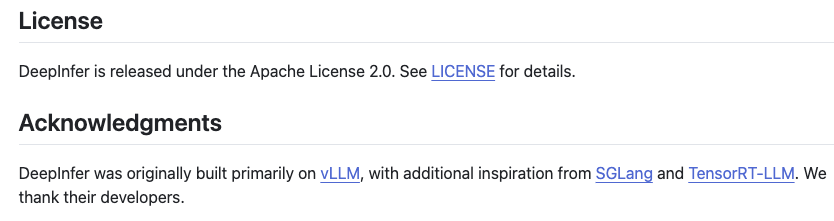
DeepSeek officially open-sourced DeepInfer under Apache 2.0, its production-grade inference engine serving DeepSeek-V4.1-Flash at scale. Originating from vLLM with architectural refinements from SGLang and TensorRT-LLM, DeepInfer natively targets NVIDIA SM100 GPUs and Huawei Ascend 950 NPUs. It integrates specialized kernels including FlashMLA, DeepGEMM, DeepEP, and TileKernels. The engine features DSpark confidence-scheduled speculative decoding with 5-token drafts, SWA bounded replay over a 140-token sliding window, and balanced MoE expert parallelism. DeepSeek simultaneously open-sourced deepseek-recipe, delivering an end-to-end open ecosystem across models, kernels, and inference runtimes.

DeepSeek Open-Sources DeepInfer Inference Engine: Powering V4.1-Flash at Scale Across NVIDIA SM100 and Huawei Ascend 950

Key Takeaways

  • DeepSeek officially open-sourced DeepInfer under Apache 2.0, releasing the production codebase powering DeepSeek-V4.1-Flash at massive scale
  • Natively optimized for both NVIDIA SM100 GPUs and Huawei Ascend 950 NPUs with deterministic, batch-independent output guarantees
  • Integrates custom FlashMLA, DeepGEMM, DeepEP, and TileKernels, alongside DSpark 5-token speculative decoding and 140-token SWA replay
  • Simultaneously released deepseek-recipe, aligning open-source local deployments perfectly with DeepSeek's official production API tokenization
Read full story
ADSponsored

llm-d 1.0 ships: the Kubernetes-native open-source distributed inference stack led by Red Hat, IBM and Google hits production readiness, with vendors reporting 3,000 self-hosted coding agents at 5-10x lower cost than commercial APIs

At PyTorch Conference North America on Oct 20, the CNCF Sandbox project llm-d released version 1.0. It turns inference engines such as vLLM and SGLang into one coordinated serving pool, and 1.0 adds multi-tenant priority and fairness scheduling (flow control), router high availability with zero-downtime rolling upgrades (DisaggregatedSet), a v1 configuration API, and agent-aware session routing with Responses API state. Founded in 2025 by Red Hat, IBM, Google Cloud, CoreWeave and NVIDIA, the project has 500+ contributors, and JetBrains, DigitalOcean and Mistral already run it in production.

llm-d 1.0 ships: the Kubernetes-native open-source distributed inference stack led by Red Hat, IBM and Google hits production readiness, with vendors reporting 3,000 self-hosted coding agents at 5-10x lower cost than commercial APIs

Key Takeaways

  • Scale (Red Hat press release, vendor-reported): GLM 5.2, roughly 753B parameters, on NVIDIA GPUs peaked at 6.6M output tokens per minute and served up to 3,000 concurrent coding agents with zero preemptions, 5-10x cheaper per token than equivalent commercial API pricing at cloud rental rates
  • Cache reuse: IBM says the prefix-aware router captured 97% of available cache reuse on an agentic coding workload; an IBM Research quantum error correction project saw ~98% prefix hits, ~$0.11 per million tokens, and 11.5x lower cost than an all-proprietary setup
  • Google Cloud figures: on Ironwood TPU, prefix-aware routing plus host memory offload cut median time-to-first-token by more than 85% and raised throughput 2.4x on an agentic coding workload; the Gemini platform doubled its prefix cache hit rate from 35% to 70%
  • New in 1.0: flow-control multi-tenant QoS, router hot-standby HA, DisaggregatedSet for coordinated prefill/decode rollouts, a v1 config API, and previous_response_id support in the Responses API
  • Ecosystem: 500+ contributors from 25+ organizations; JetBrains' free Junie Lite, DigitalOcean Serverless Inference and Mistral's tiered commercial traffic run on it; the GitHub v1.0.0 notes admit not every tracked goal shipped
Read full story

vLLM-Omni Integrates PhysisServe: Accelerating Video Diffusion & Physical-World AI with 4.1ms Chunk Output

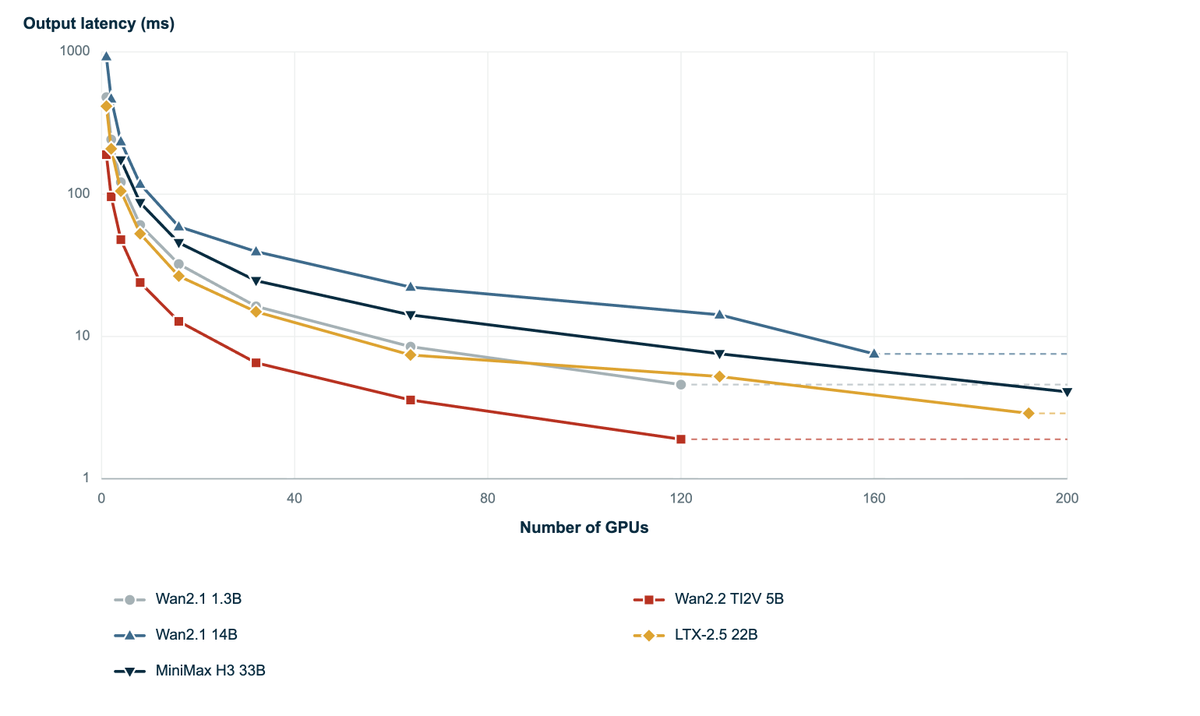
The vLLM Project officially announced that PhysisServe's core physical-world serving techniques are being integrated into vLLM-Omni. Addressing the severe memory bottlenecks and latency spikes of multi-step video diffusion and physical AI generation, PhysisServe introduces cross-denoising-step pipeline parallelism across Transformer blocks, time-shared batching, and virtual-rank joint scheduling. Benchmarked on MiniMax H3 33B across 200 GPUs, it generates a chunk every 4.1 ms (~1,000 FPS without VAE decoding), while cutting single-GPU latency for Wan2.2 5B from 173 ms down to 98 ms.

vLLM-Omni Integrates PhysisServe: Accelerating Video Diffusion & Physical-World AI with 4.1ms Chunk Output

Key Takeaways

  • The vLLM project announced the upstream integration of PhysisServe's serving architecture into vLLM-Omni for physical AI and video models
  • Introduces cross-timestep block pipelining and time-shared batching to eliminate GPU communication bubbles in multi-step diffusion
  • Generates a video chunk every 4.1 ms on MiniMax H3 33B across 200 GPUs (~1,000 FPS), cutting Wan2.2 5B single-card latency to 98 ms
  • Expands 24-GPU serving concurrency by 1.7x to 3.3x, with full open-source code merging into the vLLM-Omni mainline
Read full story
Linked Models & Agents:

Xiaomi AI Lab Introduces Xiaomi-Lens-0: 4B MLLM Built on Qwen3.5 Sets SOTA on RefCOCO with Native Pixel-Level Mask Decoding

Multimodal LLMs excel at holistic image captioning but struggle with pixel-level spatial grounding due to lack of spatial supervision. Xiaomi AI Lab unveiled Xiaomi-Lens-0 (arXiv:2610.23279), a 4B MLLM based on Qwen3.5 that natively predicts pixel masks. A lightweight decoder integrates patch embeddings, visual latents, and mask-token activations, driving RefCOCO comprehension (REC [email protected]: 94.6% / 92.1% / 92.5%) and segmentation (RES cIoU: 83.4% / 79.9% / 81.1%) past Florence-2 and LISA-7B while preserving a 69.7% MME-RW score.

Xiaomi AI Lab Introduces Xiaomi-Lens-0: 4B MLLM Built on Qwen3.5 Sets SOTA on RefCOCO with Native Pixel-Level Mask Decoding

Key Takeaways

  • Xiaomi AI Lab released Xiaomi-Lens-0 (arXiv:2610.23279), a 4B MLLM based on Qwen3.5 that natively generates pixel-level masks
  • Outperforms Florence-2 and Grounding-DINO-L on RefCOCO/RefCOCO+/RefCOCOg REC benchmarks with 94.6%, 92.1%, and 92.5% [email protected]
  • Achieves 83.4% / 79.9% / 81.1% cIoU on RES segmentation, substantially surpassing 7B models like LISA and GSVA
  • Maintains superior general perception, scoring 69.7% on MME-RW-en and outperforming Qwen2.5-VL 7B
Read full story
Linked Models & Agents:

HKU Introduces ReaDy for Hybrid Linear Attention: Recurrent States as Dynamic Context Accelerates B200 Decoding to 302 TPS

Traditional speculative decoding relies on static target hidden features that fail to supply varying contextual needs across draft positions. HKU researchers introduced ReaDy (arXiv:2610.20503). Designed specifically for Hybrid Linear Attention (HLA) architectures combining Transformers with recurrent linear attention states, ReaDy leverages compact recurrent states as dynamic context for drafting. On a single NVIDIA B200 GPU serving Qwen3.8-27B, ReaDy achieves an acceptance length of 4.53 and 302.78 TPS, accelerating inference by 2.4x over standard autoregressive decoding.

HKU Introduces ReaDy for Hybrid Linear Attention: Recurrent States as Dynamic Context Accelerates B200 Decoding to 302 TPS

Key Takeaways

  • HKU introduced ReaDy (arXiv:2610.20503), the first speculative decoding framework customized for Hybrid Linear Attention (HLA) LLMs
  • Reuses compact recurrent states as dynamic context for drafting, overcoming the static context bottleneck of feature-based drafters
  • Achieves 302.78 TPS for Qwen3.8-27B on a single NVIDIA B200 GPU (2.40x over AR and +7.97% over SOTA DSpark)
  • Reaches an acceptance length of 4.53 tokens using an ultra-lightweight Rank-8 reader
Read full story
Linked Models & Agents:

vLLM Ships Precompiled Bytecode Images and Decision 3.0 Serving: Cold Start Accelerated by 18%, MI325X Decision Throughput Hits 1.8x

The vLLM team announced two major milestones: shipping precompiled Python bytecode via uv in v0.32.0 release images cuts cold-start container launch by 14–18% (~18s on NVIDIA H100) with zero runtime recompiles. Additionally, vLLM integrated the Decision 3.0 (D3) structured reasoning family (0.6B to 27B) into the /v1/systemone endpoint, ranking #1 on the Jev Decision Index and delivering 1.8x req/s on a single AMD MI325X under 64 concurrent clients.

vLLM Ships Precompiled Bytecode Images and Decision 3.0 Serving: Cold Start Accelerated by 18%, MI325X Decision Throughput Hits 1.8x

Key Takeaways

  • vLLM ships precompiled Python bytecode via uv in official images, reducing H100 cold starts by 14–18% (~18 seconds saved)
  • Natively serves the Decision 3.0 (D3) family (0.6B to 27B) via the /v1/systemone structured decision endpoint
  • D3 models rank #1 on the Jev Decision Index with 66.3 in text and 71.3 in vision
  • D3 27B achieves 1.8x the request throughput of standard checkpoint servers on a single AMD Instinct MI325X under 64 concurrent clients
Read full story
Linked Models & Agents: